
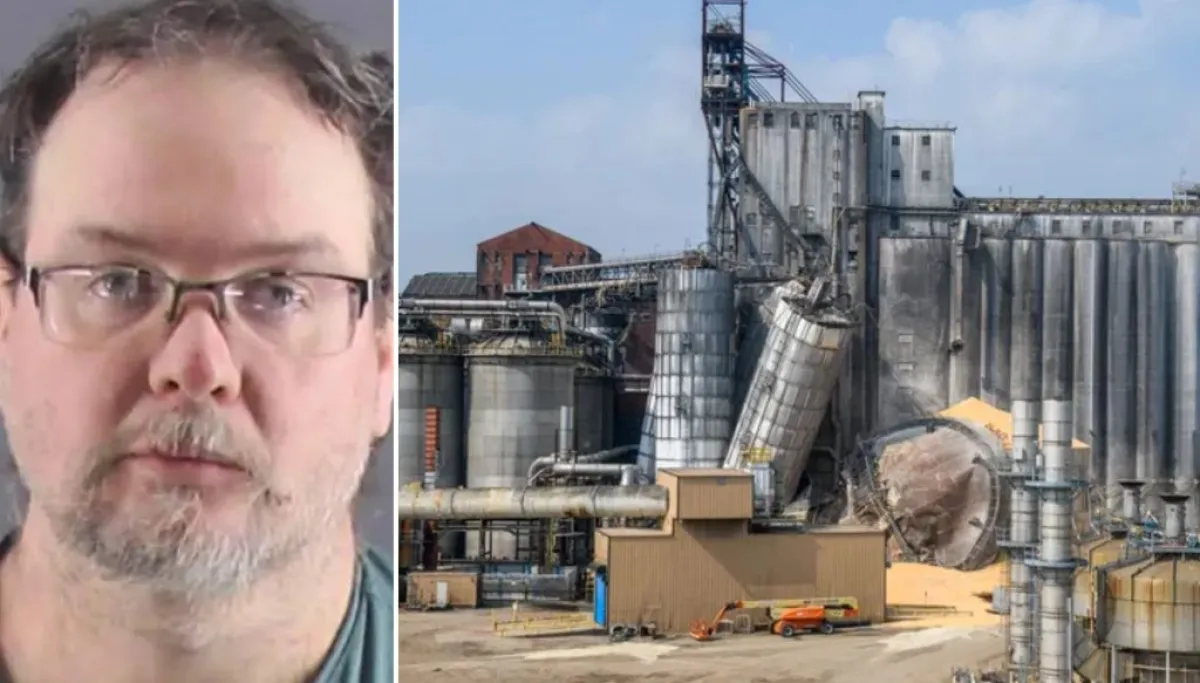
A federal grand jury has indicted an Illinois man on charges that he emailed a bomb threat to an ethanol plant in Peoria last week. Authorities later found an explosive device at the plant and evacuated thousands of people within a 1-mile area.Andrew M. Kozak, 41, of Chillicothe, Illinois, was charged with threats regarding explosives and transmitting a threat in interstate commerce, according to an indictment filed Tuesday in U.S. District Court in Peoria.The indictment alleges that Kozak “sent an email to BioUrja which indicated that explosive devices had been placed at the BioUrja facility in Peoria.” The indictment alleges the email was sent on Nov. 13. The indictment does not accuse Kozak of actually planting a bomb, but authorities have said an explosive device was found at the ethanol plant. “The FBI and its partners have been combing through evidence, serving legal process, conducting interviews and executing searches to identify this individual,” FBI Springfield Special Agent in Charge Ryan Presley said at a news conference Tuesday at the U.S. Attorney’s Office in Peoria.Bureau of Alcohol, Tobacco, Firearms and Explosives Assistant Special Agent in Charge John Maniff said Kozak’s arrest Monday morning, within 72 hours of the incident, resulted from a coordinated investigation involving federal, state, and local authorities. Kozak was arrested when he arrived at BioUrja.The indictment does not give a motive, and other information in the case remains sealed. Authorities have not said why BioUrja was targeted. Officials also declined to say whether others were involved or how Kozak was identified and did not give details beyond the discovery of an explosive device at the plant on Friday. The FBI says the investigation remains active.Kozak was scheduled to make his initial appearance in federal court in Peoria on Tuesday afternoon. No attorney was listed for Kozak on the federal court website. He remains in the custody of the U.S. Marshals Service.If convicted, Kozak faces up to 10 years in prison on the explosives threat charge and up to five years on the email charge. Each count also carries a fine of up to $250,000 and up to three years of supervised release. First Assistant U.S. Attorney Darilynn J. Knauss and Assistant U.S. Attorney Douglas F. McMeyer are prosecuting the case. An indictment is merely an accusation, and the defendant is presumed innocent unless proven guilty. A LinkedIn profile matching Kozak’s name lists a process trainee job at BioUrja. “Learning how to operate an ethanol plant,” Kozak wrote under his job description. BioUrja has not confirmed whether Kozak worked there.Kozak has a criminal record in Nebraska, where prison records show he served two years in prison on burglary charges in three counties. He was released in 2008. Kozak went back to prison in 2013 on a burglary charge in a fourth county and was released in 2014, records show.Kozak allegedly planted the bomb on Friday, then sent a bomb threat to the company. Federal agents executed a search warrant at Kozak’s home in Chillicothe, about 15 miles north of Peoria.The FBI’s Springfield office is now in charge of the investigation.BioUrja notified Peoria police around 1:08 p.m. Central on Friday that it had received a bomb threat. Employees were in the building when the email arrived, Peoria Police Department Public Information Officer Semone Roth told the Washington Examiner. Police found a suspicious package at about 2 p.m., determined at about 6:45 p.m. that it posed a credible threat, and rendered it safe at about 9:12 p.m. No injuries were reported.The evacuation order lasted about 18 hours and affected thousands of people. Peoria Police Chief Brad Dixon estimated about 2,500 homes were affected. The order was lifted around 1 p.m. on Saturday after searches found no additional devices. The zone covered parts of Downtown Peoria, much of the Southside and Warehouse District, and areas across the Illinois River, including residential zones. Due to the flammability of materials inside the facility, the device was estimated to have resulted in a 1-mile blast radius if it had gone off, Dixon said.OUTAGES SWEEP ACROSS EVERY INDUSTRY: HERE’S WHAT YOU NEED TO KNOWThe plant makes ethanol, a highly flammable liquid used in fuel, beverages, and hand sanitizer, along with ingredients for adhesives, detergents, and corn-based oils for renewable diesel, according to the company’s website. BioUrja bought the plant from Archer Daniels Midland in late 2021.The Washington Examiner has reached out to BioUrja, the FBI’s Springfield office, the Peoria Police Department, and the U.S. Attorney’s Office for the Central District of Illinois for further comment.
Man charged in Peoria, Illinois ethanol plant bomb threat that forced mass evacuation
Full Article
Original Source
Read the full article at Washingtonexaminer →KhanList aggregates and links to publicly available news content. We do not host full articles from third-party sources. Always verify important information with original sources.