
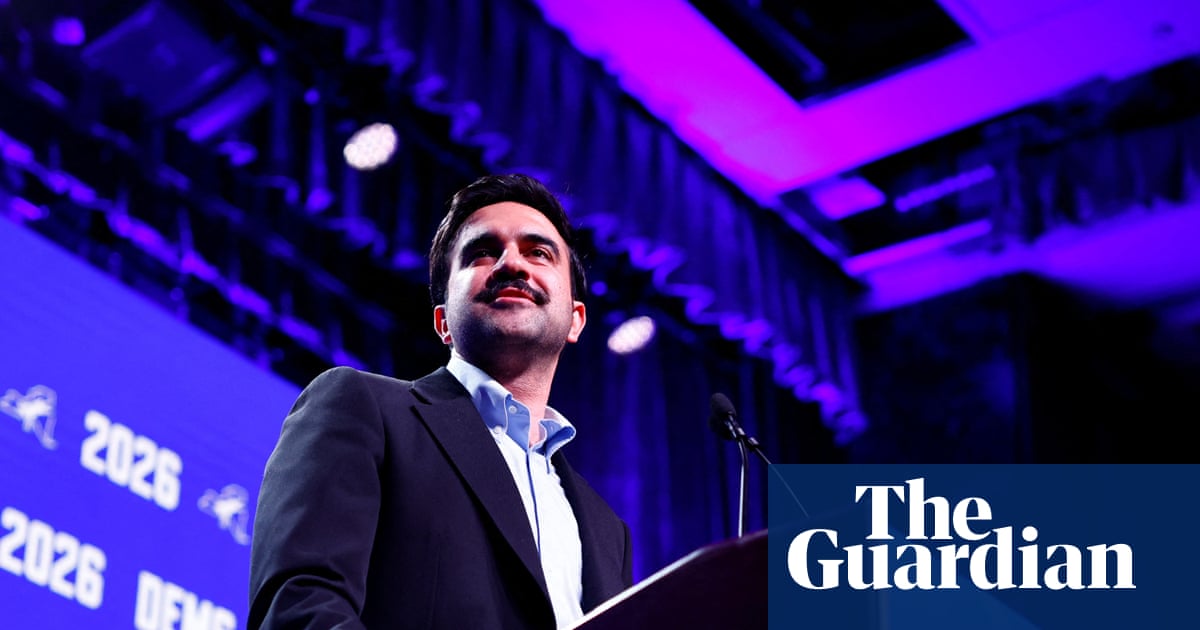
Zohran Mamdani wasn’t running in the midterm elections. In races across the country, however, the New York City’s mayor influence could be seen, as Democrats adopted a laser focus on affordability and downed establishment opponents.From Texas to Kansas, Democrats ran by pointing out the high cost of living and, frequently, by linking that to billionaires.It was similar messaging Mamdani used during his upset victory in New York’s mayoral election last year. It made sense for Mamdani, a self-described democratic socialist, but even centrist candidates in traditionally Republican states borrowed from his playbook.“The biggest divide in this country is not left vs. right. It’s top vs. bottom. Billionaires want us looking left and right at each other instead of looking up at them,” James Talarico, the moderate Democrat who won a Senate seat in Texas, wrote on his campaign page.Josh Turek, who was elected to the US Senate seat in Iowa – hardly a hotbed of radicalism – had a similar message: “Life is harder for working-class people because Washington is riddled with corrupt politicians who are out of touch and focused on enriching themselves.”Clearly, the messaging worked. As of Thursday, Democrats led Republicans by 255 to 168 seats in the House of Representatives, and have flipped eight seats in the Senate – votes are continuing to be counted in some races.“I would say there was a Mandami-inspired movement in the midterms. Mandami helped define a central issue of this midterm, which was affordability, and that, along with corruption, was the central narrative of this midterm election,” said Joseph Geevarghese, the executive director of Our Revolution, a progressive organization.“He was able to recognize that the issue was about populism, not partisanship. He understood that people were voting for Trump because Trump said he would make their lives economically better. And Mamdani was then able to effectively campaign on that issue.”Mamdani’s campaign was renowned for using social media to communicate – something the mayor continues to do – and Geevarghese saw that used by others.“He had an influence on the medium. He was able to communicate his affordability message using new media, through his social media platform and creative videos, and he was able to do creative campaigning to move that message online,” he said.Mamdani has progressive politics, but his messaging and focus during the mayoral race was not on political philosophy, but prices and inequality. “New York is too expensive. Zohran will lower costs and make life easier,” was the simple message on his campaign website, as Mamdani ran on making New York more affordable for regular people.It was a message that could have run across any Democrats’ platform in the midterms. In Kansas, Adam Hamilton’s campaign centered on affordability, and at campaign rallies and in interviews Hamilton linked the war in Iran to the higher costs Kansans faced.“There’s a whole lot of people in Kansas, hundreds of thousands of people are living paycheck to paycheck, and this is not OK,” Hamilton said in his victory speech, blaming: “Decisions made in Washington that are hurting people in our own state who are struggling already.”Mamdani is surely aware of his status as a political tastemaker. Asked in a CNN interview in the wake of the midterms, he said Democrats need to focus on: “Change that is urgent, it has to be change that speaks to the crisis in working-class Americans’ lives. And it has to be change that can be measured in the day-to-day lives of those same Americans, something that isn’t just an ideal or a value, but something that is also what they’re struggling to afford every single day, be it rent, be it childcare, be it groceries.”In New York City, Mamdani’s influence was undeniable. Darializa Avila Chevalier, Brad Lander and Claire Valdez all won their primaries in safely Democratic districts after being endorsed by the mayor. (They all won election to the House on 3 November.) Nationwide, Trip Yang, a New York-based Democratic strategist, said Mamdani wasn’t the only cause of the affordability message.“Mamdani’s race got the most attention of any race, obviously, so his campaign popularized it, but campaigns by and large were talking about affordability. You could make the case that Donald Trump was talking about affordability in 2024: when he was running for president, he was talking about [how] egg prices will go down, gas prices will go down,” Yang said.Part of Mamdani’s success lay beyond just his politics, Yang said.“If you view it holistically, he had a large impact that was very positive for Democrats. Here’s the reason why,’ Yang said.“A year ago, national Republicans were saying: ‘We are going to tie Mamdani, this new democratic socialist mayor of the nation’s largest city, to national Democratic candidates everywhere. We’re going to make them all defend Mandani’s policies.’“Lo and behold, what happened? Donald Trump meets with Mandani many times this past year. Donald Trump has a love crush on Mandani. It prevents Republicans nationally from really tying Mamdani to Democratic candidates, and guess what? Mamdani’s approval rating is pretty good. He’s actually one of the more popular national Democrats.”Yang added: “They had planned to use Mamdani as a boogeyman, as a liability for national Democrats. They could not.”Americans across the demographic spectrum shifted towards Democrats in November, and Richard Florida, a distinguished professor at Vanderbilt University, said Mamdani had a “big effect” in that area.Florida’s work has focused on how class structure has changed in the US, developing beyond the traditional blue-collar and white-collar, working-class and middle-class framework. He instead divides most US workers into three categories: the creative class, meaning people in knowledge-based jobs such as educators, doctors and lawyers and managers; the service class, which includes carers or those with jobs in retail stores and restaurants; and the working class, which he defines as factory and construction workers.The working class, Florida said, lean Republican, the creative class Democrat. The service class, Florida says, are those more likely to swing between parties. They were enticed by Trump’s economic populism as they struggled with low pay and economic uncertainty, but Mamdani managed to win some of those Americans in New York.Democrats have tried before to build a coalition of the creative class and the service class, Florida said, but no one managed to build such a “robust” coalition as Mamdani.“He built a coalition around affordability that brought these two groups, which most people never thought would go together, into alignment,” Florida said, by leaning into high prices and inequality.“And I think the Democrats kind of did that in the midterms,” Florida said. “I think they saw that the issue of affordability resonated, and they saw that charismatic young, vital candidates resonated.”Since elected, Mamdani has been an almost inescapable presence in New York, repeatedly touting his administration’s successes, in areas like winning money for delivery workers and managing to implement his much-publicized rent freeze.Geevarghese, the Our Revolution executive director, said that for Democrats, the work similarly starts now.“Democrats have to deliver on what they ran on, and they ran on issues of affordability. They committed to pursue policies that would raise the standard of living for everyday Americans. And they committed to taking action on corruption, to expose how Donald Trump and his contributors, his campaign donors, have benefited off the presidency at the expense of the American people.“So I think Democrats have to deliver legislation and put it on the president’s desk and force the question: ‘Are you with the American people who want lower costs, or are you with your oligarch donors?’”
Mamdani’s influence sharply felt as Democrats win big in affordability election
Full Article
Original Source
Read the full article at Theguardian →KhanList aggregates and links to publicly available news content. We do not host full articles from third-party sources. Always verify important information with original sources.