
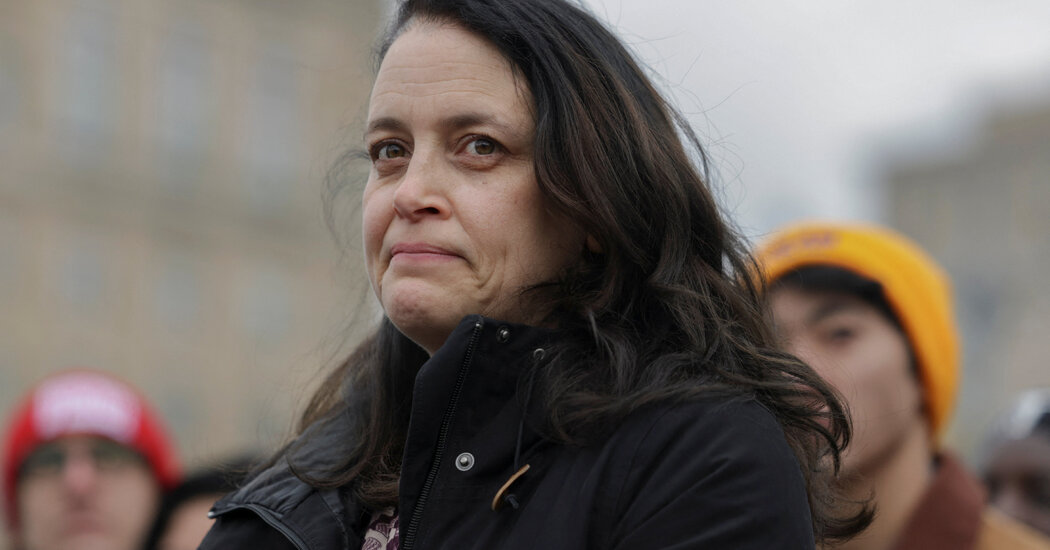
AdvertisementSKIP ADVERTISEMENTAt a New York City Council hearing, frustration grew as Mayor Zohran Mamdani’s representatives were unable to answer questions about the mayor’s use of influencers.Tascha Van Auken, commissioner of the Office of Mass Engagement, told a City Council hearing that her office does not work with influencers.Credit...Jeenah Moon/ReutersSept. 22, 2026, 8:19 p.m. ETThe New York City Council held an oversight hearing on Tuesday to scrutinize the Mamdani administration’s use of influencers and its communication methods. It became quickly clear that the Council would not be getting what it wanted.“How many social media influencers have worked with the mayor’s office or the various city agencies?” the minority leader of the Council, David Carr, wanted to know.None of the members of the Mamdani administration called to testify could answer him. A torturous back-and-forth followed, questions met with empty replies.The hearing on Tuesday arose from reporting in the Columbia Journalism Review and in The New York Times that detailed how the mayor’s office has cultivated an army of influencers. Members of the administration used a private Signal chat to correspond with more than 250 influencers, sending them talking points, information about the mayor’s priorities and opportunities to follow the mayor to events and news briefings.The influencers were not paid, but city agencies have paid other influencers to promote local initiatives, like the Sanitation Department’s work on composting.But when Council members tried to question the mayor’s representatives at the hearing, their frustration grew with each response.“Do you know how much has been spent?” Mr. Carr, a Republican of Staten Island, asked to no avail, referring to the paid influencers. “What are the rules for publicly disclosing these kinds of relationships?”The Mamdani administration was represented by the commissioner of the Department of Records and the commissioner of the Office of Mass Engagement, who said her team doesn’t work with influencers. Emilia Rowland, a new media expert who oversees the influencers’ effort as the director of new media and cultural communications, did not testify.“I have to ask the obvious: Where is Emilia Rowland today?” said Phil Wong, a Democratic councilman of Queens who is sponsoring a bill on strengthening disclosures for paid content. Council members also tried to find out more about the administration’s use of Signal, an encrypted messaging app designed to shield posts from public view. At least one of the influencer Signal chats run by Ms. Rowland was set to erase her messages after she sent them. The day after inquiries from a Times reporter, the channel setting was changed to preserve the messages.Signal was used even though the mayor’s chief counsel, Ramzi Kassem, instructed aides in a January memo not to use the app, writing, “You should not use WhatsApp, Signal, or any other communications app or platform for work.”Mr. Mamdani addressed the frustrations over Signal use again on Tuesday.“I’m confident in the testimony that our administration is providing today, that it will be sufficient in answering the Council’s questions,” he said at an unrelated news conference.Council members made clear that it was not. Even Jumaane Williams, the city’s progressive public advocate, castigated the administration.“I have great respect for this administration, so it upsets me that they have me agreeing with Council member Carr,” he joked.Nearly every seat in the hearing room was filled. Among those present were influencers, government reform activists and members of the press.Shawnta Smith-Cruz, commissioner of the Department of Records and Information Services, explained that city employees can use Signal to send “transitory” messages, but if they send anything “substantive” they have to move the message over to a platform where it can be retained. City workers get training on how to identify a message that is substantive.But the explanation — ringing a little of “I know it when I see it” — did not satisfy many on the panel, including Councilwoman Gale Brewer.“Substantive — I don’t know what that means,” Ms. Brewer said. “In my world of 40 years, that means it needs some help in terms of defining what it is.”Later, Ms. Brewer added in an interview: “It would have been helpful if the folks who are doing the actual work with the influencers would have been able to attend.”But Jon Paul Lupo, a top adviser to former Mayor Bill de Blasio, said that “it would be highly unusual” to send a communications staff member like Ms. Rowland to testify before the Council.The Council is considering a handful of bills to bring more transparency to the city’s work with influencers. One would strengthen the rules around disclosures for paid content that influencers post promoting local political issues.Dr. Anya Schiffrin, co-director of the Technology Policy and Innovation Concentration at Columbia’s School of International and Public Affairs, who recently published a report on the Mamdani administration’s relationship with influencers, said she recommends that all city agencies use a standard disclosure when working with paid influencers. She also recommends disclosures for unpaid influencer content. Taiwan Green, a music producer and influencer who has worked with the mayor’s new media team, testified that he has never been paid by the mayor’s office.“I have lost money from calling out of work to cover press conferences,” he said. “Why am I doing this for free? I never thought a person who comes from where I come from would have this access.”Emma Goldberg is a Times reporter who writes about New York City and the Mamdani administration.Related ContentAdvertisementSKIP ADVERTISEMENT
Mamdani Aides Give City Council Little Insight Into Influencer Effort
Full Article
Original Source
Read the full article at Nytimes →KhanList aggregates and links to publicly available news content. We do not host full articles from third-party sources. Always verify important information with original sources.