
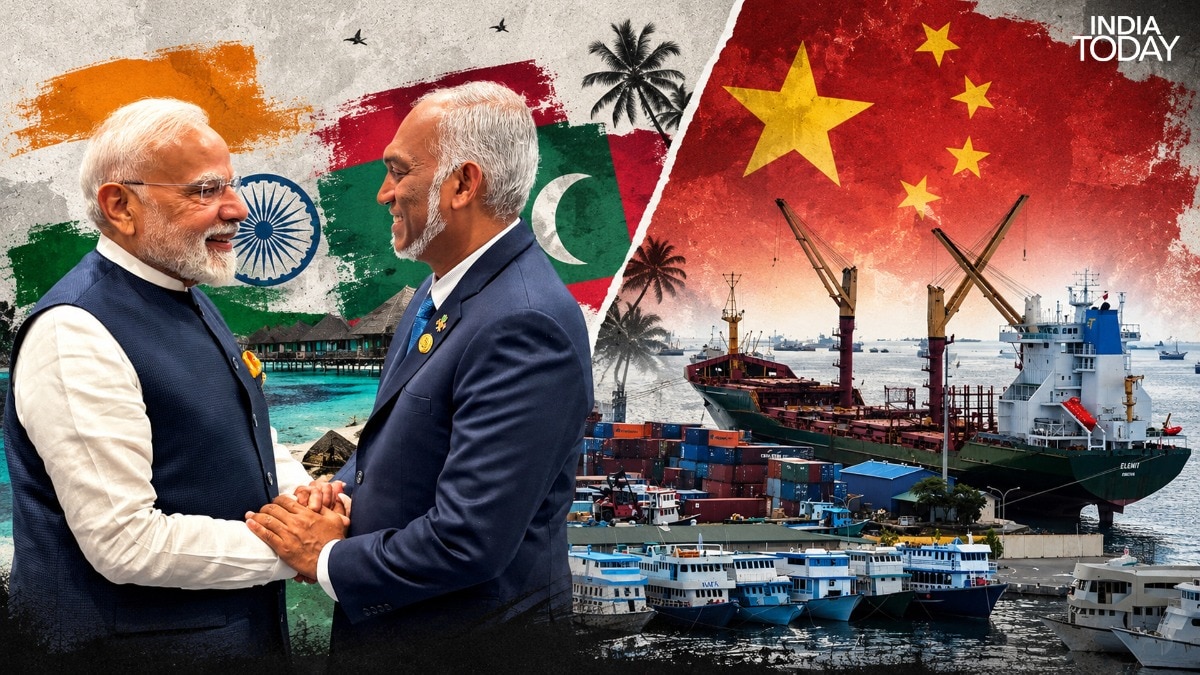
Barely a week after Maldivian President Mohamed Muizzu described the India-backed Thilamale Bridge as a symbol of the "enduring ties" between Male and New Delhi, an older development involving another strategically important infrastructure project in the Maldives has come back into focus.Earlier this year, Maldives Ports Limited (MPL), the government-owned port operator, announced that China Harbour Engineering Company (CHEC) had been awarded Phase 1 of the Thilafushi Port Development Project, also called the Local Harbour Relief Project. The announcement did not gain much traction in India when it was made in February. It has now drawn attention again because of what it says about the Maldives' balancing act between India and China, and because it comes just days after the latest sign of Muizzu's dramatic political shift towards New Delhi.The development matters for more than just the fact that a Chinese company has won the first phase of the Thilafushi project. It is already a key part of India's connectivity push in the Maldives, and the new port is eventually expected to shift much of the country's commercial cargo operations out of crowded Male.Thilafushi is an artificial island located west of the Maldivian capital, Male. It was created in 1991 following a government decision to use the island as a municipal landfill. The port development project is aimed at easing congestion at existing port facilities, improving cargo handling and expanding the Maldives' logistics capacity. The China Harbour Engineering Company (CHEC) has been awarded Phase 1 of the Thilafushi Port Development Project in February 2026. (Image: Google Maps) A CHINESE COMPANY GETS THE PORT CONTRACT IN MALDIVESThe first phase of development of the country's main business port has been assigned to China Harbour Engineering Company (CHEC) Limited, according to PSM News, the Maldives' state broadcaster. At a ceremony in Male, MPL Managing Director Mohamed Rishwan had in February signed the agreement with CHEC Maldives Country Manager Mao Bao. Rishwan described the occasion as historic and said the project had been a dream for MPL for nearly 40 years.PSM News reported that the existing five-hectare port would be expanded to 20 hectares. The project will include 650 metres of quay wall and a 125-metre roadside jetty, along with a bonded warehouse, an X-ray facility and automated services.The stated objective is to reduce the time required for clearing goods from about five days to 48 hours.The project is also tied to a larger plan to move the Maldives' main business port operations away from the Maafannu area in Male to Thilafushi. Muizzu, who rode to power on an "India Out" campaign, had said in February that the relocation is expected to take place in November 2027.The MPL said the move will address capacity problems affecting the Male, Hulhumale and T-Jetty facilities.The design phase was still under way when the February announcement was made.So, this is not merely another construction contract. It is part of a long-term attempt to reorganise the Maldives' commercial maritime infrastructure around Thilafushi, and that is where India's role enters the picture.THILAFUSHI IS ALREADY AT THE CENTRE OF INDIA'S CONNECTIVITY PUSH IN MALDIVESThe Chinese involvement in the commercial port project is particularly noteworthy because Thilafushi is also one of the destinations covered by India's flagship Greater Male Connectivity Project (GMCP).Muizzu recently praised the India-backed Thilamale Bridge as a symbol of the "close, enduring relationship between the Maldives and India". He thanked Prime Minister Narendra Modi and the Indian government for their role in the project and highlighted the work of technical teams from the two countries.The GMCP is a 6.7-km network of bridges, roads and causeways connecting Male with Vilimale, Gulhifalhu and Thilafushi. Financed through a $400 million line of credit from India's Exim Bank and a separate $100 million Indian grant, the project is being constructed by Afcons Infrastructure.This makes the current situation more complicated than a simple India-versus-China contest.India is helping build the connectivity infrastructure that will link the capital to Thilafushi. China Harbour Engineering Company, meanwhile, has been awarded a contract to develop a major commercial port facility at Thilafushi.The two projects, therefore, exist alongside each other in the same strategic geography. That is important because ports are not just economic infrastructure in the Indian Ocean, they also have strategic significance because of the Maldives' location close to some of the world's busiest maritime routes.The Secretariat, in an analysis by senior journalist Jayanta Roy Chowdhury in 2024, highlighted the strategic competition surrounding Maldivian infrastructure. It noted that India and China have both sought influence in the archipelago because of its location astride important shipping lanes linking Asia with the Middle East.The point is that infrastructure in the Maldives can have consequences well beyond just infrastructure.MUIZZU'S BALANCING ACT BETWEEN INDIA, CHINA GETS MORE COMPLICATEDThe Chinese port contract also offers a reminder that Muizzu's rapprochement with India does not mean that Male has abandoned Beijing.Muizzu came to power in 2023 on the back of the "India Out" campaign and was widely seen as more favourably disposed towards China. His first foreign visit after becoming president was to China, where bilateral ties were elevated to a "comprehensive strategic cooperative partnership."But economic realities forced a rethink for the Maldives.As The Secretariat reported in 2024, the Maldives was facing serious financial pressures, including a heavy debt burden. India stepped in with financial support, including a $400 million currency swap arrangement and Rs 3,000 crore through the Reserve Bank of India (RBI). New Delhi also extended short-term financial assistance to help Male meet its external obligations.That economic dependence seemingly helped drive Muizzu's recalibration towards India, and the shift has since become increasingly visible. The same Maldivian president who once demanded the withdrawal of Indian military personnel is now publicly thanking PM Modi for India's role in building one of the Maldives' most important connectivity projects.But the Thilafushi port deal shows that the Maldives is not simply choosing between India and China. Male needs infrastructure, investment and economic support, and China remains an important partner.The "India Out" president might have made a U-turn in recent times, but when it comes to the Maldives' ports, infrastructure and strategic partnerships, Male appears determined to keep both India and China in the picture.- EndsPublished By: Anand SinghPublished On: Sep 8, 2026 08:00 IST
Maldives gave big-ticket project to China, paid just lip service to India?
Full Article
Original Source
Read the full article at Indiatoday →KhanList aggregates and links to publicly available news content. We do not host full articles from third-party sources. Always verify important information with original sources.