
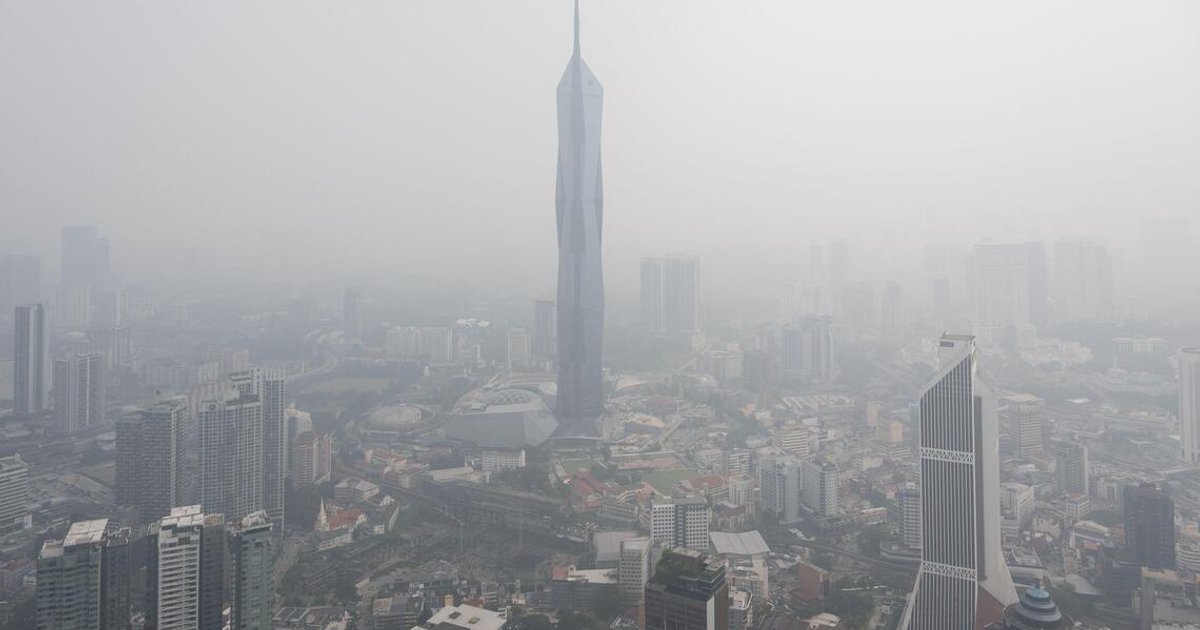
KUALA LUMPUR/JOHOR BAHRU – Every day this week, 45-year-old executive Alisha Chan has been reaching for her phone to check pollution readings and school announcements, to find out whether her children will be going to school the next day – and whether she needs to arrange childcare around her full-time job.With two school-going children aged 17 and seven, she faces the possibility of disruptions to family routines and work when haze from fires in Indonesia forces schools to close.“We parents are living in fear, constantly checking for updates on school closures. It feels like a time bomb,” she told The Straits Times.“Today (Oct 14), while we were preparing for our children to stay home because of the school closures, the Education Ministry suddenly announced that schools would be open as usual tomorrow (Oct 15).“We can’t plan things in advance and have to make arrangements at the last minute, which is stressful for a full-time working mother. I feel exhausted and have a headache from all these last-minute arrangements, as we are not employees who can work from home every day.”The frustration has also spilled into online education support groups, with parents unhappy over the issue of school closures.Indonesia is experiencing an unusually severe fire season, with prolonged heat and dryness exacerbated by a very strong El Nino. Fires are burning large areas of Sumatra and Kalimantan, blanketing the region in haze. After decades of recurring episodes, Malaysians are growing increasingly frustrated — not just at the disruption, but at the apparent failure of national and regional authorities to hold polluters to account and prevent the crisis from recurring.The recent school closures in some states have added to parents’ frustration, with last-minute announcements making childcare arrangements difficult for working families.The shifting announcements have become one immediate source of that frustration.School closures leave parents scramblingK. Rizal, whose 10-year-old child attends school in Kuala Lumpur, said school closures depend on readings from designated air-quality monitoring stations, which may not reflect conditions in every neighbourhood.“I can see the haze, but because the reading at the monitoring station is fine, we have to pretend like it’s OK and go to school,” she told ST, calling for schools to have more flexibility to decide when to close.“We can see the difference between a clear day and a heavily hazy day. Some of us also experience eye irritation, throat discomfort or difficulty breathing. If healthy adults already feel uncomfortable, naturally we worry about our children,” Ameirul Azraie Mustadza, a father of five and chairman of a parent-teachers association, told ST.“Parents need confidence that the system can respond to the conditions their children are experiencing. Clear explanations, timely communication and responsive action are essential to building that confidence,” he added.On Oct 7, some 20 protesters from Greenpeace Malaysia and a coalition of environmental and civil society groups marched to Parliament, demanding stronger laws to hold companies accountable for environmental damage linked to fires in Indonesia.“Enforcement is an issue... at the end of the day, it’s the governments that approve the operating licences and financial institutions that oversee financing for these companies,” Adam Azlan, a global strategic campaigner for international environmental organisation Greenpeace told ST.The campaigners want governments to investigate links between fires and corporate operations, make evidence public and enforce environmental rules, alongside a Clean Air Act to hold Malaysian businesses accountable for haze pollution caused by their overseas operations.While these may take time, for families, however, the consequences of the haze are immediate. School closures can protect children from unhealthy air, but announcements made late in the afternoon leave parents scrambling to arrange childcare, rearrange work schedules and supervise home-based online learning instead.The week-long school closures in Johor announced on Oct 10 amid worsening haze conditions have given parents there greater certainty, but still complicate childcare arrangements, particularly for those who work across the Causeway in Singapore.Truck driver Shahruddin Haeal Helmy Mohd Noh, 39, who lives in Iskandar Puteri, Johor, works in Singapore, as does his wife. The couple have had to send their two children to their grandparents’ home amid school closures.“The school closures are definitely a challenge because we need to find caregiving arrangements for our children while my wife and I are at work in Singapore,” he said, adding that unpredictable work schedules and cross-border traffic make planning difficult.Fariza Mohd, an assistant manager at a private after-school care centre in Pasir Gudang, Johor, said staff were overwhelmed as more working parents turned to daycare during school closures.“Usually we have 40 students split into two sessions, morning and afternoon but now we have 25 to 30 children staying for the entire day,” she said. With home-based learning, all three staff members must also help supervise lessons for the children.Shifting rules add to confusionThe uncertainty has been compounded by changing closure thresholds and differences in local air-quality readings.On Oct 14, Education Minister Fadhlina Sidek reinstated the threshold for school closures at Air Pollutant Index (API) readings above 200, reversing temporary rules introduced on Oct 8 that required closures when readings exceeded 180, or 150 for three consecutive days. API readings of between zero and 50 indicate good air quality, 51 to 100 moderate, 101 to 200 unhealthy, 201 to 300 very unhealthy, while readings above 300 are categorised as hazardous.Fadhlina ruled out blanket closures announced days in advance, citing rapidly changing air quality. “Children’s safety and health remain our priority. However, every school day also holds significant value for their development and learning,” she said in a Facebook post on Oct 14.A woman walks as haze shrouds Malaysia’s Petronas Twin Towers and other commercial buildings in Kuala Lumpur on Oct 13. PHOTO: AFPParents who remain concerned about their children’s health and safety may keep them home, she said.That post attracted around 4,000 comments, with some criticising the Education Ministry’s apparent lack of consistent policies and contingency plans.The Melaka Action Group for Parents in Education (MAGPIE) urged the authorities to clarify school-closure guidelines and announce closures earlier, preferably by noon the previous day, to give parents, teachers and school transport operators time to prepare.“This is not about criticising the authorities for taking precautionary measures. Rather, it is about ensuring that decisions affecting students, teachers and thousands of families are transparent, consistent and properly communicated,” its chairman Mak Chee Kin was quoted as saying by the Free Malaysia Today news website on Oct 14.The debate over closures is also raising questions about what happens to children when they are told to learn from home.Online learning is no easy fixThe concerns extend beyond whether classrooms are open. For some families, switching to online classes is no easy solution, particularly if children lack devices, reliable internet connections or support at home.“Home-based learning should not become a mere formality. Schools must consider whether students have access to devices, internet connectivity and appropriate learning support, particularly those from disadvantaged households,” education watchdog Parent Action Group for Education (Page) chairman Noor Azimah Abdul Rahim told ST.For the most part, however, Jakarta’s refusal of assistance and its response thus far to regional concerns have become the main lightning rod for Malaysian anger.Democratic Action Party MP Lim Guan Eng said Malaysia must stop taking a lax approach to the recurring haze crisis, urging Malaysia, Singapore, the Philippines and Indonesia to establish a permanent ASEAN task force with year-round firefighting personnel.“If Indonesia continues to reject the ASEAN haze task force on grounds of national sovereignty, Malaysia has no choice but to pursue legal action to seek compensation,” he said in Parliament on Oct 15.The Malaysian-Indonesia Journalists’ Friendship Association (ISWAMI Malaysia) has also called for stronger enforcement against open burning, closer bilateral cooperation and more effective ASEAN action.“Cross-border haze can no longer be seen as a seasonal problem without an effective long-term solution,” said its acting president Ahmad Zaini Kamaruzzaman in an Oct 12 statement.Remarks by an Indonesian official that the country supplies oxygen to Singapore and Malaysia drew criticism online.On Oct 10, Syahganda Nainggolan, head of Indonesia’s Government Communications Agency, defended the country against criticism over transboundary haze, saying: “We’re not just sending over the haze. When there’s no haze, we send oxygen. The oxygen in Singapore and Malaysia comes from our forests, right?”“Someone please inform the Ministry of Education. We have an entire primary school science syllabus to amend,” said Threads user veronicazo.Sign up for our weekly Asian Insider Malaysia Edition newsletter to make sense of the big stories in Malaysia.
Malaysia’s haze frustration boils over as calls grow to hold polluters to account
Full Article
Original Source
Read the full article at Straitstimes →KhanList aggregates and links to publicly available news content. We do not host full articles from third-party sources. Always verify important information with original sources.