
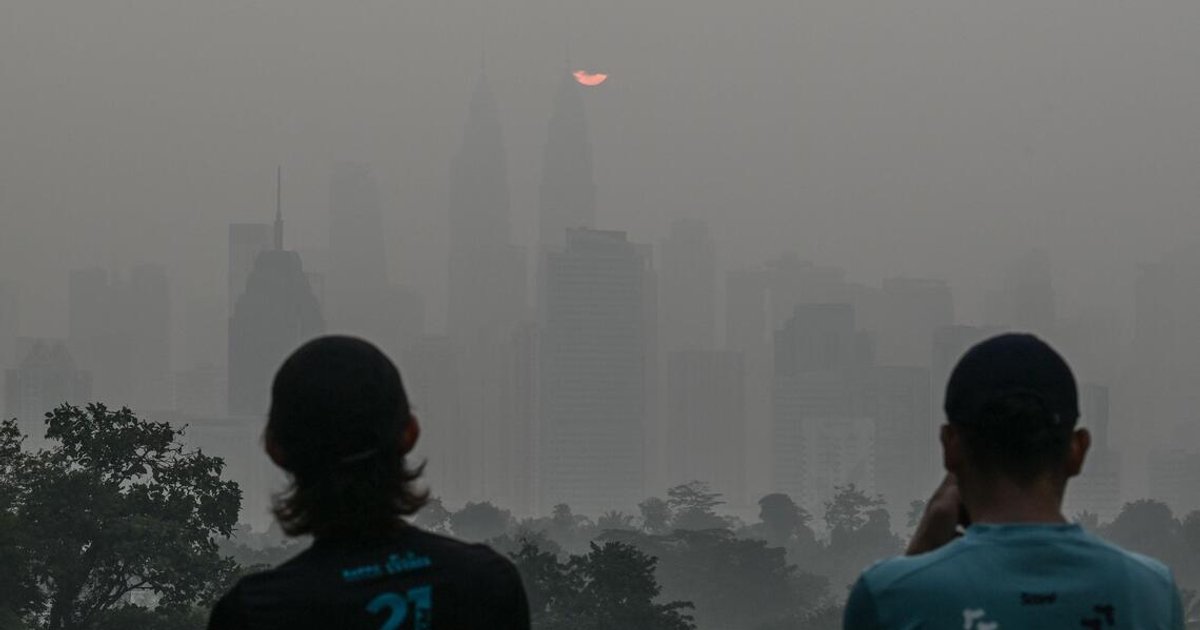
KUALA LUMPUR – Hasnah A.R. has spent years reaching for the same Indonesian products: Indocafe for her morning coffee, Sosro sweetened tea for a drink and Kara coconut milk for cooking.Now, as anger grows over transboundary haze drifting into Malaysia, the 67-year-old is ready to give them up.“I am sure those made in Malaysia are equally good,” said Hasnah, a non-governmental organisation president who plans to stop buying Indonesian products once she finishes her remaining sachets of Indocafe.For her, the boycott is not just about the haze. It is also a response to what she sees as insulting remarks on social media, including one by Indonesian Government Communications Agency head Syahganda Nainggolan about Malaysia getting its oxygen from the country.“If we don’t teach them a lesson, they won’t stop,” she told The Straits Times.The anger comes amid a recurring regional problem: Smoke from fires in Indonesia has repeatedly drifted across borders, degrading air quality in neighbouring countries and disrupting daily life. In Malaysia, severe haze episodes have forced school closures and caused economic losses. Despite years of regional cooperation, the haze continues to test relations between Indonesia and its neighbours.Hasnah’s stance reflects the frustration of Malaysian netizens, some of whom have listed Indonesian products to avoid and suggested local alternatives.One Facebook user, Salbiah Ahamad, asked which coconut milk consumers were switching to, in response to the “oxygen” remarks. Her post attracted more than 400 comments, with many saying they would switch to local brands such as Saji or Rasaku, among others.Another social media user, Mohd Fikri, sarcastically warned that Indonesian ministers might stop oxygen from entering Malaysia if they learnt of the boycott.“Just boycott them. They’re so comfortable insulting us with their oxygen jokes,” wrote another commenter, Sky Ikemen.But boycotting Indonesian products may do little to hurt the companies responsible for the fires unless consumers can identify and target them.As frustration mounts, Malaysia is instead exploring tougher responses, from pressuring banks to cut financing to potential legal action against companies and a law modelled on Singapore’s. The challenge is proving who caused the fires and linking them to the harm suffered across the border.Economist Barjoyai Bardai said that a blanket boycott of Indonesian products is unlikely to solve the haze and could hurt Malaysian businesses that depend on Indonesian suppliers.“Malaysia and Indonesia have deeply interconnected economic interests, making a broad-based boycott difficult to sustain and potentially costly to both countries,” he told ST. Bilateral trade between the two countries reached US$26.6 billion (S$34 billion) in 2025.He said a targeted boycott of companies credibly linked to forest fires would be more effective, but only as part of wider pressure through financial institutions, stronger enforcement and diplomatic cooperation.“The real objective should not be to boycott Indonesia as a country, but to make forest burning economically unattractive and corporate accountability unavoidable,” he said.Muar MP Syed Saddiq Syed Abdul Rahman is among those urging Malaysians to boycott companies linked to forest burning in Indonesia. He has also called on banks in Malaysia and Singapore to cut financing for these businesses.“If companies are involved in slash-and-burn practices, even to a limited extent, they should not be allowed access to capital markets or loans from our institutions. We need to hit them where they hurt the most,” he said in Parliament on Oct 13.On Oct 21, he said action should be taken regardless of a company’s nationality.“If there is evidence that Malaysian or Singaporean companies are responsible, punish them,” Syed Saddiq said in a social media video, responding to criticism from former Indonesian trade minister Muhammad Lutfi over his call to treat Indonesia as an “outcast” in ASEAN over the recurring haze.Can Malaysians sue over haze?Beyond consumer pressure, Malaysians affected by the haze may also have legal avenues to seek redress from companies suspected of contributing to the fires.A legal expert said one possible route is civil action against companies in Indonesia – Malaysians affected by the haze could seek compensation, orders to stop pollution or the restoration of damaged land.Azam Hawari, a legal expert at environmental law organisation ClientEarth, said companies could, in certain circumstances, be held legally responsible for environmental harm.However, claimants would need evidence linking a company’s activities to the fires, showing that the resulting smoke exposed them to pollution, and establishing that the exposure caused their injuries or losses.That could include satellite imagery interpreted by experts, concession maps, laboratory results, witness testimony, electronic evidence and environmental forensic findings.“Medical records, receipts, earnings histories and business accounts could help substantiate and quantify the losses claimed,” Azam told ST.Separately, Malaysian Deputy Natural Resources and Environmental Sustainability Minister Syed Ibrahim Syed Noh told Parliament on Oct 21 that the government was open in principle to enacting legislation similar to Singapore’s Transboundary Haze Pollution Act (THPA).“As to whether we can introduce such legislation, as Singapore has done, the answer is ‘yes’. There is no obstacle if we determine that such legislation is necessary,” he said.But Syed Ibrahim cautioned that any Malaysian law would need clear mechanisms to ensure it could be enforced and used to impose penalties or pursue legal action.The main challenge would be obtaining sufficient evidence to identify the source of pollution and those responsible. Investigators would need information on the coordinates of fires, ownership of the affected land, the parties carrying out activities there and evidence connecting the fires to the haze.Gathering such information would require detailed investigation and scrutiny, he said.Singapore itself may consider changing its existing laws or introducing new ones as enforcement of its decade-old THPA has proved difficult.Malaysia is also continuing diplomatic efforts under the ASEAN Agreement on Transboundary Haze Pollution, while working towards the grouping’s goal of a haze-free region by 2030.The agreement, which provides a framework for regional cooperation, does not offer a straightforward route for Malaysia to compel Indonesia to compensate those affected by the haze.Why trying to sue Indonesia is harderMeanwhile, international law requires countries to take reasonable steps to prevent activities within their borders from causing serious environmental harm to other countries. But pursuing this avenue is also fraught with difficulties.Malaysia could potentially hold Indonesia legally accountable, but “proving a breach of this obligation and establishing causation would be challenging”, Mohd Hazmi Mohd Rusli, an associate professor at the Faculty of Syariah and Law of Universiti Sains Islam Malaysia, told ST.In addition, Malaysia cannot simply take Indonesia to the International Court of Justice. The court can hear the dispute only if there is a legal basis for doing so, such as both countries agreeing to it. The regional haze agreement itself calls for disputes to be settled through talks, Hazmi said.With legal avenues difficult to pursue, Hazmi said targeted boycotts could offer another way to hold polluters accountable.“Beyond legal remedies, Malaysia could consider boycotting products associated with companies proven to be responsible for the fires. Consumer pressure could encourage greater corporate accountability, although such measures should be evidence-based,” he said.“Malaysia and Indonesia share close relations, which partly explains Malaysia’s preference for diplomacy. However, diplomacy should not come at the expense of accountability,” said Hazmi.Sign up for our weekly Asian Insider Malaysia Edition newsletter to make sense of the big stories in Malaysia.
Malaysians want to ditch Indonesian goods, but will this make polluters pay for the haze?
Full Article
Original Source
Read the full article at Straitstimes →KhanList aggregates and links to publicly available news content. We do not host full articles from third-party sources. Always verify important information with original sources.