
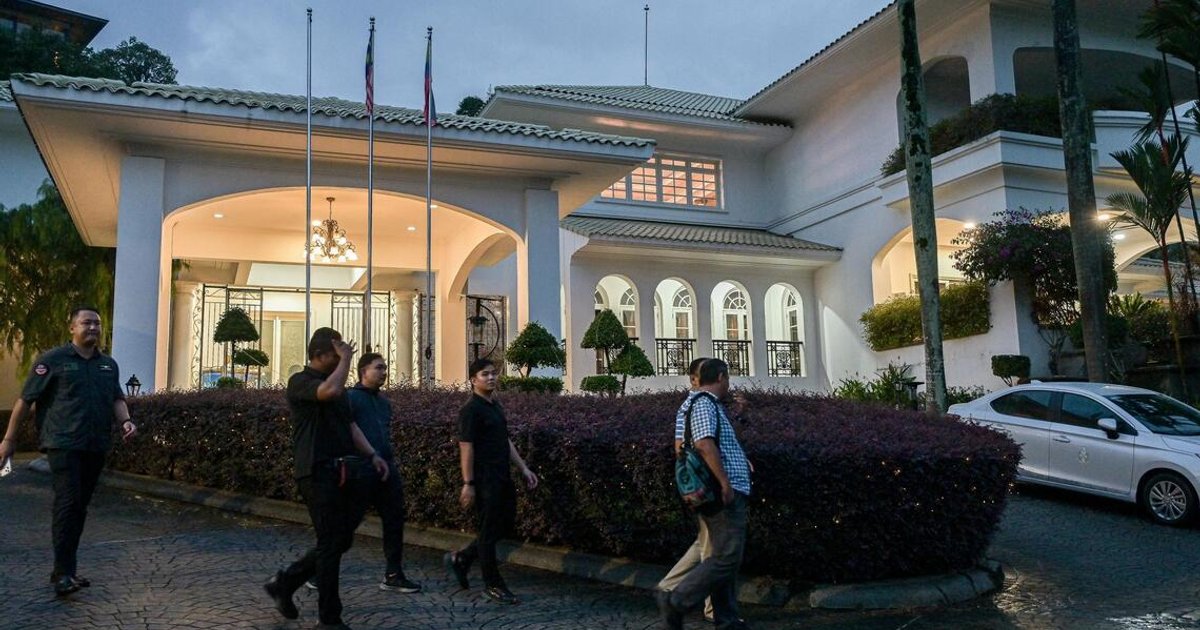
KUALA LUMPUR – Former Malaysian prime minister Najib Razak’s transfer to house arrest remains in limbo despite fulfilling the conditions of a royal pardon, as a legal dispute over two corruption sentences complicates his move home.Malaysia’s King, Sultan Ibrahim Iskandar, issued a stern warning on Nov 7 against questioning his conditional pardon order, declaring that it was “clear, explicit and unambiguous” and unrelated to Najib’s other cases.“Given that all the conditions stipulated in the conditional pardon order have been fulfilled, any argument questioning the order would amount to moving towards defying the decree of His Majesty the Yang di-Pertuan Agong,” the palace said, adding that there should be no confusion or prolonged uncertainty over its implementation.The unusually forceful royal intervention has brought the King’s constitutional power of pardon and the judiciary’s authority to interpret court orders into sharp focus, while increasing political pressure on Prime Minister Anwar Ibrahim’s government.The Attorney-General’s Chambers (AGC) insists it is not challenging the King but wants a court ruling on whether Najib’s payment of a RM50 million (S$15.7 million) fine ends his current sentence, potentially triggering a separate 15-year jail term. Malaysia’s Attorney-General on Nov 6 halted Najib’s house arrest transfer, in a last-minute intervention after the court cleared him to leave prison four years into his sentence.On Nov 7, UMNO also called for the immediate implementation of the Pardons Board’s decision allowing Najib to serve the remainder of his prison sentence under house arrest, following the King’s firm decree on the matter.How did Najib’s house arrest become a legal dispute?Najib’s expected Nov 6 homecoming ended with the 73-year-old back in Kajang Prison, hours after his party, UMNO, fully paid the fine required under the royal pardon.The former premier had briefly left prison for a dental appointment as preparations were made for his transfer to his Kuala Lumpur residence. But the AGC intervened, calling for the house arrest arrangement to be temporarily suspended pending legal clarification.Najib’s lawyers protested against the AGC’s move, saying every condition set by the King in his pardon had been met and that there was no lawful reason for their client to remain in prison. They demanded that Najib be released immediately into house arrest, in a statement.“To claim the power to suspend His Majesty’s order by media statement is, in our view, executive overreach,” the Nov 6 statement read.The controversy centres on a conditional pardon granted on Sept 18, allowing Najib to serve the remainder of his sentence in the SRC International corruption case under house arrest until Aug 23, 2028, provided he paid the fine.Najib has been imprisoned since August 2022 over the misappropriation of RM42 million from SRC International, a former subsidiary of the scandal-hit state investment fund 1Malaysia Development Berhad (1MDB). His original 12-year sentence was halved and his RM210 million fine reduced to RM50 million under an earlier royal pardon in 2024.Following the payment of the fine on Nov 6, the Kuala Lumpur High Court issued an order authorising his discharge while also stating that he should serve the remainder of his SRC sentence under house arrest.The AGC says the wording creates uncertainty over whether the payment merely satisfies the financial condition, allowing Najib to continue serving his sentence at home, or whether the discharge means that his SRC sentence has legally ended.Former Malaysian prime minister Najib Razak has been imprisoned since August 2022. PHOTO: REUTERSWhy does his second prison sentence matter?Najib was separately sentenced to 15 years in prison in December 2025 for corruption and money laundering in the 1MDB case, with the High Court ordering that the sentence begin after he completes his SRC sentence.He is appealing that conviction, but the High Court rejected his application to suspend the sentence on Oct 14.If the SRC sentence remains in force, Najib could serve its remainder under house arrest until August 2028, with his separate 1MDB sentence beginning afterwards.But if the discharge order means the SRC sentence has legally ended, the second prison term could take effect immediately.The conditional pardon only applies to the SRC case.The AGC argues that judicial clarification is necessary to prevent conflicting interpretations and protect Najib’s rights against being detained beyond his lawful term.“If the court determines that the sentence in the SRC International case has been completed, continued detention on the basis of that sentence could result in him being detained beyond the period he should lawfully serve,” the AGC stated.Police outside the residence of jailed former Malaysian Prime Minister Najib Razak on Nov 6. PHOTO: REUTERSRoyal interventionThe palace’s intervention came a day after the AGC halted Najib’s planned transfer, citing unresolved legal questions over the royal pardon and the subsequent court order.In its statement, Istana Negara stressed that the power of pardon was a royal prerogative under Article 42 of Malaysia’s Federal Constitution and must be respected in accordance with the country’s constitutional monarchy and the rule of law.The palace also pointed out that the Sept 18 Pardons Board meeting had been attended by the Federal Territories Minister and the Attorney-General, who provided advice to the King before he approved the conditional pardon.The reference to their involvement underscored the palace’s position that the decision had been made through the constitutional process.The AGC, however, maintains that the royal power of pardon and the courts’ authority to determine the legal effect of an order are separate matters.In a five-page statement on Nov 7, an hour after the palace issued its statement, the AGC rejected allegations that seeking judicial clarification amounted to defying the King or assuming his constitutional power of pardon.It argued that ensuring a royal pardon was properly implemented in accordance with valid court orders was part of upholding the monarchy and the rule of law, rather than an act of defiance.The distinction is central to the dispute. While the palace maintains that its pardon order is unambiguous, the AGC says the uncertainty concerns the subsequent court order and its implications for Najib’s two prison sentences.In the latest development, the Attorney-General has sought an audience with the King to seek forgiveness and convey his commitment to complying with the King’s decree concerning the Conditional Pardon Order granted to Najib, according to the Prime Minister’s Office in a statement issued later on Nov 7.It also said the Attorney-General will clarify the legal questions arising from the High Court’s release order following the payment of a RM50 million fine. These questions must be determined by the courts as they affect the commencement date of Najib’s prison sentence in the 1MDB case.Tension within the governmentThe King’s statement prompted a strong response from UMNO, the party Najib once led and a key partner in Anwar’s coalition government.UMNO secretary-general Asyraf Wajdi Dusuki said the royal decree could imply that acts of defiance against the monarch had occurred, warning that Malaysia should not be governed by those who disregarded the Federal Constitution.The party demanded immediate implementation of the pardon and legal action against those who failed to comply.Youth chief Akmal Saleh also chimed in, saying that the party’s youth wings across the country would lodge police reports to investigate possible breaches of the law over the delay in Najib’s planned house arrest transfer.He rejected further legal proceedings as grounds for postponing Najib’s house arrest, arguing that any questions over the pardon should have been raised when the Pardons Board met on Sept 18, rather than after its conditions had been fulfilled.The dispute has exposed tensions within Anwar’s coalition, which brings together UMNO – Malaysia’s founding Malay nationalist party – and the Chinese-led Democratic Action Party (DAP), two parties with sharply differing positions on Najib’s treatment. Both parties are crucial in Prime Minister Anwar Ibrahim’s unity government and are also seen as key players in the next general election that must happen by February 2028.Meanwhile, DAP secretary-general Anthony Loke has pledged to resign as Transport Minister once Najib returns home, while UMNO has continued pressing for the latter’s immediate transfer to house arrest.DAP secretary-general Anthony Loke has pledged to resign as Transport Minister once Najib returns home. ST PHOTO: KELVIN CHNGAnwar has publicly disagreed with UMNO’s decision to pay the fine on Najib’s behalf, although he acknowledged that the party was entitled to do so.The ongoing controversy leaves the prime minister navigating competing demands from coalition partners while his government’s legal advisers seek a judicial resolution.It also revives the political sensitivities surrounding the 1MDB scandal, which contributed to Najib’s election defeat in 2018 and remains closely associated with public concerns over corruption and accountability.For now, Najib’s return home remains uncertain.The AGC has called for an immediate court determination, insisting that the move is not intended to delay or frustrate the royal pardon but to prevent conflicting interpretations and unlawful detention.Until that legal ambiguity is resolved, Najib’s payment of RM50 million may fulfill the condition for house arrest, but offers no guarantee of his return home.Sign up for our weekly Asian Insider Malaysia Edition newsletter to make sense of the big stories in Malaysia.
Malaysian King’s warning raises stakes as Najib’s house arrest remains in legal limbo
Full Article
Original Source
Read the full article at Straitstimes →KhanList aggregates and links to publicly available news content. We do not host full articles from third-party sources. Always verify important information with original sources.