
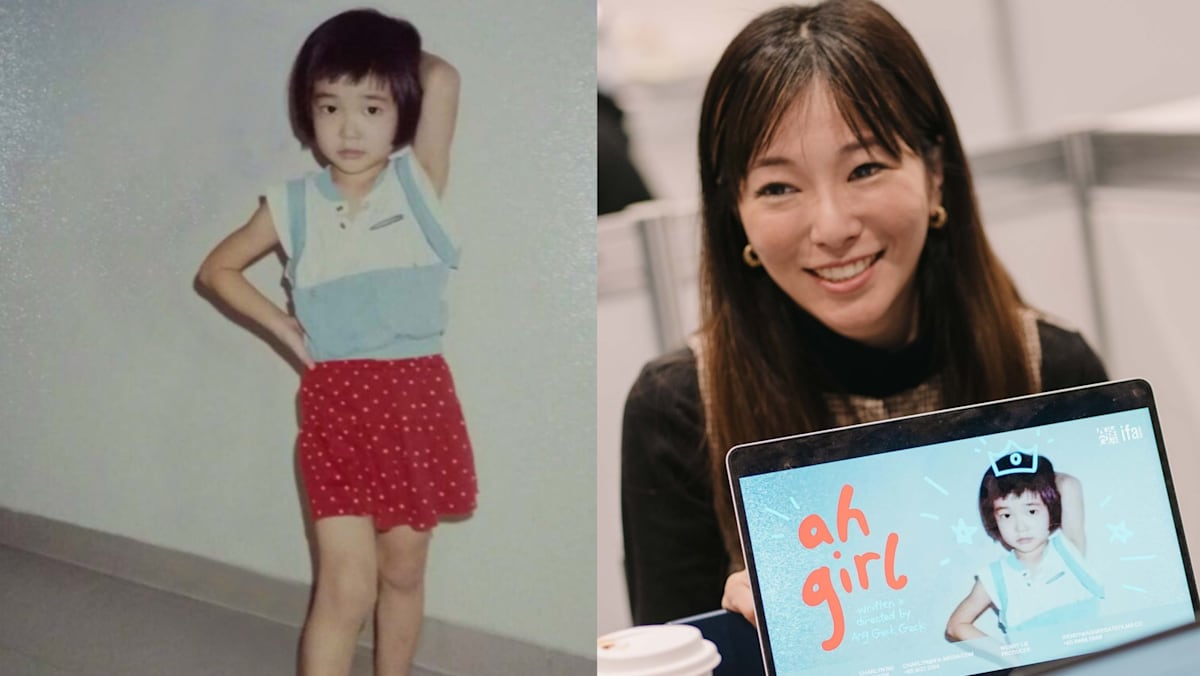
The year is 1994. A young girl, known to her family as Ah Girl, is lying on the floor with her younger sister, colouring with crayons she scavenged from the dustbin at the void deck of their flat.In their tiny apartment, her grandmother is counting coins as the television switches between English and Mandarin channels in the background. Her father has gone out with his new girlfriend, and she has little idea when her mother, whose visits are erratic, will come by again. This is one of the many poignant scenes in Ah Girl, the feature debut of Singaporean filmmaker Ang Geck Geck Priscilla, who drew inspiration from her own childhood.Set in 1990s Singapore, Ah Girl follows a seven-year-old girl and her younger sister Ah Tian as they navigate their parents’ separation, financial difficulties and the complicated relationships between the adults in their lives. The Mandarin-language film won several accolades in 2026, including the Youth Jury Award at the International Film Festival Rotterdam and Best Asian Feature Film at the Singapore International Film Festival. It also received three nominations at the 2026 Golden Horse Awards, for Best New Director, Best Adapted Screenplay and Best New Performer for Ong Xuan Jing, who played Ah Girl.After a year of screening at film festivals around the world, Ah Girl opened in Singapore cinemas on Nov 19, 2026.PROCESSING HER CHILDHOOD THROUGH FILM Ah Girl has won awards and received nominations at several international film festivals and awards ceremonies this year, including Bangkok International Film Festival, Malaysia International Film Festival, Hong Kong International Film Festival and Golden Horse Awards. (Photo: Ang Geck Geck Priscilla) “Whatever Ah Girl went through in the film, I understand her, because I went through something like that,” Ang told CNA Women.“I had this strong desire in me to tell that story – my story – and the story of many other children who grew up like me. Making Ah Girl was cathartic.”Growing up, however, Ang struggled to express herself or articulate how she felt about her family.Her parents separated when she was around six, although she and her younger sister, who is a year younger than her, had already been living with their paternal grandparents.Both parents were seeing other people, and their visits to their daughters were irregular. Ang also spent part of her childhood living with half-siblings from her parents' other relationships.Some of the film's more striking details also came from her own experiences. Ang secretly sold chewing gum to her primary schoolmates, hoping the money would help her father settle his debts. She also broke her piggy bank in anger when she overheard arguments between the adults about money.She laughed as she recalled how much she could realistically have earned from her chewing gum “business”. But to her younger self, even a dollar deposited into her piggy bank felt like a meaningful contribution."I went through so much, but I never really learned to talk about it – I just didn't even know how to begin," she said.That changed when she enrolled at Nanyang Technological University's (NTU) School of Art, Design and Media (ADM). Ang with her paternal grandmother who raised her, at her university convocation in 2012. (Photo: Ang Geck Geck Priscilla) The self-described introvert discovered that filmmaking gave her a way to express feelings she had never shared openly.Her 2012 student short Broken Crayon, which won Best Short Film at the 2013 Singapore Short Film Awards, would eventually grow into Ah Girl.“Films were the best thing that happened to me. For the first time, I felt like I could talk about what happened to me as a kid,” she said. “I could use visuals and scenes instead of just words, and it was the best way to express myself. I felt so liberated.”Some audience members approached her after screenings of Broken Crayon to thank her for telling a story that resonated with their own lives."Through film, I realised that I could also make people feel less alone," she said.Encouraged by those reactions to her short film, Ang continued exploring the character of Ah Girl through two more short films in 2014, Three Little Pigs and Happy Birthday, before embarking on the feature-length version in 2015.OVERCOMING HURDLES AS A FEMALE FILMMAKER IN SINGAPOREAng said she often struggled to be taken seriously as a relatively new female director.“People assumed I was the producer or even an actress. They would also look at me with doubt when I corrected them to say I’m the director,” she said. Ang pitching the story of the character Ah Girl as a student at NTU ADM. (Photo: Ang Geck Geck Priscilla) However, prospective backers deemed a character-driven story about a young girl growing up in Singapore to be “too simple” or “boring”, Ang said.“It’s not blockbuster or dramatic, and people told me that was what audiences wanted,” she added. “That was how films could make the most money.“I understood those concerns, but I didn’t want to listen. I knew I had a good story to tell and I just wanted to tell it on my own terms.”In 2019, just when it seemed her perseverance had finally paid off, a producer with whom she had spent two years discussing the project suddenly withdrew.Ang likened the experience to someone promising to marry you, only to walk away after years of building a relationship."That was one of the worst challenges I ever faced because I started doubting everything about myself – my voice, my story, my filmmaking skills, whether any of it was worthwhile at all," she said.“The experience also brought back the feelings of abandonment I went through as a child.”While researching the film's characters, she spoke with mental health professionals to better understand the psychological effects of growing up in a dysfunctional household.One of them subsequently suggested that she consider seeking help herself.Initially taken aback, she began therapy, which helped her recognise the impact of her childhood on her relationships and her reaction to rejection.Ang, who is single, realised that she often gravitated to partners who were emotionally unavailable or treated her unkindly, while struggling to accept affection from people who genuinely cared for her. While creating Ah Girl, Ang went to therapy to understand how her childhood has affected her life. (Photo: Ang Geck Geck Priscilla) "All my life, I've been chasing after my parents' love," she said. “It was also why the producer’s rejection in 2019 felt especially painful – even after I was so vulnerable and open to sharing my story, no one listening thought it was even worthwhile to pursue as a film.” By 2022, she was close to giving up. She then approached producer Charlyn Ng, hoping for one last opportunity to move the project forward.Ng agreed to try, and the team subsequently secured a grant from the Infocomm Media Development Authority (IMDA).“While the amount we received from IMDA was huge, it did not cover the entire production budget, which was over S$800,000,” Ang said. “But I knew I had to make it happen.”To help cover the shortfall, she took on additional work in film production, copywriting and marketing. She also set aside a significant portion of her savings to cover potential funding gaps. The team continued seeking financial backing even after production began.FINDING PEACE AND FORGIVENESS THROUGH AH GIRLAs Ang progressed in therapy, she moved away from the bleak portrayal of abandonment and family dysfunction in her earlier short films. She wanted the film to offer hope to people who had experienced something similar."I started to heal," she said. “So I hope people who experienced the same thing will get healed watching the film.” Ang with Ong Xuan Jing, who played Ah Girl in the film. Ong won Best Actress awards at the Hong Kong and Malaysia international film festivals and was nominated for Best New Performer at the 2026 Golden Horse Awards. (Photo: Ang Geck Geck Priscilla) The shift also influenced how Ang portrayed the parents in the film. Despite their flaws and the hurt they caused their children, she did not want them to become one-dimensional villains."I tried to understand from their perspective why they do what they do," she said, adding that she believes parents sometimes repeat harmful patterns from their own upbringing without fully understanding how those experiences affect how they raise their children."It's not that they don't know how to love us. They do – and I believe my own parents loved me, too – it's just that they don't know how to give what the kids need," she said.“But children will remember. They may not understand the complexities of their parents' relationships, but they are often more aware of what is happening than adults assume.”Ang wanted the film to unfold from Ah Girl's perspective, capturing the confusion, disappointment and affection that can coexist in a child's relationship with her parents. She therefore took particular care when working with young actresses Ong and Sydney Wong, who play Ah Girl and Ah Tian, respectively.She spent months getting to know them through games, outings and home visits before filming began, learning how they reacted in different situations. Ang wanted them to understand their characters and perform naturally. Ang directing Ong Xuan Jing in one of the scenes from Ah Girl. (Photo: Ang Geck Geck Priscilla) Some scenes were filmed in Ang’s father’s home.“It was a weird feeling to be filming scenes about Ah Girl’s mother and her boyfriend at my father’s real home,” Ang said. “At some points, my dad would peek out of his room during filming – though I don’t know if he understood that the scenes reflect our own family history.”Only Ang’s paternal grandfather attended the film's gala premiere. Her paternal grandmother, who helped raise her, is now bedridden. Neither of her parents was present, and Ang has little contact with her mother.She has come to see her parents as people with their own struggles and shortcomings, rather than only through the hurt she experienced as their child.“I’ll always remember, but I’ve also learned to forgive in my own way,” she said.When the film premiered in Rotterdam, Netherlands, Ang was taken aback to hear audiences laughing and crying at the story of a Singaporean girl growing up in the 1990s.Many later approached her to share how much they related to the characters.For Ang, those reactions affirmed what she believed all along: a deeply personal, distinctly Singaporean story could still resonate with people who had never experienced her world.Ang hopes to make two more films, following the character through her teenage years and later adulthood, although she is in no hurry."I still have so much of Ah Girl’s story to tell – but I'll let Xuan Jing and Sydney grow up first," she said. Ah Girl is currently showing in Singapore cinemas. CNA Women is a section on CNA Lifestyle that seeks to inform, empower and inspire the modern woman. If you have women-related news, issues and ideas to share with us, email CNAWomen [at] mediacorp.com.sg.
‘Making Ah Girl was cathartic’: Director Ang Geck Geck Priscilla on healing from her childhood trauma
Full Article
Original Source
Read the full article at Cnalifestyle →KhanList aggregates and links to publicly available news content. We do not host full articles from third-party sources. Always verify important information with original sources.