
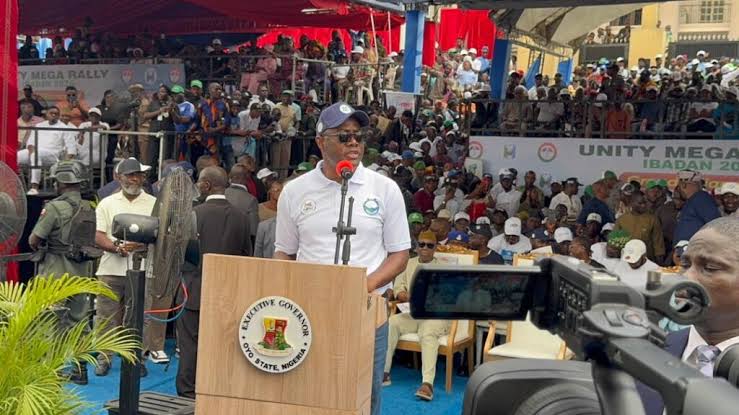
*Confirms ongoing talks with Atiku, Obi *Says failure to honour unity govt deal severed relationship with Tinubu Chuks Okocha in Abuja and Sunday Ehigiator n Lagos Oyo State Governor and presidential candidate of the Allied Peoples Movement (APM), Seyi Makinde, has said opposition parties must forge an alliance and rally behind the presidential candidate with the strongest electoral prospects to defeat the ruling All Progressives Congress (APC) in the 2027 general election. Makinde, who confirmed that he was actively involved in discussions over a possible opposition alliance, declared his willingness to work with either former Vice President Atiku Abubakar or the presidential candidate of the Nigeria Democratic Congress, Peter Obi, if the arrangement offered the best chance of defeating the ruling party. Speaking in an exclusive interview with ARISE News, the Governor said the choice of a candidate should be determined by data, manifestos, past performance and the sentiments of Nigerians rather than personal preference.“We’re still discussing,” he said. Asked directly whether he was open to an alliance with other leading opposition figures, Makinde answered in the affirmative.“Not only that I’m open, we’re actively discussing this,” he said.He declined to say whether he would prefer an arrangement with Atiku or Obi, arguing that such a consequential political decision should be based on evidence. “To arrive at a decision, you need data,” he said.“We just won’t say, ‘Oh, okay,’ take emotional decision and say, ‘Oh, it’s you.’ We have manifestos now, we have certain things in that manifesto. We will sit down, we have maybe historical performance. We also have the sentiment of the people. All of those things will come together and arrive at a decision.”Makinde drew on his background in the oil and gas industry to explain how political rivals could become partners when their interests and capabilities aligned. He said companies operating in the same field could compete in one circumstance, collaborate in another or enter into a commercial relationship, depending on what was required to develop an asset successfully.Applying the analogy to the presidential contest, he said: “Depending on what we see between now and the election time, we may be rivals, we may be collaborators, we may be — one may be the client of the other.”Asked whether he was prepared for such an arrangement in pursuit of his campaign to “reset Nigeria”, Makinde replied: “To reset Nigeria, yes.” Asked specifically whether he would work with Atiku if available data showed that the former vice president was the strongest candidate around whom the opposition should coalesce. “Yes,” Makinde replied.“I’m willing to work with any Nigerian.”The Governor also invoked the 1999 presidential election, noting that Olu Falae performed overwhelmingly well in the South-west but could not translate his regional strength into a national victory.“Our biggest challenge is, first, to agree on what is the best course of action, and then seek an alliance,” he said.He also pointed to South Africa’s experience of political cooperation as evidence that competing political forces could negotiate an arrangement when circumstances demanded it. “That negotiation will not be anything personal,” Makinde said. “That negotiation will be the deal for Nigeria, by Nigeria.”That personal ambitions should not prevent opposition figures from adopting a common electoral strategy.He said the APM has the backing of most of the Peoples Democratic Party’s (PDP) political structure as he prepared to contest the presidency in 2027. The APM presidential candidate said the party’s strength partly derived from the political structure that supported his emergence as Oyo State governor under the PDP, despite the internal challenges that affected the opposition party.“Remember, I became Governor under PDP. Remember, we had issues within PDP. But majority of the PDP structure, they’re actually with us in APM.” He confirmed that the APM was a faction of the PDP when the interviewer asked whether his party was relying on the PDP structure.“Yes, it’s a faction of the PDP,” he said.He described the APM as a relatively new party but argued that its age would not prevent it from making a strong showing in the 2027 presidential election. “APM is relatively new,” he said.Makinde also cited the performances of the Labour Party and the New Nigeria Peoples Party (NNPP) in the 2023 election to support his argument that a party with a limited electoral history could attract significant votes.“Labour Party in 2019, throughout the country, had 6,000 votes. 6,000 and some. In 2023, Peter Obi moved into Labour Party. No governor, no senator, no big politician. And he was able to move Labour Party’s vote from 6,000 four years earlier to 6 million plus in 2023,” he said. He also referenced the NNPP’s performance after former Kano State Governor, Rabiu Kwankwaso, joined the party.“Four years earlier, they were right around 6,000 plus also nationally. And former governor Rabiu Kwankwaso moved into NNPP. And the share of votes went from 6,000 to 1.4 million votes.”Challenged on the comparison, given that Obi had been a vice-presidential candidate in 2019 and Kwankwaso had previously contested the presidency, Makinde maintained that his own political journey showed that a candidate did not necessarily need a long record in public office to build electoral support. “If you read my trajectory to becoming the governor of Oyo State, this is my very first job in the public sector.”The governor also defended his decision to seek the presidency, arguing that the country needed fundamental changes in the way it was governed rather than gradual policy adjustments.He criticised Tinubu’s administration over electricity, saying: “The president promised that, look, I will fix electricity. Nigerians believed him. Has electricity been fixed?” Makinde said he believed the country was underachieving and that incremental reforms would not address its problems.“They don’t seem to be working. We’re underachieving. As a matter of fact, we have to completely change the game.”He also rejected arguments that improvements in the economy at the macroeconomic level would eventually benefit ordinary Nigerians, saying the government should be judged by the impact of its policies on households.“If you’re saying, oh, things are happening at the macro level, but it will filter down to micro, I see those as just excuses and shifting blimps.” Makinde questioned whether Nigerians were experiencing relief from the rising cost of living and whether families could afford their basic needs.“What’s the impact on the ordinary people on the streets? Are Nigerians hungry? Are more families able to, you know, afford certain things?” he asked. Makinde Scores Tinubu 34%, Commends State Police, Student Loans Makinde scored Tinubu’s administration 34 per cent, while acknowledging progress on state police and student financing but insisting that the government had fallen short of what Nigeria required.“It’s just about the same percentage of the people that supported him in 2023. Thirty-four per cent,” he said.The governor argued that Tinubu’s challenge went beyond implementing individual policies to building sufficient national support for his government’s programmes. “You need the 67 per cent of Nigerians that were against him in 2023 to be on board,” he said. “This is a massive number.”On the push for state police, which he has long advocated as part of his argument for bringing security decisions closer to communities, Makinde gave Tinubu credit for advancing the proposal. “The President has done well with the formation of the state police,” he said.He, however, argued that state policing should not necessarily be introduced simultaneously across the federation. Instead, states capable of establishing their own police services should be allowed to proceed, while others could join when ready.He also offered qualified support for the Federal Government’s intervention in tertiary education through student financing, arguing that providing students with access to funds addressed only one part of a much broader challenge. “Having money for students to go to school… is a small fraction of what they’re supposed to do. You need the teachers that are motivated. You need even security” for educational institutions.He argued that reforms must ultimately ensure young Nigerians acquire the skills and knowledge required to secure employment or become entrepreneurs. Makinde said isolated interventions could represent progress without necessarily resolving the underlying problems.“If you have three or four pockets and one is being addressed, I would say it’s a movement in the right direction. But that alone will not solidly ensure that our children have skills and knowledge that can either make them employable or turn them into entrepreneurs.”He maintained that Nigeria needed a more coordinated approach to economic development, security, education and governance, presenting his proposed “Reset Nigeria” agenda as an alternative to the current administration. Promises Transparent Fuel Pricing, Says Petrol Can Be Cheaper Makinde promised to publish a transparent petroleum pricing template, saying Nigerians should know exactly how pump prices were determined. He said Nigerians could pay significantly less for petroleum products, alleging corruption within the existing system and promising to make the country’s fuel pricing template public if elected president. He said transparency in petroleum pricing would be a priority from his first day in office. “I believe that there’s corruption within the system,” he said. The governor, who worked in the oil and gas industry before entering politics, said Nigerians should be able to see the components used to determine the prices they pay for petroleum products rather than being presented with a final figure without sufficient explanation. He said his administration would disclose the pricing template, allowing the public to understand the assumptions and costs behind pump prices. Pressed to state exactly how much Nigerians should expect to pay for petrol under his presidency, Makinde declined to give a specific figure but insisted that the price could be “significantly lower”. He said his position was informed by his professional experience in the petroleum industry, describing oil and gas as an area in which he had considerable technical expertise dating back to the early 1990s. He also questioned the long-running debate over fuel subsidy, recalling Tinubu’s position during the 2012 subsidy protests and arguing that inefficiencies and corruption within the petroleum system needed to be confronted. Makinde criticised the federal government’s management of the economy and the impact of national policy decisions on households and subnational governments. He said increased nominal revenues should not automatically be interpreted as improved prosperity because inflation and the depreciation of the naira had significantly increased the cost of wages, infrastructure and other government obligations. Using Oyo State as an example, Makinde said the state’s monthly salary bill had risen from about N4.5 billion when he assumed office in 2019 to approximately N18 billion. He argued that wages and government revenues should therefore be assessed in terms of purchasing power rather than nominal increases. Makinde also recalled that a 65-kilometre road awarded by his administration in 2019 cost less than N9 billion, saying comparable infrastructure would cost substantially more today. He said his economic programme would focus on improving purchasing power and productive capacity rather than relying on higher nominal government revenues as evidence of prosperity. He nevertheless insisted that greater transparency and the removal of corruption and inefficiencies from the system would result in Nigerians paying substantially less for fuel. Accuses Tinubu Administration of Using EFCC to Pressure Governors Makinde accused the Tinubu administration of using the Economic and Financial Crimes Commission (EFCC) to pressure opposition governors into joining the APC, warning that the alleged practice threatened Nigeria’s multiparty democracy. He described the alleged political blackmail as an attempt to weaken opposition parties ahead of the presidential election, arguing that rather than seek the support of Nigerians who did not vote for the APC in the last presidential election, the ruling party had concentrated on attracting governors through coercion. “What we’ve seen is, well, okay, I have the governors, they come to APC. If you don’t, you will be blackmailed,” he said. He cited a scenario in which a contractor working for an opposition-controlled state could be subjected to scrutiny over contracts and financial transactions. “The EFCC will come down from that place. ‘Look, how much did they award this to you? Go and bring your account. Who have you been paying?’ That is the situation that we are facing today,” he said. He did not, however, provide evidence during the interview to establish that the EFCC had been directed by Tinubu or the APC to conduct such investigations. Makinde linked his allegation to what he described as a wider pattern of pressure on opposition parties and politicians, questioning why several opposition platforms were experiencing internal crises as the election approached. He warned against Nigeria drifting towards a one-party political system, arguing that electoral contests should be decided by voters rather than through the courts, intimidation or pressure on political opponents. Makinde nevertheless said he would accept defeat if Nigerians rejected his presidential bid in a properly conducted election. “If the process is free, fair and credible, yes, I will,” he said when asked directly whether he would concede if he lost. The governor, however, expressed confidence that he would win at the polls. He repeatedly framed the coming election as a contest between the APC and Nigerians dissatisfied with the direction of the country, arguing that opposition parties must be allowed to compete freely for power. Says Failure to Honour Unity Deal Severed Relationship with Tinubu Makinde accused Tinubu of failing to honour an agreement reached with opposition governors ahead of the 2023 presidential election, particularly the proposed formation of a Government of National Unity, saying this led to the breakdown of their relationship. The governor also disclosed that he had not spoken directly with Tinubu since the abduction of students and teachers in Oyo State, despite attempting to reach the President during the 56-day ordeal. Explaining why he decided to challenge the incumbent President, Makinde identified accountability as one of the major shortcomings of the Tinubu administration. He argued that despite the government’s claims of improvements at the macroeconomic level, ordinary Nigerians were yet to experience meaningful relief from the country’s economic challenges. “The major issue that we’re faced with is that this current administration seems to be falling short on accountability.” Makinde also said Tinubu had not contacted him over the kidnapping of students and teachers in Oyo State, despite his attempts to reach the President during the incident. He said he had expected the President to call him, considering the gravity of the security situation. “I expected the President to call me. He did not. The President did not call you? No. Till tomorrow,” he said. The governor added that he had attempted to reach the President through the State Chief of Protocol but was unsuccessful. He, however, said he was not dwelling on the strained relationship, insisting that his priority remained governance and addressing the challenges facing Nigerians. Reacting to suggestions that his decision to challenge a sitting Yoruba President could make him another Chief Samuel Ladoke Akintola, who broke ranks with Chief Obafemi Awolowo in the 1960s, Makinde rejected the comparison. He argued that Nigerians should have the freedom to choose among presidential candidates, irrespective of their ethnic backgrounds. Citing the 1999 presidential election, he recalled that Yoruba voters supported Chief Olu Falae, while the rest of the country largely supported former President Olusegun Obasanjo, who eventually won. “If the solution will come from a Yoruba President, they must have choices,” he said. Makinde maintained that his presidential ambition was not an attempt to undermine Yoruba interests but an opportunity to present an alternative for the country. “I am running to tell the people of Nigeria that the inability of the current administration to tackle decisively our economic issues, to tackle decisively the issue of insecurity, to tackle decisively the issue of skills and knowledge for our people is not a Yoruba agenda,” he said. On the collapse of the G5 governors’ alliance and the political crisis within the PDP, Makinde said he was the only member of the group who had left the party. He also argued that federal allocations alone could not guarantee economic prosperity, insisting that Nigeria needed to rebuild its productive capacity through industrialisation, agriculture and infrastructure development. Makinde cited the closure of industries in Oyo State, including Leyland Assembly Plant, Exide Batteries, Ferodo and ISO Glass, as evidence of the country’s declining industrial base. He said his administration had prioritised agribusiness and infrastructure development through the Oyo State Agribusiness Development Agency and investments in the state’s airport to facilitate the export of agricultural produce. The governor disclosed that a judicial panel of inquiry established by his administration had submitted its report and that a government white paper would be released within the week. He accused federal security agencies of failing to cooperate fully with the state government during the investigation. Makinde also denied allegations that he orchestrated the kidnapping for political purposes, describing such claims as illogical. “I swore an oath to protect these people, and I will not politicise security because hardly will you be able to do anything in an atmosphere of insecurity,” he said. Makinde, who pledged to serve only one presidential term, said his proposed transitional administration would pursue constitutional reforms, including requiring a presidential candidate to secure 50 per cent plus one of the votes to win the presidency. He argued that the existing constitutional requirement allowed a candidate to emerge as President without securing the support of a majority of voters. He said his broader vision was to promote true federalism, national unity and respect for the cultural diversity of Nigeria’s constituent nationalities. He cited Nigeria’s founding leaders, including Sir Abubakar Tafawa Balewa, Chief Obafemi Awolowo and Dr Nnamdi Azikiwe, as political figures whose approaches to negotiating the country’s federal structure offered lessons for the future. “Let us move away from projecting ethnicity to gain political power. Let us move away from projecting religion to get political power. But let us respect the culture, the traditions in different nations that make up this country called Nigeria,” he said.
Makinde: Opposition Must Forge Alliance, Rally Behind Candidate with Strongest Electoral Prospects
Full Article
Original Source
Read the full article at Thisdaylive →KhanList aggregates and links to publicly available news content. We do not host full articles from third-party sources. Always verify important information with original sources.