
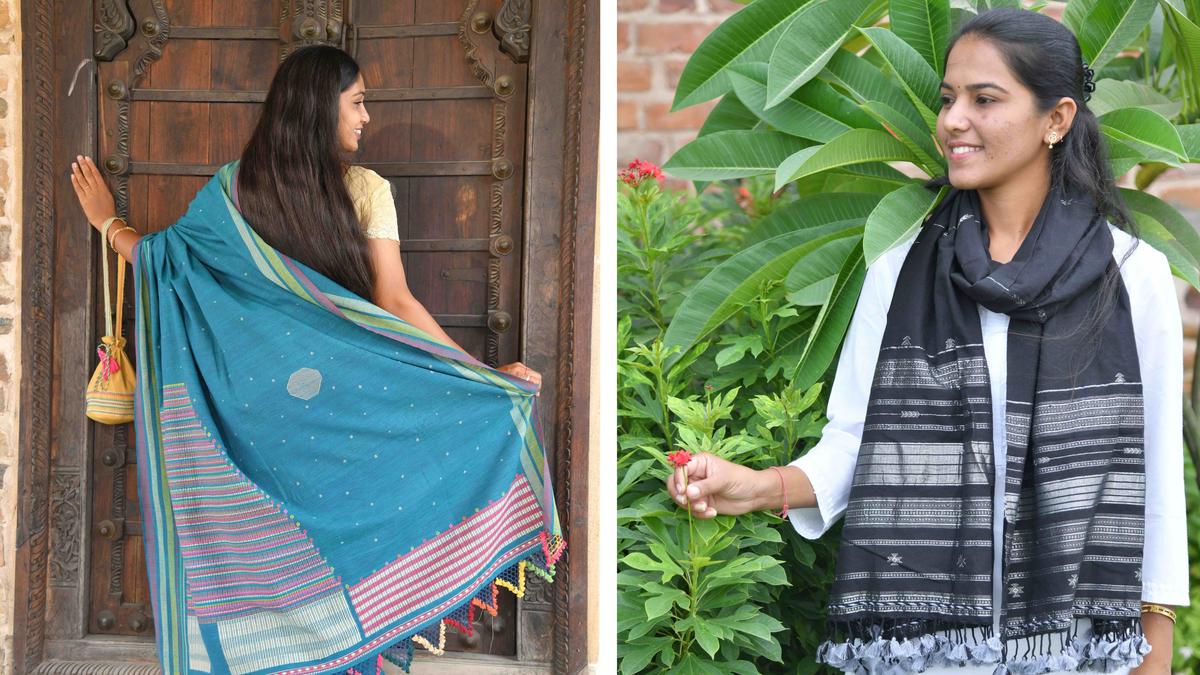
Traditional handcrafted textiles and crafts with a bit of innovation is the highlight of Ek Pehel, a three-day exhibition by Satt Baayu starting October 15 at Saptaparni in Hyderabad.Big stepEk Pehel, meaning first step, marks a significant move for Satt Baayu, a collective of seven women artisans from Kutch in Gujarat. Formed seven months ago, Satt Baayu or seven women in Kutchi, has been developing a new collection based on their individual ideas and design approaches. Women artisan designers of Satt Baayu The collective brings together their different craft practices, including Mashru and Kutchi weaving styles, and Suf and Rabari embroideries reflecting their diversity. “We know that people in Hyderabad appreciate crafts, heritage, and handmade things. So it felt like a good place to begin for us,” says Krishna Velji Vankar, one of the artisans, about their first exhibition.Speaking over the phone from Sarli village, around 30 km from Bhuj in Kutch, Krishna, an extra-weft weaving artisan designer, represents the collective’s other artisan designers and co-founders— Bhawna Puwar, Amruta Vankar, Renu Rabari, Pooja Vankar, Usha Jaypal and Karmi Ben Rabari from the neighbouring villages of Faradi, Bhujodi, Desalpar, Varamseda and Gadhpadar.Family legacy Celebrating the crafts | Photo Credit: Special Arrangement Although the craft has been passed down to them from their ancestors, this is the first time that these women are at an independently organised exhibition. “Many women in Kutch practice weaving and embroidery but due to family responsibilities they often work at home. They do not have the opportunities to build business or travel independently for exhibitions,” says Krishna. By coming together as a group, the women hope to support each other, grow stronger collectively, and create more opportunities for other women artisans.Stories from the KutchEK Pehel, a three-day exhibition by Satt Baayu, a collective of seven women artisan designers is at Saptaparni, Road No.8, Banjara Hills. The display from October 15 to 18 has a collection of saris, stoles, dupattas, jackets, kaftan, bags, carpets, tops, kurtas, skirts and beaded jewellery. The exhibition also features work of three artisan groups from Karnataka, Meghalaya and Arunachal Pradesh who have been part of Somaiya Kala Vidya’s outreach projects. Visitors can meet the artisan designers, explore the new collection and shop directly from the makers.The artisans are graduates of the design course at Somaiya Kala Vidya (SKV) and are currently pursuing the institute’s Business Management for Artisans (BMA) programme. While each of them has specific organisational responsibilities, they also create and develop their own designs.Preserving and innovating For an ethnic look | Photo Credit: Special Arrangement The women artisans have worked with colours, motifs, materials and forms to integrate their ideas into the craft. Preserving the craft’s identity while innovating is their hallmark. Kutchi weaving is marked by setting up the loom, preparing the yarns, applying starch with a Kalori brush and creating extra-weft motifs. “This technique is being preserved while experimenting with motifs and colours,” says Krishna.Each artisan-designer is inspired by different elements to create garments and accessories. Instead of the traditional stripes made in Mashru weaving, Amruta has experimented with checks in her new collection. Even materials like mulberry silk, which is not part of family tradition, has been explored. They have also worked with trying a colour palette with black and white designs, emerald blue, deep purples, pink and green combinations.Some collections are inspired by Dravidian architecture, crafts from Karnataka, and the kolam tradition from Tamil Nadu. “Since Hyderabad has a mix of cultures and audiences, we thought it would be interesting to bring our collection here.” Embroidered top with motifs | Photo Credit: Special Arrangement The collective hopes visitors will see how Kutch crafts can evolve through innovation, technique, finishing, new designs, and the involvement of educated artisans, while retaining their distinct identity. “We want people to look at a piece and easily identify it but at the same time be surprised and think, ‘Is this really Kutch craft?’. We also want people to see how artisans are taking responsibility for design and also marketing, displaying, and pricing, while finding ways to build sustainable businesses of their own,” she adds.Through Ek Pehel, the women artisans hope to inspire other women to take their craft forward and explore entrepreneurship while holding on to tradition.
Make way for Satt Baayu, an all-women Kutch collective weaving tradition and innovation
Full Article
Original Source
Read the full article at Thehindu →KhanList aggregates and links to publicly available news content. We do not host full articles from third-party sources. Always verify important information with original sources.