
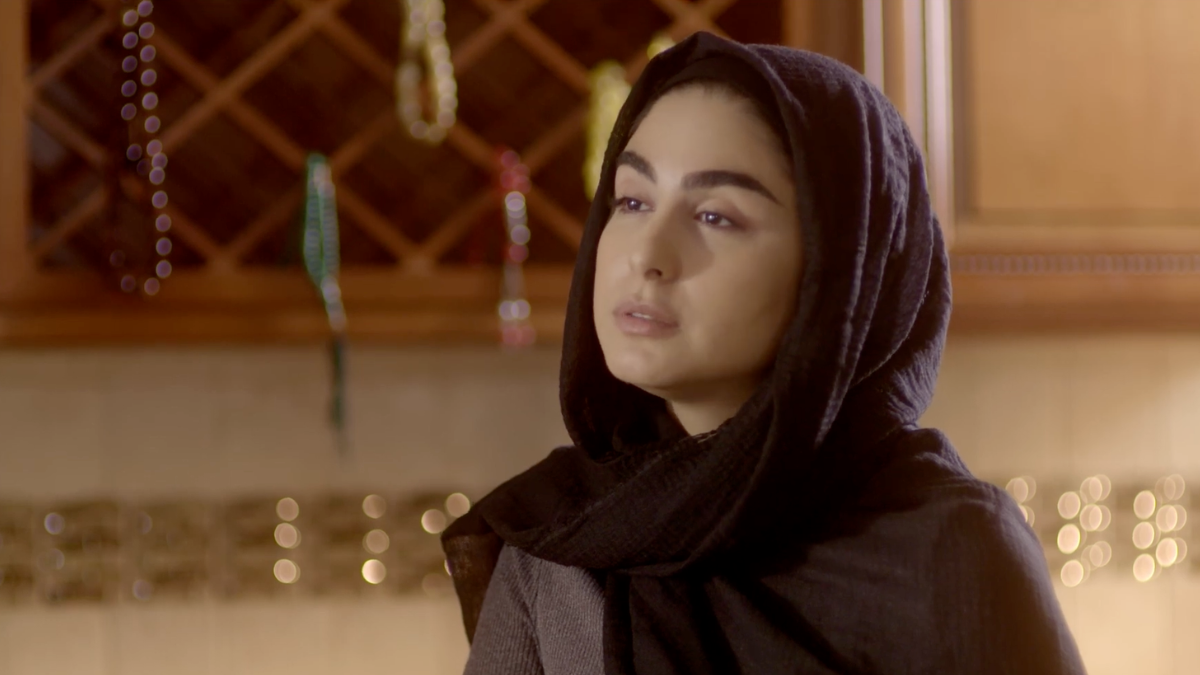
Weam Namou is a prolific author, acclaimed filmmaker, and spiritual teacher. A Chaldean Christian who escaped persecution in Iraq when her family fled the country when she was just nine years old, she has found safety and success in the United States. But now she worries that the same kind of persecution she faced in the Middle East is beginning to manifest in the country where she sought refuge. For Namou, this isn’t an abstract fear. In Iraq, she and her family “were considered second-class citizens” because they were Christians in a Muslim country. ISIS “totally destroyed” the town her parents and grandparents once called home in 2014. Iraq’s population of Christians has plummeted to nearly a tenth of its former size in roughly two decades, Namou said, from more than 1.5 million to less than 150,000. Canceled for Presenting the Hijab as Optional? While she’s long been aware of what her family suffered in Iraq, Namou traces her increased awareness of the danger in the U.S. back to a troubling experience she had when working on her feature film, Pomegranate, an adaptation of her book by the same title. The film tells the story of a young Muslim woman in the U.S. who wrestles with whether or not to continue wearing the hijab. Namou told The Federalist the film is “really about choice and respect for the people that want to” wear the garment, not denigrating women who choose to wear the hijab or those who opt not to. The film has garnered more than 50 international awards and has been screened in 25 countries. But not all feedback on the movie or book has been positive. None of the awards are from the “Muslim or Arab world,” Namou told The Federalist. She also described a more direct experience with negative reactions. The Interfaith Leadership Council of Metropolitan Detroit initially reached out to her and asked her to participate in an event and talk about her book and film, Namou said. The organization then said a discussion with a Muslim counterpart would be better, but when Namou selected a male from a list of potential interlocutors, she was told a man and a woman having a debate would be problematic. After further back and forth, the council ultimately told Namou it was canceling the event “because of all the tension that was created in the Muslim community due to the story line in the book about the Muslim woman removing her hijab at the end of the book.” ‘Shocked’ “I was shocked,” Namou told The Federalist, “because … up until that point, I really, based on my relationships with the Muslim community, who I supported and they in a way supported me … We worked together.” The Muslims in the film are played by Muslim actors and actresses, Namou said, and the Christians are played by Christian actors and actresses, and the former were also surprised by the negative response. “When this cancellation happened, I think it was a month before we started filming. And I didn’t want to discourage the women who were so happy to be part of the film. And I think I told them, maybe like in the end or after, and they were shocked.” I come from a very loving place and just [say] truthful things, and sometimes some people might disagree, but I’m not like aggressive about anything. And I grew up with Muslims. I mean, I was born in Baghdad, and my best friend was Muslim. The people in the film are Muslim. We work together like family. I consider them family, and they love being part of this project. Namou said she faced a similar rejection by the Arab American National Museum, with whom she had maintained “a cordial relationship” over the years. When Namou contacted the museum to discuss a possible showing of Pomegranate, the museum made it sound like a genuine possibility. But after a discussion of open dates and a potential showing of the film, she was told that dates previously described as open actually weren’t open. (Neither Interfaith Leadership Council of Metropolitan Detroit nor the Arab American National Museum responded to a request for comment.) “Then I realized this is really serious. … There is an ideology that we thought … we’ve kind of gotten past.” But that wasn’t the case. ‘Disowned or Abused’ For Namou, the experience was eye-opening, allowing her to see concerning trends she hadn’t picked up on in the past. She described a “major shift” among Muslims in the United States that go back five years or more and accelerated after Hamas’ Oct. 7 terror attacks on Israel. She pointed to “an ideology that has been injected into academia” and other institutions, taking “advantage” of the West’s openness and naivete. “There were stories that I had witnessed that I underestimated, because I still believed that — I thought that they were isolated, but then I realized, you know what, I don’t need stories that are isolated.” Namou then discussed the persecution that Muslim women face for not wearing hijab or violating other sharia-based Islamic rules. She told The Federalist she knows of at least four women who faced persecution because they chose not to wear the hijab. “There’s no way there’s any Middle Easterner living in the West that does not know of a woman who is disowned or abused for deciding to remove the hijab.” Namou also related an experience she had translating for a Muslim woman who was admitted to the hospital with a broken spine. Her family members kept changing the story of how her spine was injured. “The entire thing was a lie. She obviously had done something, crossed the line somehow — and you know, passing the line is like, oh, talking to a guy, thinking about removing the hijab, whatever it is — and everybody was covering for everybody.” “These stories, we know about them, but suddenly, after the cancellation, they were magnified. So then I felt worse, thinking, like, these are just the stories that are coming to men as I’m going about my day. They’re not even stories where I’m living amongst this.” Namou has also written about the experiences of a young Muslim woman who converted to Christianity after seeing Jesus and Mary in a dream. Her mother and brother “beat her with steel wires and locked her in her room” before she ultimately escaped Iraq and found safety in Lebanon and then Italy. Namou, who has numerous contacts among Arabs and Muslims in the U.S., has also heard rumors of honor killings passed off as suicides. Such killings have been documented in Iraq and other Muslim-majority countries, where the murders for violations of sharia are, in some cases, given a free pass by local governments and victims are buried in unmarked graves. That behavior is coming from certain countries, and it’s coming … as a result of what’s written and and the book that teaches this. And if you’re a good person, you’re naturally not going to be attracted to the passages about, well, kill the infidels and do this and this to women. You’re going to ignore that and focus on the more of the poetic verses. And when you’re trying to compare that to Christianity … there’s nowhere that Jesus said that. And I think part of the problem with Christianity is … Jesus also taught discernment, but there’s more focus … [on] you “turn the other cheek,” and that has not worked so well in the Middle East, because the Middle East and North Africa were once … Christian countries. ‘It’s Not Cute’ Namou is determined to keep speaking out, regardless of cancellations or backlash. At the end of a 2023 presentation on genocide in Iraq, Namou pressed UNESCO Chair for Genocide Prevention Studies Dr. Salah al Jabari on why “he did not bring up the word Christian.” The speaker “just kind of blew it off,” Namou said. When a Dearborn, Michigan-based group released a study on depictions of Muslims in film, Namou found it ironic that her positive portrayal of Muslims in Pomengranate was completely overlooked. “I just took the name of every single researcher, and emailed them, and said, ‘You need to look at yourselves. You guys canceled the book talk; none of the Arab world has embraced a film that was made by Christians and Muslims of that background, while others have embraced it.’ … The only group that won’t even look at it is the group that it represents.” When asked about the rise of Sen.-elect Abdul El-Sayed and his Muslim Brotherhood ties, Namou said, “Of course, it’s very concerning.” Namou completely disagreed with El-Sayed’s equating sharia law with canon law, and pointed out how the soon-to-be senator has been evasive and equviocal in answering questions about his connections to the Islamic group. Saddam Hussein, “knowing the danger of the Muslim Brotherhood,” barred it from the country, Namou said. But she recounted witnessing the influence of the Muslim Brotherhood in Jordan pushing restrictive dress codes and reflected on how the same kind of Islamic ideology led to the collapse of women’s rights in Afghanistan after the U.S. withdrawal. Namou also pointed out the absurdity of female politicians who have donned the hijab like “they’re playing house.” New York Gov. Kathy Hochul, Sen. Kirsten Gillibrand, D-N.Y., Rep. Alexandria Ocasio-Cortez, D-N.Y., and now-Sen.-elect. Peggy Flannagan, D-Minn., are prominent examples of women who have engaged in this type of behavior. “The women, they always fall target to this ideology,” Namou said. “This is … a serious issue. It’s not cute. It’s not cute for you to be doing that. You, in your position, must be aware of the abuses that take place when women try not to put that on. And then you … just give a speech in front of all men because the women can’t be in the same room with them — how do you have the heart to do something like that?” Namou said. “We need you to understand we need your voice for the opposite. … You’re insulting all of the women, and you’re insulting yourself in front of all these men that were able to manipulate you into doing that.” Joshua Monnington is an assistant editor at The Federalist. He was previously an editor at Regnery Publishing and is a graduate of Midwestern Baptist Theological Seminary. Abdul El-SayedabuseBooksChristianityfilmsHamasHijabIraqIslamIslamificationMoviesMuslimsOct. 7persecutionShariaterrorismWeam Namou
‘Major Shift’: Christian Filmmaker Who Fled Persecution In Iraq Warns Of Rising Islamification In U.S.
Full Article
Original Source
Read the full article at Thefederalist →KhanList aggregates and links to publicly available news content. We do not host full articles from third-party sources. Always verify important information with original sources.