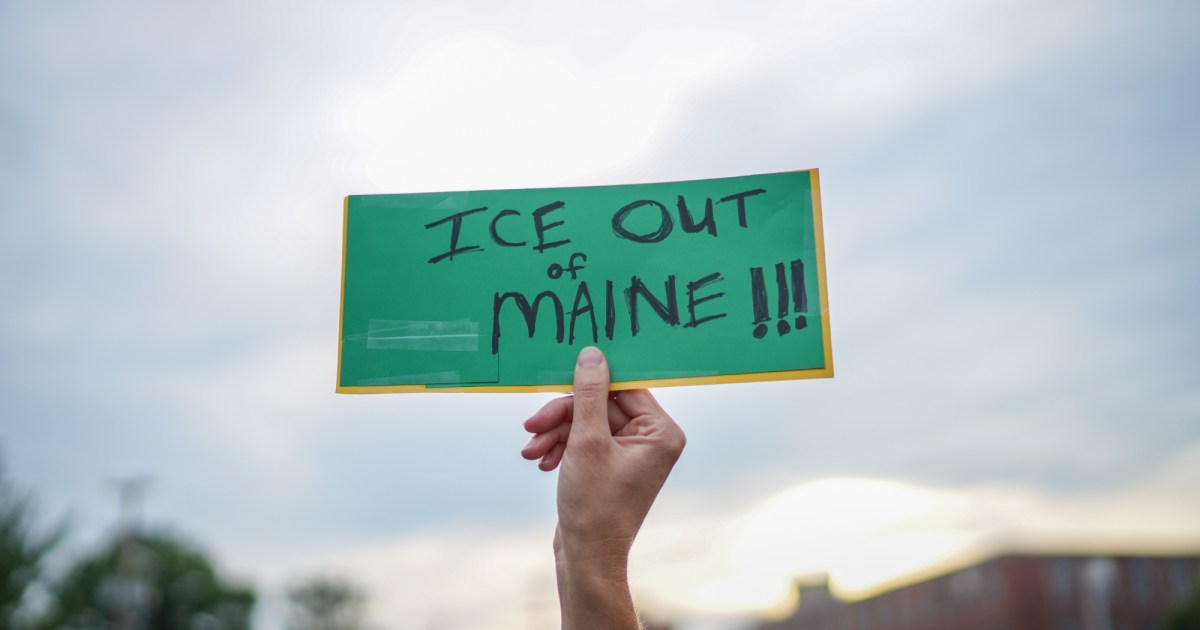
A protester holds a placard during a vigil for Johan Sebastián Durán Guerrero, who was killed by an ICE agent on July 13, 2026 in Biddeford, Maine. Ryan Murphy/Getty Get your news from a source that’s not owned and controlled by oligarchs. Sign up for the free Mother Jones Daily. A suite of new laws restricting cooperation between Maine law enforcement and Department of Homeland Security agents is set to take effect today, less than three weeks after an ICE agent shot and killed 25-year-old Johan Sebastián Durán Guerrero in Biddeford, Maine. These “ICE Out laws,” as they’re collectively known, will limit collaboration between state and local police and federal agents, and forbid landlords, hospitals, and schools from sharing personal information with ICE. “What we saw in Biddeford was not an aberration,” said Zach Heiden of the ACLU of Maine at a press conference Tuesday. “It was the result of intentional changes at ICE that have unleashed thousands of masked and menacing agents on communities across the country.” The new laws, Heiden explained, are meant to reshape the relationship between those agents and local institutions such as elementary schools, libraries and the DMV. “These new laws will affect hundreds of entities, including 253 school districts, 107 police departments, and 17 housing authorities,” Heiden said. Since the start of Donald Trump’s second term, a dozen states have passed similar laws. These are outgrowths of the “sanctuary city” and “sanctuary state” laws of the first Trump term, which generally limited local police partnerships with ICE. Those policies, according to a landmark Stanford study released in 2020, did effectively reduce deportations—and, contradicting right-wing narratives about immigration, did not lead to an increase in crime rates. But laws like Maine’s go further, extending these non-cooperation agreements beyond police. “That includes not just police departments and sheriff’s offices, but also state agencies responsible for enforcing labor law, environmental law, housing law, or any other state or local law,” said Michael Kebede of the ACLU of Maine at Tuesday’s press conference. The goal is to “make sure local resources are not used to support the deportation machine.” Data from the Migration Policy Institute shows that the number of state-level laws relating to immigration surged in the first year of Trump’s second term. A total of 106 immigration-related laws were enacted in 2024—which more than doubled to 213 in 2025. Meanwhile, tracking by the National Immigration Law Center indicates that at least 12 states have passed laws this year restricting ICE’s operations within their borders. But at least eight states have passed laws mandating local agency cooperation with ICE, instead. These states now require participation in 287(g) deputization programs, and some have outlawed local sanctuary policies. Maine advocates hope that new “ICE Out” policies—signed into law months before Johan Sebastián Durán Guerrero’s death, but only now coming into effect weeks after he was killed—will help prevent further violence. “Every day, we hear from families who are afraid to participate in ordinary life, workers who are afraid to speak up, parents who are afraid to take their children outside, send them to school, or seek medical care,” said Ruben Torres of the Maine Immigrant Rights Coalition. “We see businesses lose employees, communities lose opportunities, and all of us lose something when fear becomes a part of everyday life.” Because ICE is a federal agency, Maine cannot fully bar it from operating in the state—but there are some things states can do to restrict the agency’s movement. ICE Out laws, Torres said, “offer a different path.”
Maine Just Told ICE to Get Out
Full Article
Original Source
Read the full article at Motherjones →KhanList aggregates and links to publicly available news content. We do not host full articles from third-party sources. Always verify important information with original sources.