
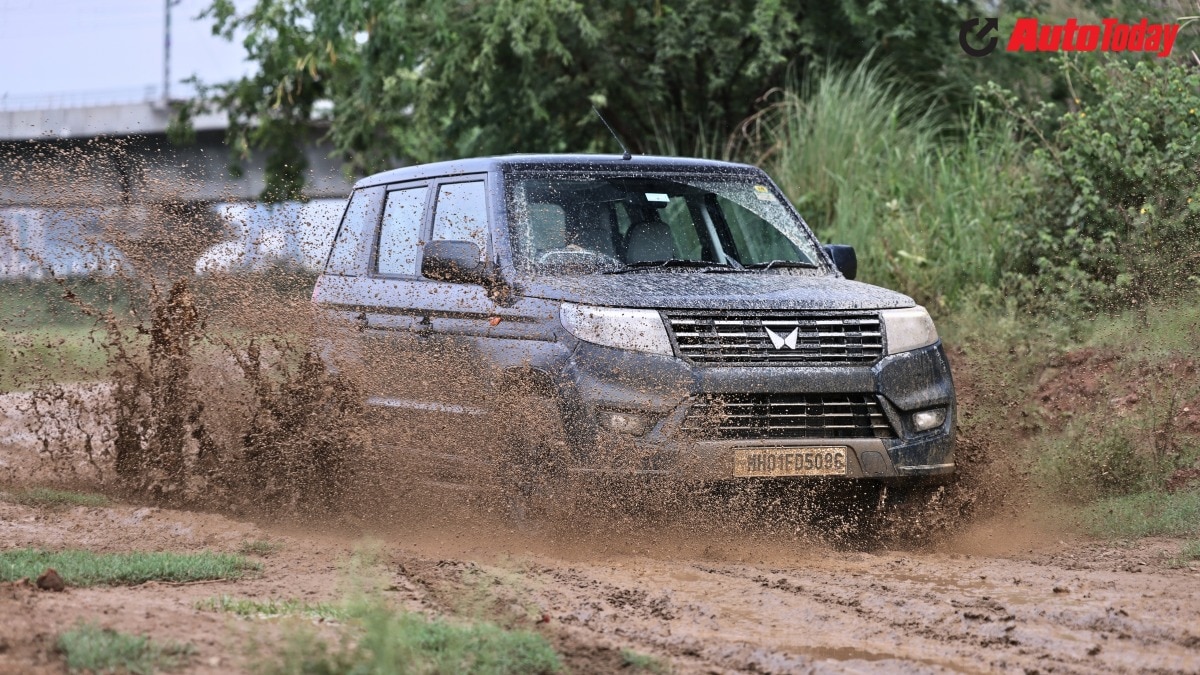
Mahindra has spent over two decades earning the trust of buyers who value durability over design trends and capability over creature comforts with the Bolero nameplate. When the Bolero Neo first arrived over five years ago, it was meant to carry that legacy forward, although with a slightly different brief. Based on the old TUV300, it aimed to bring a more civil driving experience without distancing itself from the rugged DNA that made the Bolero a household name. In an era where almost every SUV has become another crossover with chunky styling and front-wheel-drive underpinnings, the Bolero Neo continues to stick to its guns. It remains one of the few affordable ladder-frame SUVs on sale in India, which makes it a unique proposition. Last year, Mahindra updated the Bolero Neo with horizontal grille slats, chrome air dam inserts and a silver-finished front skid plate. The changes made last year were subtle, and that felt entirely appropriate. Up front, the vertical slats gave way to a statelier horizontal pattern. The air dam got chrome inserts, and the front skid plate had a silver finish. Around the side, there wasn’t much to speak about apart from the 16-inch blacked-out alloy wheels, an upgrade from the 15-inch ones earlier. The only notable side update was the shift from 15-inch to 16-inch blacked-out alloy wheels. Lower spec variants still get the silver-finished 15-inchers. There’s a dual-tone finish to the paint job, and this ‘Jeans Blue’ colour fits nicely with the top-of-the-line N11 variant. The upright stance, squared-off proportions and commanding driving position remain exactly as they should. At the rear, it remained exactly as it did earlier. The rear gets side-facing jump seats. Step inside, and the cabin benefits from meaningful improvements in perceived quality. There’s leatherette upholstery, and the dual-tone colour scheme was inverted. The Bolero Neo’s cabin gets leatherette upholstery, an inverted dual-tone colour scheme and improved perceived quality. There’s also a larger 9-inch touchscreen infotainment system, and the central AC vents have a black finish. Last but not least, there’s a rear-view camera and USB-C charging port up front. The Bolero Neo also gets a larger 9-inch touchscreen, while the central AC vents now feature a black finish. Underneath the refreshed appearance is the same ladder-frame chassis, rear-wheel-drive layout and ‘Multi-Terrain Technology’ with a mechanical locking differential, reserved for the N10 (O) variant, which is the most expensive variant on sale at 10.79 lakh (ex-showroom), and is almost Rs 50,000 more expensive than the N11. The front suspension now features Frequency Dependent Damping (FDD), improving ride comfort. Spend a few kilometres behind the wheel, and it becomes obvious why the Bolero Neo deserves to be judged differently from the growing list of monocoque SUVs. Its character comes from its construction. The body sits on a ladder-frame chassis, the rear wheels handle propulsion, and the suspension has been tuned to absorb punishment rather than chase cornering speeds. Speaking of which, Mahindra has also added FDD or ‘Frequency Dependent Damping’ to the front suspension, which has greatly aided ride quality. This is the same technology employed on the Scorpio-N. The familiar 1.5-litre mHawk diesel produces 100bhp and 260Nm, paired with a five-speed manual gearbox. Power comes from Mahindra’s familiar 1.5-litre, three-cylinder, mHawk diesel engine producing 100bhp and 260Nm, paired with a five-speed manual gearbox. On paper, those numbers don’t stand out, although they rarely tell the full story. The engine delivers its torque cleanly and predictably, making relaxed progress easy in both city traffic and on open roads. There’s a great surge in the mid-range between 60kmph and 80kmph, which comes in handy during overtakes. The gearbox isn’t especially slick, but the shifts suit the vehicle’s easy-going nature. Fuel efficiency-wise, the Bolero Neo returned an indicated 15-16kmph in the city, which is really good. The engine delivers power smoothly and consistently, making driving effortless in city traffic as well as on open highways. However, where the Neo shines is its ride quality over broken roads. Large potholes, uneven village tracks and scarred highways barely unsettle the suspension. There is an underlying robustness that many softer crossovers simply cannot replicate. The steering is light enough at urban speeds, and visibility is excellent, making it surprisingly manageable despite its upright dimensions. The seating position provides a commanding view of the road, reinforcing that traditional SUV feel. The flip side of the light steering is the overall dullness and lack of feel, which doesn’t work when taking corners at higher speeds. Body roll is naturally present, and enthusiastic cornering isn’t part of its repertoire. Push harder, and the ladder-frame construction makes itself known, although expecting quick responses would miss the point entirely. Even without MTT, the Bolero Neo feels capable off-road and can get itself out of most tricky situations, and can be a boatload of fun too. I also loved the fact that there is very little pretence here. Every control, every movement and every response feels honest. Of course, the Bolero Neo certainly isn’t perfect. The diesel engine can sound coarse under hard acceleration, highway refinement trails more premium rivals, and the cabin cannot match newer monocoque SUVs for outright sophistication. Those compromises are easy to identify, although they are also easy to understand once you recognise the Neo’s priorities. It remains a proper utility SUV that has learned a few modern manners without forgetting its origin.Verdict The Bolero Neo retains its rugged, dependable character while gaining comfort and usability. It may lack refinement and features, but its toughness remains its biggest strength. The Bolero Neo succeeds because it refuses to follow the crowd. While many rivals wear SUV clothing over crossover foundations, this Mahindra continues to deliver the qualities that originally defined the segment. It feels tough, dependable and remarkably capable once the tarmac begins to fall apart. The updated iteration improves comfort and usability without diluting that identity. It isn’t the most refined, the quickest or the most feature-packed SUV in its price bracket. That’s not the point. Its greatest strength is its honesty, and in today’s market, that may be its biggest advantage.Subscribe to Auto Today Magazine - Ends
Mahindra Bolero Neo review, first drive: Old school, still cool
Full Article
Original Source
Read the full article at Indiatoday →KhanList aggregates and links to publicly available news content. We do not host full articles from third-party sources. Always verify important information with original sources.