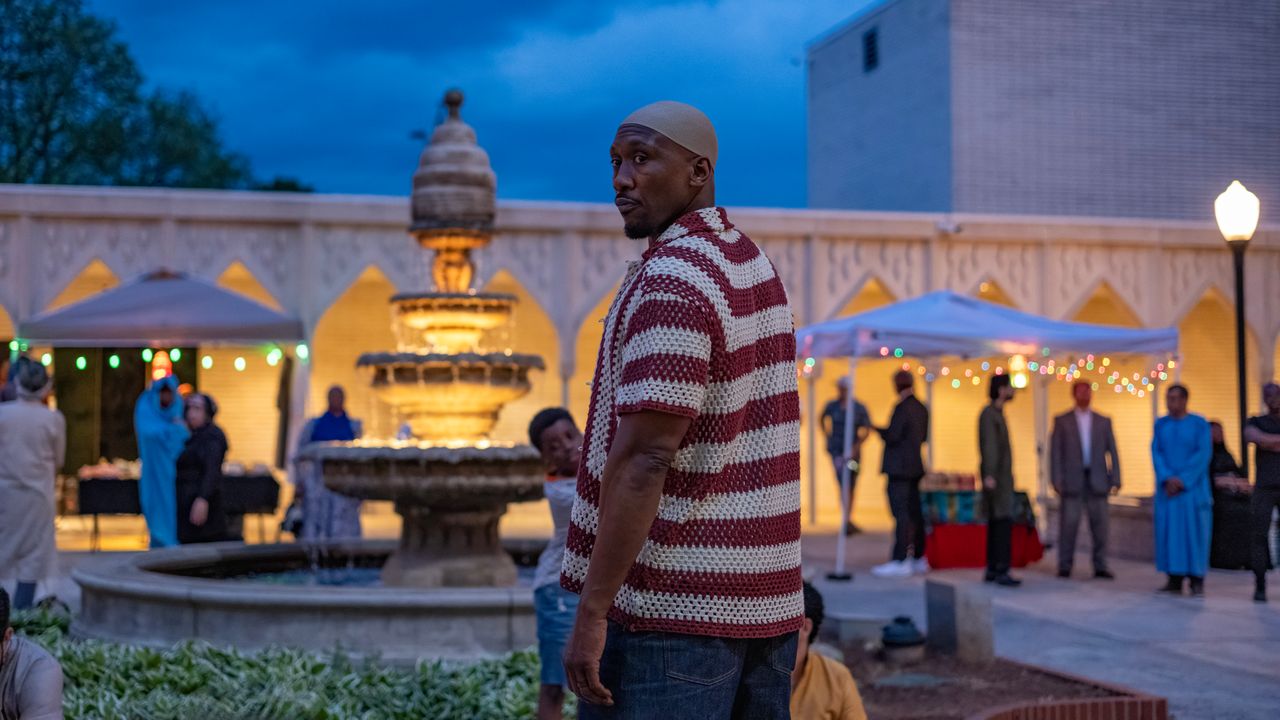
Mahershala Ali Makes His Own Hero Moment in Your Mother Your Mother Your MotherThe two-time Oscar winner “moved on” from a long-awaited Marvel role—and re-teamed with writer/director Bassam Tariq for an original, “uniquely deep” action project instead.Jaclyn Martinez/Courtesy of AmazonIt’s been seven years since Mahershala Ali walked out at the end of a Marvel panel at Comic Con to reveal blockbuster news that seemed both shocking and like a slam dunk: he was going to be the MCU’s Blade. The announcement was met with rapturous applause in the room and universal praise online (including one writer—OK, it was me—who simply tweeted, “HOLY F—.”) Almost a decade later, Ali made a brief, voice-only cameo in the post-credit scene for the MCU’s Eternals— and that was it.At this point, Ali has officially moved on. “If they wanted to do it, we would've done it,” he tells GQ of Marvel’s failure to launch his Blade movie. (Marvel’s Kevin Feige has blamed the delay on a script that never came together, while admitting that he felt like “a gigantic loser and a failure” after the project foundered.) But in the course of his long, ultimately unsuccessful journey to bring the vampire hunter back to the big screen, Ali acquired the necessary skills—and connected with the perfect director—to make a film he says might be the most rewarding work of his career, which is quite the bold statement from a two-time Oscar winner.After making his narrative feature debut with 2020’s Mogul Mowgli, Bassam Tariq was hired to direct Ali in the reboot of Blade, whose pre-MCU incarnation starred Wesley Snipes as the titular vampire hunter. But, in Sept. 2022, with production supposed to be just months away, Tariq departed the project, before a near-tragedy in his own life inspired him to write Your Mother Your Mother Your Mother. The filmmaker always envisioned a reunion with Ali, who eagerly signed on to Bassim’s new project as Latif, a devout Muslim who works as a hitman in Houston. His world and beliefs are shaken when his wife suddenly dies, leaving him to care for his newborn and two other children.“I didn't feel great about the fact that things finished the way that they did [with Blade]; I like seeing things through,” Ali says, adding that he “couldn’t say no” after reading Tariq’s script: “I was really attracted to the challenge of playing a character that felt so stretched, but also the intimacy of his situation and the potential care he would take in executing his mission. All TV and films are hard, and I just want it to be difficult for the right reasons, and it felt like this was going to be that. I'm so grateful that we were able to see this through and find what I believe is the right thing together.”As dramatic as the stakes are for Latif in Your Mother, he also has to kick plenty of ass. In the midst of his search for breast milk for his baby, Latif is pulled into a political and religious war, putting him on the wrong side of the dangerous and colorful Pastor Hwan Yoon (John Cho), a former soldier who has founded the radical Church of Divine Fire.Jaclyn Martinez/Courtesy of Amazon“Even with the teaser, Mahershala and I were like, ‘How do we explain what this movie is?’” Tariq explains. “Something that I realized was so central to this film is this concept of mercy. Cinematically, it's not as sexy as justice, retribution, and vengeance, but, to me, mercy is the thread that we hang on. And what's mercy if it's not being forgiven or getting a pass when you don't deserve it? I was always curious, and I’d never seen an action film that dealt with it.”The aforementioned teaser—which smartly included Ali holding a sword—generated a “fresh and new” level of excitement that the actor admits to having never experienced before. Below, Ali and Tariq fully peel back the curtain on Your Mother Your Mother Your Mother, while Ali also explains why he’s done talking about Blade.GQ: There seems to be a real buzz for the film after the teaser. And including the shot of you pulling out the sword was some genius-level marketing—it plays to the people who’ve been waiting forever to see you as Blade.Mahershala Ali: I would agree with you, and I’m glad we were able to satisfy that and kind of move on. I'm looking forward to what this film is able to do from the standpoint of incorporating action elements that you’d expect in a big-budget superhero piece, but we did that in a real mom-and-pop, couple bag of nickels way. And I actually love that we were limited. We got to lean into action when it was appropriate, and the story gets to go to an almost magical realism place, which you can do with these superhero stories. But this story presents an opportunity to be uniquely deep. The breadth of what Bassam was able to achieve, there's so much there to tackle, and I don't think we could have done that in a big-budget studio film. So if it's a this or that type of thing, personally, for me, I would take this. It was a really fulfilling experience.What was the early collaboration like on Blade where you clearly realized that, no matter what happened with that film, you were going to work together?Bassam Tariq: I didn’t even tell Mahershala this until recently, but, in the earliest drafts of this, I didn't even have a name for the character — I just wrote “Mahershala.” Because I've been imagining, how do you carry dignity and grief, and have grace under fire? It's a tough thing. Some actors are incredible thespians, but when they move or run, they can't nail it. Mahershala is an athlete, and I saw the way he uses a sword on Blade. The first time he was doing sword practice on Blade, the stuff coming back was incredible. Then, here, it was exceptional to see the way Mahershala rose to that occasion; he was able to anchor it all.Part of the anticipation for Your Mother is that people are just pumped to see Mahershala leading a movie. After the success you had with Moonlight and Green Book, I’m sure you were flooded with opportunities, but you seem to have really picked your spots and not just working to work. How do you decide which projects are worth your time?Ali: I've always tried to make choices that I felt like I could stand by. Sometimes you just have to take a job, and I’ve had those moments. When we have success, I think we imagine that the seas part and everything is just thrown at your feet — and that can definitely happen. But I still feel that there has to be a real consciousness around what you say yes to, because then you could be busy just to be busy and lose the specificity in your work and the resonance that has made you worthy of getting those opportunities. And, to be honest with you, some of how quiet I've been is not really of my own choosing.Bassam, once Blade didn’t pan out, how did you arrive on this idea?Tariq: I started writing this during COVID. After my wife gave birth to our first child, she went into the ICU; she had an infection, and we weren't sure if she was going to make it. My son was a week old, and he was only nursing and not taking any formula. I wasn't able to communicate with my wife at all, and I was running around New York City, with my son strapped to me, trying to find breast milk. I was calling up these women networks, sounding like a creep. It was really sad but also really funny, and I found that I liked the absurdity at those moments, and that was something I wanted to talk about. Thank God my wife's fine and he finally nursed with her. What was so crazy was, after she nursed him, on the way home, he was still agitated, and then when I finally took a deep breath and was calm, he calmed down. He just needed me to be me — not supermom. I was drawn to that idea of letting go of all these masks we put on and trying to be a parent.Bassam, your religion has been so ingrained in your work over the years. Mahershala, you don’t always have the chance to blend that into your performances, but you jumped at doing so on Ramy. It’s not often that Muslim characters are leading big Hollywood stories, especially in a genre like this. Did you put an extra responsibility on yourself because of that, or is that a dangerous mindset to carry?Tariq: We were constantly wrestling with the responsibility and how we really bring this to life. With Mahershala, I'm blessed that I had a Muslim brother with me on this. We also have very different experiences in the faith, and I think it’s so central to this that we had a shorthand right away. We shot this film with the Black Muslim community in Atlanta involved in so many capacities. The first woman that speaks in the movie washes bodies for a living at the mosque, so she came in to teach us how to do this, and I was like, "You're in the film.” Sometimes one person thinks they can speak for the community, and I don't ever want to be that person.Jaclyn Martinez/Courtesy of AmazonAny time something starts to feel like a representation thing, it feels like propaganda to me, or I just roll my eyes like, “Oh, great, this film gets a pass because it's the ‘minority movie’ and the diversity thing that has to be done.” What’s interesting about the strange place we’re at in this country right now is that people aren't giving anything a pass. I like that a film really has to be able to stand on its own two feet, and our communities are pushing us to be better.Ali: For me, all of my characters are spirits having a physical experience and struggling with their faith. One of the first things I ask myself is, “Where is that person at with God? Do they believe or not?” And wherever they are on that scale is part of where I start from. Considering that I am Muslim, I did feel an added responsibility in trying to take care of certain elements around Islam and making sure that we navigate that space as responsibly as possible, and what gave me comfort was being able to do that with Bassam.Mahershala talked about not having the same resources as a big-budget superhero film. I don’t know if this is why, but you really pick your spots with the action in this film—it’s not just fight scene after fight scene. What was your mindset in terms of how you wanted to deploy the action sequences?Tariq: The story is so central to any of our fights. Audiences have gotten so smart, and that's why the box office is showing that people are not as excited with these superhero movies, because we kind of know what's going to happen. So instead of just spending time working on epic fight scenes, how do you build tension? How do you escalate? How do you make the stakes matter? We had to be smart with our time. When our stunt coordinator visualized the stunt, we’d go over it with Mahershala, and he’d study this stuff and break it down and ask really smart questions. “Why am I doing that? Why does this character do this?” It needs to feel like him, be in the language of Latif, and not just be a cool for a cool kick’s purpose.Mahershala, in my mind, it feels like you’ve done a bunch of action films, and then looking at your filmography, that’s not the case.Ali: It really felt like my first action film. Jurassic World Rebirth is more of an adventure thing, and, in other films I've been in that have action sequences, I've died as the action starts, like Predators and Hunger Games. [Laughs.] So I've been wanting to do a grounded action piece for years. As a former athlete, I've dreamed of doing my own stunts. I was very excited to do stunts in Blade and trained for a long time for that, so it was a huge relief to get to put that work to use.We have to talk about John Cho. For the most part, he’s been known as a comedic actor, but he’s shown in recent years that he has another side to him, like in Columbus. And yet, I wasn’t ready for what he does here. On the surface, he feels like such an out of the box selection, so what was it about John that you saw in this role, and then what was it like letting him loose?Ali: That dude, my god. His real first day was his hardest stuff—a big song number, marching up the stairs, challenging me—and if we’d had the camera moves worked out, we could have kept his first take. He was a little apprehensive about the teeth and the jacket and how big it all was, but, once he said yes to it, you would think he came up with all of it. He owned it in such a way that you’d never guess that there was any resistance to that earlier on.Tariq: I just knew him for his comedy, but we had a few conversations about the character before it all came together, and he is so intelligent. He's able to be analytical and then just switch that part off and be present. The three of us built all this stuff together. The first rehearsal we did during prep, it was actually Ramadan, so Mahershala and I were fasting, and we were still figuring out what John’s character was going to be like. In rehearsal, John was pushing and asking really difficult questions, and then he made it his.Courtesy of Amazon MGM StudiosHis grill was inspired by a Vietnamese jeweler in Houston. I said to John, “I was going to cast either a Vietnamese or Korean man, because I wanted it to be a colonized Asian, someone who’s got this inferiority complex built into their system of being, where you feel like you're always taken over by the whites.” So then what you do is you end up taking on affectations of other cultures, and something that happens a lot in Houston—particularly Asian communities—is we take on Black affectations.John’s father used to be a pastor of a church in Houston, so he knew what these songs should sound like, and he helped us write the salvation song. Because he has an incredible singing voice, there was a version where we went, "No, the singing is too good,” so he went back into the recording.There are always challenges to working with young actors, but, with having a baby this heavily involved, how restricted were you at times?Ali: We were working with a set of twins, and it was such a gift. It was also definitely difficult. It didn't allow me to think about things that I would normally get to work through or focus on. I just had to be present with the baby, and so the dialogue was almost secondary in a way in which it probably should be. We were limited at times. There's a scene with Tramell, and the baby was having a difficult day, and for some reason, we only had access to one of them, so we were having trouble getting what we needed. We had a doll that was a huge help and allowed us to shoot well into the night and do things that would’ve otherwise been dangerous, like running with the baby in areas that clearly weren’t safe to be running in. As challenging as you would imagine it would be, yeah, it was, but the only way you could do it is to work with that child, because, in the end, the baby actually just gives so much life to the story and the stakes. It was a beautiful struggle.Jaclyn Martinez/Courtesy of AmazonWe’ve mentioned Your Mother’s connection to Blade throughout our chat, and Marvel boss Kevin Feige recently made headlines by declaring that he feels like a “failure” for not getting your film off the ground. Mahershala, are we any closer to Blade finally becoming a reality?Ali: Not with me. The best way I can answer this question is, when I look at what is for me, is it was either this or that—and I'll take this. No offense to them. I've been doing this professionally for pushing 30 years now, and one thing I've learned is that what is for you is for you and what is not is not. For whatever reason, that project is not for me. If they wanted to do it, we would've done it. So I have to move on, and I have moved on. Your Mother Your Mother Your Mother feels very much in alignment with the type of work I want to be known for. I don't really want to be known for remakes. I’d love to do original work that resonates with people and impacts them in unique ways.So, I'm good. [Laughs.] Again, you had me under contract, they have billions of dollars, if they wanted to do the movie, we would've done the movie. So we're not doing the movie. When I look at this and Blade, I couldn't have done both, and the reason this even exists is because that project fell apart and Bassam had the time, space, energy, and focus to go and write this and then re-approach me. And I was able to use those skills that I had been working on for over a year training for Blade. In that way, I feel creatively redeemed on some level, just in my own journey between me, myself, and I. But I feel ready to move on from the Blade questions. Those questions are for them. They didn't want to do it, so they should answer that question.Derek Lawrence is a pop culture writer who has been covering film and TV for over a decade. His work has appeared in GQ, Vanity Fair, Vulture and Entertainment Weekly. He’s also the author of the upcoming book A Quarter-Mile at a Time: The Oral History of the Fast & Furious Franchise. ... Read More
Mahershala Ali on ‘Your Mother Your Mother Your Mother’ and Why He's Done Talking About ‘Blade’
Full Article
Original Source
Read the full article at Gq →KhanList aggregates and links to publicly available news content. We do not host full articles from third-party sources. Always verify important information with original sources.