
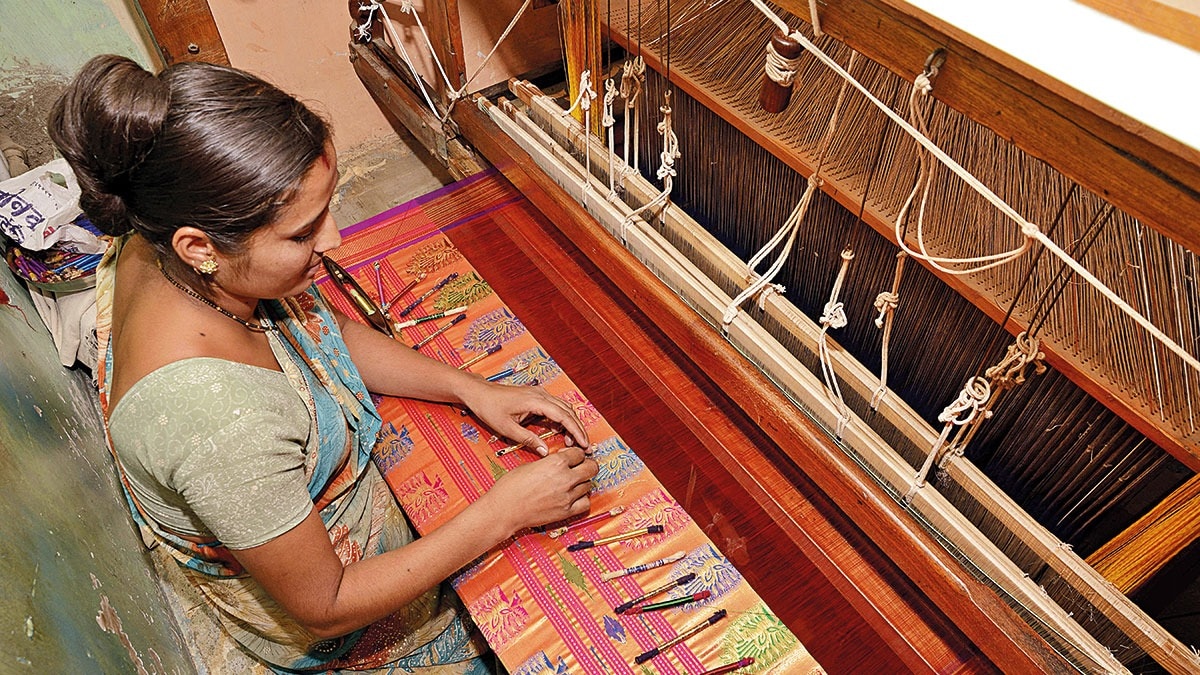
The barcode will embed details about the fabric, threads, production time and even the weaver's name to assure buyers ?he sari is an original PaithaniThe Maharashtra government, in a relief to traditional weavers and consumers, is planning to launch a barcoding system for the famed Paithani sari to prevent imitators from cheating buyers.Paithani saris are handwoven and have intricate motifs and zari work using gold and silver metallic threads. Paithan taluka in Chhatrapati Sambhajinagar (formerly Aurangabad) and Yeola taluka in Nashik district are known for production of these saris.The handloom, pure mulberry silk and zari product received its Geographical Indication (GI) tag in 2010. The product commands a premium in the market. However, weavers complain saris manufactured elsewhere and on powerlooms are often passed off as Paithanis. Semi-silk saris are also sold as the original Paithanis and imitation zari may be used instead of authentic threads. This results in buyers getting cheated, handloom weavers losing market and the product’s reputation being tarnished.“We are planning to introduce a barcoding system for authentic handloom Paithanis,” Sanjay Savkare, Maharashtra minister of textiles, told INDIA TODAY. The barcode will have embedded details about the fabric and threads used, the total number of days taken to weave it, and the name of the weaver. The details would be available on scanning the code. Savkare said software for the purpose had been prepared. The state’s department of textiles is planning to verify the authenticity of each Paithani sari and then allow the barcode to be affixed. The modalities are being worked out, said Savkare. Weavers will also be encouraged to weave a symbol or logo into their sari to make it stand out as original Paithani.Paithani saris are woven in multiple colours and characterised by borders of an oblique square design and a pallu with a peacock or parrot design. The back and face of the sari are similar as it is woven in the tapestry method. The zari used is on silk thread with twisted silver coated with gold. Sometimes cotton thread with twisted zari is also used. Motifs such as the traditional ‘Asawali’, geometrical-shaped flowers and shapes, may also be woven. Paithani stoles, napkins, bedsheets, pillow and cushion covers, purses, door screens, wall hangings, dress material, table cloth and jackets are also woven.The Paithanis trace their origin to the town of Paithan located around 60 km from Chhatrapati Sambhajinagar. Paithan, or Prathisthan as it was then known, was the capital of the Satavahana dynasty, which ruled from 2nd century BC to 2nd century CE.The Satavahana dynasty ruled over large swathes of Maharashtra. While author P.G. Sahasrabuddhe says it was founded by king Satavahana, other references claim the progenitor was Simuka or Shishuka. Their inscriptions are in the Maharashtri Prakrit language, a previous form of Marathi. In his ‘Maharashtra Sanskruti’, Sahasrabuddhe hails the Satavahanas as the first political dynasty from Maharashtra.Paithan used to export cotton and silk to the Roman empire from its ports during the Satavahana era, and this tradition of weaving continued into the Abhira, Vakataka, Rashtrakuta, Chalukya, Yadava, Maratha and Peshwa periods. In the late 17th century, Raghujibaba Patil, the founder of Yeola town, took along with him families of expert weavers from Paithan to Yeola. With this, Yeola too became renowned for its textiles.According to historian R.S. Morwanchikar’s ‘Prathisthan te Paithan’, the region was known for the production of cotton, and the weavers in Paithan had learnt the skill of weaving fine threads using this cotton. These threads were used to weave fine fabric clothing.Subscribe to India Today Magazine- EndsPublished By: Shyam BalasubramanianPublished On: Sep 7, 2026 18:50 IST
Maharashtra's famed Paithani sari set to weave in trust with barcodes
Full Article
Original Source
Read the full article at Indiatoday →KhanList aggregates and links to publicly available news content. We do not host full articles from third-party sources. Always verify important information with original sources.