
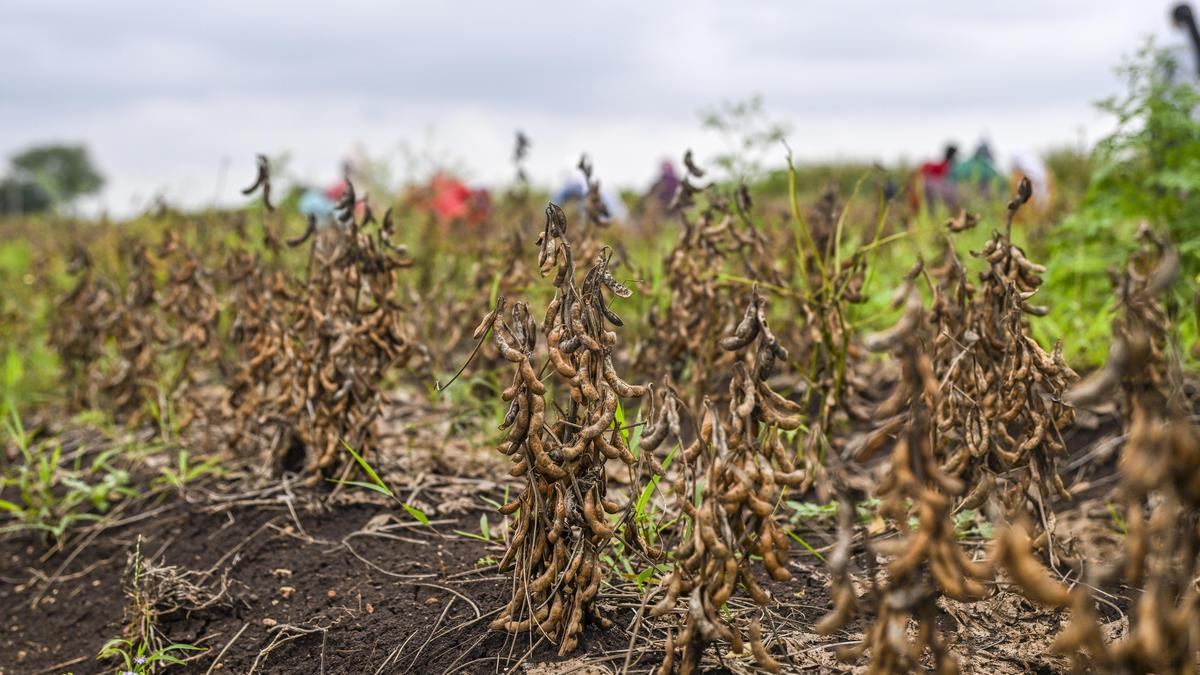
For Pramod Gaikwad (42), a soybean farmer from Dharashiv’s Chincholi village, waiting for rain is the only hope to ensure that his crops survive the long dry spell or use a rotavator, a tractor to churn the sown land and level the soil, making space for new crop. “The soybean plant flowered, but due to insufficient moisture, the germination was delayed, and saplings started drying up,” said Pramod, adding that his region received only one spell of rainfall towards the end of July, and since then it has been a dry spell. Pramod owns 10 acres of land and expects to make around ₹1 - 1.5 lakh in profit on Soybean yield this year. Like Pramod, Siddheshwar Mane (42) from Naichakur village in Dharashiv is facing a similar situation. Due to rainfall deficit and the diseases he had to face crop loss of soybean, urad daal (black gram) and harvested poor-quality moong dal. “Soybean suffered yellow mosaic virus (YMV), while urad’s leaves turned yellow and flowers never came,” Siddheshwar said. He sowed urad in one acre of land and had to bear loss around ₹80000/-. Districts like Dharashiv, Beed, and others have not received rainfall since July, affecting the crops, cattle, and daily water needs of farmers and labourers. According to state government data, the rainfall for the Chatrapati Sambhajinagar Division was recorded at 424.5 mm, while the normal rainfall expected was 613.1 mm for the period from June 1 to September 18, marking a deficit of 30.8%. Dharashiv and five other districts in Marathwada fall under the Chatrapati Sambhajinagar Division. The Pune and Nashik divisions also recorded around a 30% rain deficit, while the Amravati and Nagpur divisions recorded a 27% rain deficit. The Konkan division recorded a 6.3% rain deficit.Overall, the state recorded an 18.8% rainfall deficit, receiving actual rainfall of 755.9 mm from June to September 18, compared to its average of 932.3 mm, amid the El Niño phenomenon. At least six districts recorded a rainfall deficit of 40-50%, including Amravati, Solapur, Latur, and others.During the Kharif season, farmers in the State sow crops like soybean, cotton, millet, maize, tur, moong, and urad. Farmers in several districts have complained of crop failure due to lack of rainfall, and the incidence of pests and diseases has also increased to a large extent. On September 16, farmers in several districts, including Washim and Beed, demonstrated on the roads, demanding to announce drought and implement the relief programme for crop loss. Ravikant Tupkar, a farmers’ leader, has urged the government to announce drought and provide ₹1 lakh per hectare relief to farmers. Demand to declare Drought Chief Minister Devendra Fadnavis announced that after October 5, the crop-damage surveys (panchnamas) and ground verification will be conducted as per the norms of the National Disaster Response Fund (NDRF). Pramod and Siddheswar both echoed that there is no need for a punchnama, as the rainfall received by the State is recorded and the rain deficit is proof of the dry spell that has caused huge losses. “What punchnama will they do? This is a way of delaying the action. Under the norms of NDRF, at most they will stop school fees and provide meagre amounts that won’t even help farmers recover the investment they invested in the Kharif season,” Siddheshwar said.NCP- SP leader Sharad Pawar has written to Mr. Fadnavis urging him to provide relief of ₹50000 per hectare. Highlighting the Kharif season, Mr. Pawar said, “Vidarbha had sown 50,04,000 hectares of land in August 2025 — this year the area has reduced to 47,50,000 hectares. In the Marathwada region, 48,21,000 hectares of land were under crops last year — this year it has reduced to 46,19,000 hectares.”According to the information given by the Indian Meteorological Department last week, the impact of El Nino will be more intense, and its effects will be seen in the year 2027 as well, emphasised Mr. Pawar. 2016 Manual for Drought Management recommends declaring drought only in October — after the monsoon ends after assessing full-season rainfall figures and crop/reservoir data, allowing the central assessment team to visit before harvest. However, it also allows for earlier declaration if drought conditions are severe and evident. The Collectors need to notify the talukas/mandals/villages in each of the Talukas affected by drought.The four standard indicators for declaring drought are rainfall deficiency- June+July rainfall below 50% of average or June–September rainfall below 75% of average with visible vegetation loss; drought is indicated when Normalised Difference Vegetation Index (NDVI) deviates 0.4 or more below normal, and others. The crop-cutting experiment is used for crop loss assessment, and accordingly, relief is provided. The relief payout under current SDRF/NDRF norms is ₹8,500/hectare for rainfed land, ₹17,000/hectare for irrigated land, and perennial land, ₹22,500/hectareEffect on drinking water Marathwada and Vidarbha regions, which are currently most affected, have been water scarcity region as Marathwada features hard volcanic basalt and Vidarbha struggles with a similar basalt crust, where water percolation is naturally very poor. Given the geography of the region, the rainfall deficit has created a water crisis for people of these regions. Siddheshkar highlighted that his taluka Umarga is already facing drinking water issues. “Gram panchayat have already started brining in four tankers per day for drinking and other purposes,” he said. The population of his village is 6500 people. Commodity Market situationIndia’s 2026-27 soybean output forecast is 9.6 million tonnes, down 8% from the prior 10.4 million tonnes. Experts believe a revival is possible if it rains in October and November. “In Maharashtra, there will be a 30% drop in Soyabean, country wise 15-20% drop. With the dry spell, the volumes are projected to fall to 8.5 million tonnes. If it rains in October and November, then the later sowers will gain from it. The same is true for tur; late sowers will gain from the rain,” said Shrikant Kuvalekar, an Agri value-chain strategist. He also projected that any inflationary pressure from this Kharif season’s shortfall will start showing up from March onward, and how sharp it gets will also hinge on things outside agriculture entirely, like where crude oil settles.
Maharashtra drought: State records 18.8% rain deficit, 40-50% rain deficit across six districts
Full Article
Original Source
Read the full article at Thehindu →KhanList aggregates and links to publicly available news content. We do not host full articles from third-party sources. Always verify important information with original sources.