
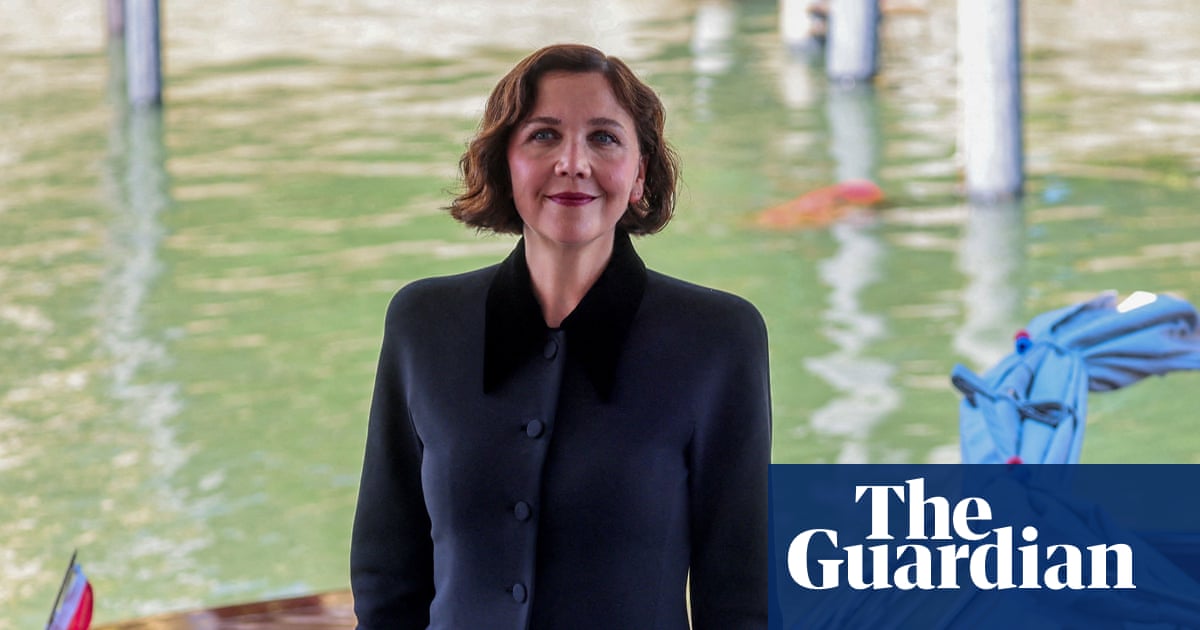
Maggie Gyllenhaal said there is a “systemic problem” that explains why only two female directors are in the running for the Golden Lion at the Venice film festival this year.“It’s harder for women to get films financed,” said the actor-director, who is heading up the jury of the world’s oldest cinema showcase this year.“Could it be possible that the things that women, having had a different experience of being alive in the world, want to make movies about are not always deemed high art?” added Gyllenhaal, whose directing debut The Lost Daughter won a best screenplay prize at Venice in 2021. “Who decides what’s good? Who decides what is valuable?”The artistic directors of the film festival have faced criticism since the original lineup revealed that that only one of the 20 contenders for the top prize was by a female film-maker, Danish-Egyptian director May el-Toukhy’s Woman Unknown.Since then, the festival has boosted the main competition with NAZA, a new documentary film directed by Yuval Abraham and Rachel Szor – two of the four directors behind Oscar-winning No Other Land. The film is produced by the Guardian.At the 83rd edition of the festival, Gyllenhaal heads a seven-member jury that also includes Kaouther Ben Hania, the Tunisian film-maker behind The Voice of Hind Rajab, Hong Kong’s Johnnie To, Afghan director Shahrbanoo Sadat, French film-maker Xavier Giannoli, British composer Daniel Blumberg and Italian film scholar Francesco Casetti.In the run-up to the festival, there had been some uncertainty whether the jury would speak to the press ahead of the festival opening at all, supposedly due to a “scheduling conflict”.A lineup unusually packed with films touching politically sensitive issues – from Israel/Palestine and Russia/Ukraine to a feature film about Rupert Murdoch and a documentary about Elon Musk – meant that the jury members may also have felt nervous about facing the media on the opening day.At the jury press conference at this year’s Berlin film festival, jury president Wim Wenders faced a backlash when he said film-makers should “stay out of politics” while fielding questions about Israel and Palestine.Asked whether directors should wade into political debates or not, Gyllenhaal said what made cinema political was its ability to generate empathy, even for “the most corrupt, the most perverse people”.“I think that if movies really are an honest look into other people’s experience, then they are fundamentally, unavoidably political, as well as a lot of other things,” said the director, whose Marilyn Monroe-inspired short film Flesh Impact will screen out of competition later in the event.
Maggie Gyllenhaal says film industry has a ‘systemic problem’ with sexism
Full Article
Original Source
Read the full article at Theguardian →KhanList aggregates and links to publicly available news content. We do not host full articles from third-party sources. Always verify important information with original sources.