
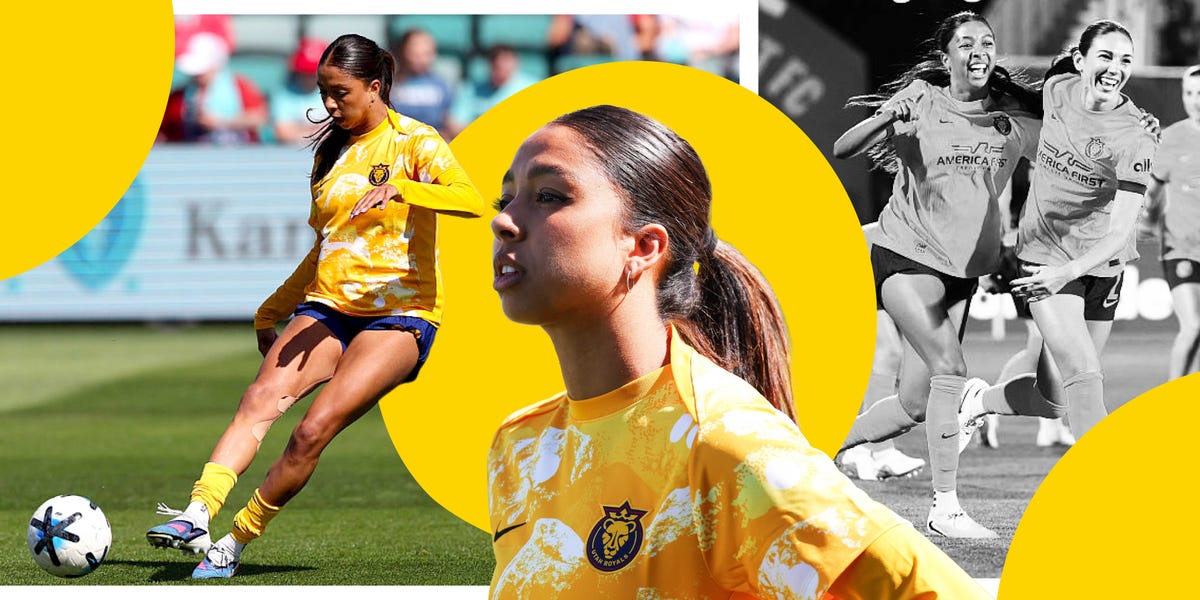
5 min readAt first glance, Nike’s newest N7 Collection might look like another summer product launch: a jersey and shorts rendered in rich earth tones and streaked with blue. But for Madison Hammond, the design carries a much deeper meaning.When the Utah Royals defensive midfielder looks at the pattern, she does not simply see a colorway. She sees the Rio Grande cutting through the clay-rich soil where her family has lived for generations.Hammond, who is San Felipe Pueblo (Katishtya), Navajo (Diné), and Black, helped design and launch the collection, bringing elements of her culture, family, and soccer career to the creative process.“Particularly for this collection, it was really important to me, because it was obviously putting Indigenous culture on display, but it was telling a soccer story,” she tells Women’s Health.That story is deeply personal for Hammond, who became the first Native American player in the NWSL when she signed her rookie contract with OL Reign in 2020. As her professional career has evolved, so has the way she understands her identity and the responsibility of representing communities that have long been overlooked in elite sports.“Throughout my journey as being a professional athlete, that has also kind of coincided with this journey of telling my story about who I am and where I come from,” she says. “This collection is just a perfect amalgamation of everything that I love and feel so proud to say about myself.”Hammond says she was particularly enticed to collaborate with Nike after the brand said the collection was focused on Southwest Native culture, and she was drawn to the N7 Fund’s investments in nonprofits that serve Indigenous communities in North America through CAF America.She acknowledges that there are so many Indigenous communities across the United States alone, that it felt especially important to highlight where her family is from. “I also think there's just a way in which different cultures, when you look at the collection, you can appreciate it from a fashion perspective, but if you're Native, you appreciate it for the smaller details that exist in it,” she says.A couple of signature details Hammond was drawn to were the distinct pattern on the back of the jersey and the Navajo scarf braided in her hair, gifted to her by her grandmother. Hammond feels confident that other Native people will recognize these details and feel seen in the design.For Hammond, those details helped distinguish meaningful representation from a collaboration that simply borrows Indigenous imagery.Hammond says she was immediately pleased with the collection, but was even prouder that her family also liked the designs. In fact, she used her relatives as touchpoints when evaluating the designs to see if she could picture them wearing the pieces.“That is what I wanted things to be rooted in—this is for the culture, by the culture,” she says.Her family’s roots with the brand run deep, with Hammond’s uncle, Notah Begay II, starting the NB3 Foundation, one of the nonprofits that Nike and the N7 Fund have supported. Begay was also the first N7 athlete, making another full circle moment for Hammond’s family.“This is for the culture, by the culture.”As a minority, Hammond says she is always wary of feeling tokenized. She says it is important to her to attach her name and identity with something meaningful and true. With the creation of this collection, she felt empowered rather than singled out—it felt authentic, and not superficial.“With tokenization, in general, it's almost like this feeling that you have of when a brand might reach out to you and they ask you to do something, and you realize it's because they don't have any understanding of what your experience is, and so they need you to tell it,” Hammond says. “Whereas I feel like this collection was an example of, we have this ingrained in us, and we want to project that out into the public.”Hammond says her perspective on the “Native” label has changed drastically over time as she has not only come more into her own as a player, but has also established her identity more.“In the beginning, when I was a rookie and was told that, it felt like it was an identity that I had to assume instead of just continuing to be me,” she says.Kyle Rivas//Getty ImagesAfter nearly seven seasons in the NWSL, Hammond’s outlook has shifted from being focused on who others have said she is to who she believes she is, and what she can do for those who come after her.“It is more about just being my true self and being able to enter a space knowing that I am the one of one, but that that experience is laying a groundwork for hopefully someone after,” she says.While Hammond claims and embraces her identity, she also says there is a flip side.“There's also this pressure to be like, ‘Am I Native enough? Am I Black enough? Am I serving these communities in a way where the community feels like I'm showing up enough for them?’” she says.The soccer player says it is important to build a community of support, especially if those people can relate from firsthand experience. Two people in her corner who have been huge supporters are Janee’ Kassanavoid, a 2x World Track and Field medalist, and SilentRain Espinoza, a professional softball player for the Professional Softball League’s Atlanta Smoke.Kassanavoid, Comanche Nation, was the first Native American woman to medal at the World Track and Field Championships back in 2022. Espinoza, Viejas Band of Kumeyaay Indians/Penobscot Nation, is a fellow N7 athlete with Hammond.Shop Madison Hammond’s Nike N7 CollectionNike N7 Football JerseyNike N7 ShortsNike N7 Max90 T-Shirt“It's like a nice home reminder, because there are people that have such complex stories, just like me, and they're doing their thing in their sports as well,” Hammond says.Visibility, however, is only one part of what Hammond believes Indigenous athletes need. Indigenous athletes often have less access to critical resources than other communities—Hammond says if she hadn’t left New Mexico, she might not be where she is today.“In order to achieve success, and achieve elite success, you have to leave home, and that's just such a bleak reality sometimes,” she says.The message Hammond wants people to take away—not only from the Nike collection, but just from watching Indigenous athletes play—is simple.“Indigenous athletes are just good athletes,” she says. “Somebody's identity doesn't change what they do on and off the field or the court. If they're good, they're good.”Alyssa Cruz is the social media editor at Women’s Health, where she drives social strategy and helps shape the brand’s voice across platforms. Prior to WH, she worked at CBS News and palabra. Originally from Toledo, she is a proud alumna of Ohio University, where she received two bachelor’s degrees in journalism and Spanish. When she is not creating social content, you can find her trying different restaurants in New York City or planning her next trip.
Madison Hammond Wants the Next Generation of Indigenous Athletes to Have Something She Didn’t
Full Article
Original Source
Read the full article at Womenshealthmag →KhanList aggregates and links to publicly available news content. We do not host full articles from third-party sources. Always verify important information with original sources.