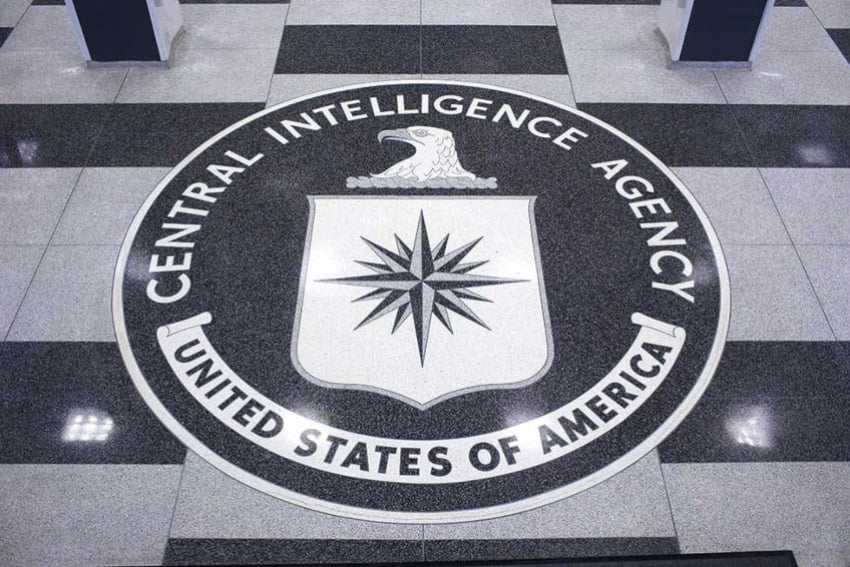
For months now, the same argument has played out in the press on both sides of the border: American voices floating military intervention against the cartels, Mexican officials answering back that nobody sorts out our house but us. This year alone, from The Atlantic to CNN to El País to President Claudia Sheinbaum’s own morning press conferences, the question of where cooperation ends and interference begins has been hard to avoid, sharpened by the Trump administration’s indictment of 10 Mexican officials on cartel-related charges. It’s not a new argument, even if the vocabulary feels urgent. In security terms, it’s close to a century old. Carlos Pérez Ricart, who studied at El Colegio de México and later worked as a postdoctoral researcher and professor at Oxford, spent years combing archives to write “Cien Años de Espías y Drogas,” a chronicle of the U.S. narcotics agents who have operated inside Mexico for 100 years, and the uncomfortably close relationships some built with the cartels they were sent to dismantle. The CIA and the ‘shaping’ of Mexican art and culture Outsized U.S. influence over Mexican art and culture became a hot-button topic at the Museum of Modern Art’s Salón Esso competition in 1965. (José Luis Cuevas/Bond Latin Gallery) There’s a quieter chapter to that history, one that never needed a wiretap because it operated in plain sight, dressed up as good taste. For roughly two decades, the U.S. Central Intelligence Agency (CIA) worked to shape Mexican culture from the inside — funding fellowships for painters, bankrolling literary magazines and cultural supplements and quietly steering the museums that decided whose work counted. It ran through galleries instead of embassies, critics instead of attachés, paintbrushes instead of sidearms. Call it interference, call it soft power, call it the ordinary behavior of a powerful neighbor with strong opinions about its own image — it is what it is, and it has a long paper trail. The playbook was built at home first The method was tested in New York first. Thomas Braden, who later ran the CIA’s cultural operations division, spent the late 1940s as executive secretary of the Museum of Modern Art under Nelson Rockefeller — at various points MoMA’s board president, wartime head of U.S. intelligence for Latin America, and the man who called Abstract Expressionism, apparently without irony, “free enterprise painting.” Braden joined the CIA in 1950 and later admitted, without much regret, that covertly funding cultural organizations abroad had largely been his idea. Writing in the Saturday Evening Post in 1967, after journalists had already exposed the program, he argued that asking Congress to approve it would have gone about as well as asking the John Birch Society to endorse Medicare. Rockefeller himself helped send the museum’s touring show “The New American Painting” through nearly every major European capital in 1958-59, with no mention that it doubled as a project of the CIA-created Congress for Cultural Freedom. MoMA already had history in Mexico by then: Its Latin American collection dates to 1935, and its 1940 show “Twenty Centuries of Mexican Art” had Mexico’s own institutional backing. The local front: A magazine in disguise By the early 1960s, Fidel Castro’s revolution had energized a generation of Mexican writers and intellectuals, and Washington’s anxiety had a specific address: ¡Siempre! and its cultural supplement, La Cultura en México, edited by Fernando Benítez — described in the CIA’s own internal paperwork as sympathetic to Havana. A memo dated June 24, 1963, proposed a rival magazine, code-named Crítica. It launched in December 1964 as Diálogos, co-edited by philosopher and poet Ramón Xirau alongside a man calling himself “Enrique P. López.” In reality, CIA officer Edward G. Tichborn, operating under a cover so deep his real name barely surfaces in the record. Xirau was chosen, the agency’s own files show, for being too intelligent to be a Marxist and for a Rockefeller Foundation fellowship that already had him in the right rooms. He believed his American benefactor was a sympathetic lawyer with money to spend. He never learned otherwise. Nobel Prize-winning author Octavio Paz was one of several notable writers to publish in Diálogos, little knowing that one of its editors was a CIA officer. (Gobierno de Mexico) The magazine ran for two decades, eventually finding a home at El Colegio de México, and published Octavio Paz, Carlos Fuentes, Roland Barthes and Susan Sontag. It was built, in part, by people who never knew what they were part of. Painting over politics: The night the Salón Esso exploded If Diálogos shows how the method worked in print, the Salón Esso shows how it played out in a gallery: in public, with fists. By the mid-1950s, Mexican muralism — the state-sponsored, politically committed art of Rivera, Orozco and Siqueiros — had become an irritant to U.S. interests for the same reason it had once been celebrated at home. It was explicitly revolutionary. Around the same time, Abstract Expressionism and its European cousin, Informalism, offered something the Escuela Mexicana didn’t: an art without an obvious political message, easy to present as pure, apolitical freedom of expression. Art historian Shifra Goldman argued, in “Contemporary Mexican Painting in a Time of Change,” that the shift was no accident of taste. She pointed to the CIA and USIS’s documented involvement in cultural programming, and to the OAS’s Visual Arts Unit, run by Cuban-born critic José Gómez Sicre, as a vehicle for promoting abstraction over social realism. Standard Oil’s Mexican subsidiary, Goldman noted, sponsored the very competition that bore its name: the Salón Esso. The Esso salon, held at the Museo de Arte Moderno on Feb. 2, 1965, was an open competition for young painters and sculptors, with winners advancing to a showcase at the OAS in Washington. Only about 30% of the works submitted were figurative; the top prizes went to two abstract paintings, by Fernando García Ponce and Lilia Carrillo, and García Ponce’s own brother sat on the jury. A fistfight over art The opening turned into a brawl. Muralist loyalists confronted Tamayo, the García Ponce brothers and José Luis Cuevas — mocked for years as having sold out to the OAS ever since Gómez Sicre sponsored his first solo show in Washington in 1954. Writer Raquel Tibol recalled one socialite fleeing the scrum in her mink coat, taunting that the communists had nothing left but hammers and sickles. Cuevas and critic Francisco Icaza came to blows. Tamayo used the moment to declare that Mexican art no longer needed nationalism as a shield. Whether the Salón Esso was a CIA operation with a paintbrush or an art-world grudge match that happened to have American money in the room is exactly what Goldman’s critics still argue about, and that ambiguity may be the most honest way to leave it. What isn’t in dispute is that the money, the institutions and the timing all pointed the same direction. The CIA preferred abstract art to the social reality of Mexican Muralism, seen in works like David Alfaro Siqueiros’ “Del Porfirismo a la Revolución.” (INEHRM) Fernando Gamboa, a senior National Institute of Fine Arts and Literature (INBA) official, spent the 1950s and 1960s denouncing American cultural influence and dismissing abstraction as decorative and second-rate. In 1972, he was named director of the Museo de Arte Moderno — the same institution at the center of the Salón Esso affair — and defended the art he had spent two decades attacking. What this is and isn’t None of this means every Mexican abstract painter was a witting or unwitting asset. Artists like Gunther Gerzso and Lilia Carrillo pursued serious, original work with little to do with Washington’s Cold War anxieties. Goldman’s thesis remains contested among art historians, not a settled verdict. What the documented record does show is that, for roughly two decades, U.S. agencies and U.S.-linked institutions treated Mexican museums, magazines and art prizes as worth a memo, a grant or a quiet word to the right curator. Three vignettes, three decades: Braden built the model in a New York museum, Xirau ran it out of a Mexico City magazine office without knowing it, and Gamboa ended up defending it from the director’s chair of the very institution where it once nearly came to blows. None of it required a single mastermind, just money, prestige and institutions patient enough to let the shift happen slowly. Pérez Ricart’s century of spies worked the border and the cartels; this article worked the galleries and the newsstands. Neither settles the argument still playing out in this year’s headlines, over where cooperation ends and interference begins. That’s a question with room for real disagreement. What both suggest is that the motive shifts by the decade: sometimes ideology, sometimes economics and sometimes simply a tighter grip on the region. In the years this piece covers, it came down to something as specific as whose paintings got hung on the wall.
Made in Mexico: How the CIA shaped art and culture in Mexico
Full Article
Original Source
Read the full article at Mexiconewsdaily →KhanList aggregates and links to publicly available news content. We do not host full articles from third-party sources. Always verify important information with original sources.