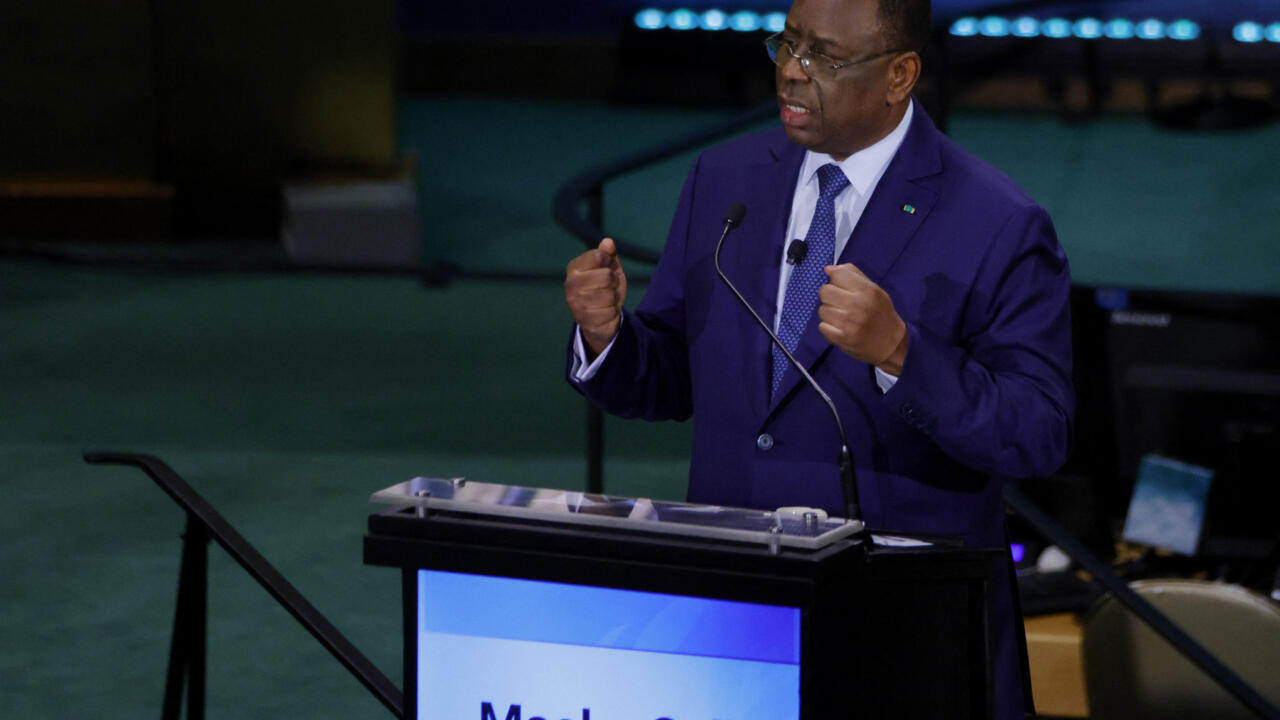
Former Senegalese president Macky Sall has pledged to restore trust in the United Nations and make the organisation more responsive as he seeks to become the first African to lead the global body in nearly three decades. Sall was among six candidates who set out their vision for the UN during a restrained debate in New York on Thursday, one week before the formal selection process begins. The candidates agreed that the next secretary-general would need to rebuild the credibility of an organisation facing deep financial pressures, growing geopolitical divisions and criticism over its response to conflicts around the world. Sall said he would use his first 100 days in office “to restore trust and put the UN on a path to become more agile, more effective and more ready to listen”. The former Senegalese leader promised an organisation able to “listen, act and bring people together”, placing effectiveness and dialogue at the heart of his campaign. Sall, who served as Senegal’s president from 2012 to 2024, is the only African and the only non-Latin American candidate in the race to succeed Secretary-General Antonio Guterres, whose term ends on 31 December. His candidacy challenges an informal tradition of geographic rotation, under which many countries believe the next secretary-general should come from Latin America and the Caribbean. Four of the six contenders are women, adding further weight to longstanding calls for the UN to appoint its first female secretary-general. Senegal's Faye backs former president Sall's bid for UN top job in U-turn Six candidates set out their credentials Alongside Sall, the candidates are former Chilean president Michelle Bachelet, former Ecuadorian foreign minister Maria Fernanda Espinosa, International Atomic Energy Agency chief Rafael Grossi of Argentina, UN trade and development head Rebeca Grynspan of Costa Rica and Guyanese ambassador Carolyn Rodrigues-Birkett. During the nearly two-hour, televised debate in the UN General Assembly Hall, the candidates answered questions from diplomats, UN employees and civil society representatives. Each presented their national or international experience as evidence of their ability to manage the organisation during an era marked by wars, political rivalry and declining confidence in multilateral institutions. Grynspan said she wanted the UN to regain a central role in resolving conflicts and delivering visible results. “Five years from now, I would like nobody to ask me again, ‘Where is the UN?’” she said. She called for the organisation to be “back at the table” in conflict situations and able to produce meaningful improvements on the ground. (L-R) Candidates for United Nations Secretary-General position, Chile's former president Michelle Bachelet, Ecuadorean diplomat and former President of the UN General Assembly Maria Fernanda Espinosa, Argentine diplomat and Director General of the International Atomic Energy Agency (IAEA) Rafael Mariano Grossi, Costa Rican economist and Secretary-General of UNCTAD Rebeca Grynspan, Guyana's former foreign minister Carolyn Rodrigues and Senegal's former president Macky Sall participate in a debate at the UN General Assembly Hall in New York, on 23 July 2026. AFP - LEONARDO MUNOZ Rodrigues-Birkett similarly promised to engage directly with the most difficult international crises. “I would be that secretary-general that would try, whether it is in Iran or in Haiti or in Sudan or in the Democratic Republic of Congo,” she said. Grossi argued that the secretary-general should intervene more actively whenever a UN member launches a war or commits an act of aggression. “We need to restore this credibility of the UN as a valid interlocutor, and then use the tools at hand,” he said. The candidates also sought to demonstrate that they would be able to stand up to powerful states without alienating the governments whose support they would need. Without referring to any country by name, Bachelet said she would resist pressure from major donor nations. “I will speak out loud what I think is my moral authority and my duty,” she said. Espinosa placed conflict prevention at the centre of her campaign, arguing that it should become an operational priority rather than simply a political slogan. She promised to ensure that the UN system was prepared to identify and respond to crises early, adding that she would personally take part in diplomatic efforts. “I will be there myself, carrying the UN flag,” she said. Calls for reform as UN marks 80th anniversary amid conflict and division Security Council prepares first vote The debate comes as the UN confronts what officials and diplomats describe as a serious crisis of both funding and confidence. The administration of US President Donald Trump has accused the organisation of excessive spending, taking on too many responsibilities and failing to deliver sufficient results. Washington wants the UN to return its focus to its founding responsibilities for international peace and security. Other member states insist that its two other central pillars – human rights and sustainable development – must remain equally important. Most of the candidates backed continuing reforms intended to make the organisation more efficient, while also calling for the secretary-general to become more closely involved in peace negotiations. They have already faced three hours of questioning individually from representatives of the UN’s 193 member states. The next decisive stage will begin on 30 July, when the 15 members of the Security Council are due to hold their first closed-door ballot on the candidates. The anonymous “straw poll” will show which contenders have the strongest support and whether any face opposition from the council’s five permanent members – Britain, China, France, Russia and the United States. Further ballots are expected until one candidate secures at least nine votes without being vetoed by a permanent member. The Security Council will then submit its chosen candidate to the General Assembly for formal approval. The new secretary-general is due to take office on 1 January 2027. Latin American governments argue that it is their region’s turn to provide the next secretary-general, although the informal system of geographic rotation has not always been followed. Sall’s supporters are instead likely to emphasise Africa’s growing diplomatic weight and the continent’s central place in many of the issues facing the UN – from peacekeeping and development to climate change and reform of the international system. The last African secretary-general was Ghana’s Kofi Annan, who held the position from 1997 to 2006. (with newswires)
Macky Sall pledges to restore trust in UN as leadership race gathers pace
Full Article
Original Source
Read the full article at Rfi →KhanList aggregates and links to publicly available news content. We do not host full articles from third-party sources. Always verify important information with original sources.