
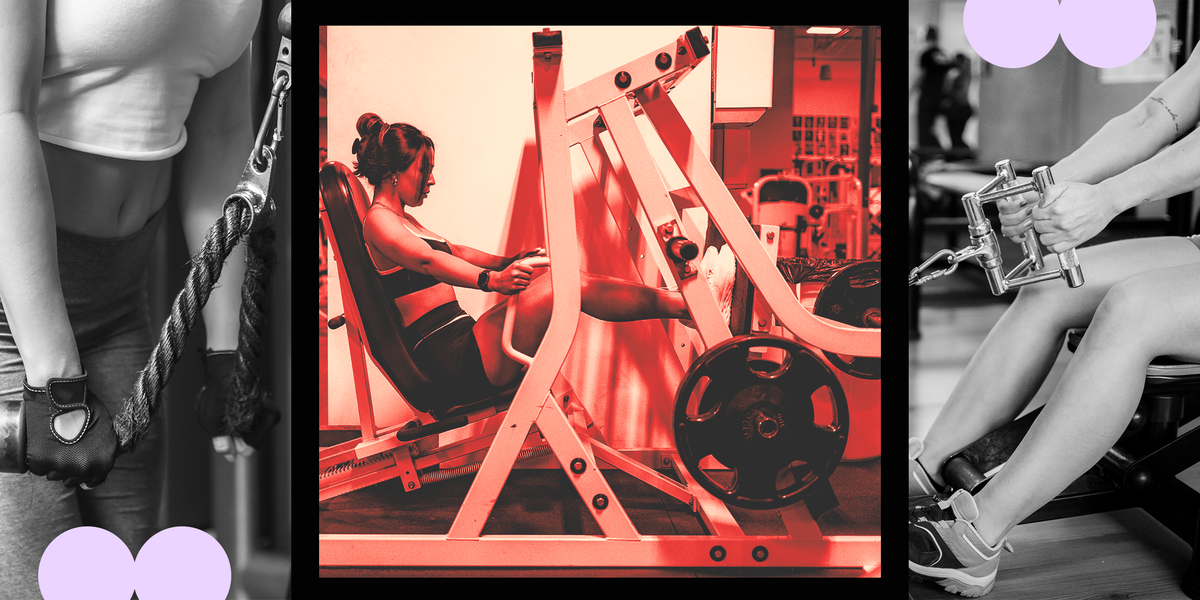
4 min readMy name is Cori Ritchey, and I am an exercise physiology nerd turned fitness journalist, and the fitness editor at Women’s Health. When I’m not writing, editing, and researching fitness, I’m teaching it to my personal training and group fitness clients. In my new column, Between Sets, I’m pulling back the curtain on the same advice, tips, and ‘aha!’ moments I share with my clients while they’re catching their breath. Stick around for the strategic, science-backed nuggets that’ll help you move better, train smarter, and actually enjoy the process.The gym can be a complicated place. There’s an endless array of equipment—dumbbells, kettlebells, rows of machines—with seemingly more being added every day. Add the unwritten rules of gym etiquette and conflicting advice on proper form, and it’s enough to overwhelm even the most dedicated gymgoer.Machines, at least, keep things simple. Each one comes with directions and often a body diagram highlighting the targeted body part. That’s a big reason so many of my clients look forward to the machine portion of their workout more than the free weight portion. I’m often asked, “Can’t we just use machines?”It’s a fair question, considering simplicity isn’t their only advantage. But is it smart to build a routine around machines alone? Or are you missing out by skipping the dumbbells and barbells? Let me walk you through it.There’s a lot that free weights can do for you that machines can’t. Yes, it’s possible to devise a workout plan using only machines, hitting all of your major muscle groups. But if you leave free weights completely out of the equation, you miss out on some serious benefits.First, let me clarify what I mean by free weights. These are weights that can be moved freely in any direction. Think: kettlebells, barbells, medicine balls, even ankle weights. Machines, by contrast, generally guide your movement along a set path.One of the biggest advantages of free weights is that they challenge your stability, balance, and control. On a machine, your body is typically supported as you perform the movement it’s designed for. With free weights, you have the freedom to move, which means more of your body has to work to stabilize your weight. That can make free-weight exercises more challenging (and why my clients tend to do them more begrudgingly!), and give you an opportunity to develop those skills alongside strength.Imagine you’re training your quads. With a pair of dumbbells, maybe you elect to do some reverse lunges. To maintain your balance and control the movement, your core, hips, knees, and ankles all have to work together. By comparison, we can look at the leg press machine, where you’re seated with your torso supported, and if you can’t push the weight back up, you can drop a safety bar to catch it.Free weights can also challenge your coordination in ways many machines may not. Your brain and body have to work together to move your joints through the exercise while controlling the weight.Another positive of free weights? They’re often more readily available. In the gym at 5 p.m. on a Tuesday? You’ll likely find plenty of dumbbells to go around, but a long line for the one leg press machine.That said, because free weights require so much coordination and stability, they can be more challenging to perform safely, especially if you’re new to an exercise or lifting more than you can control.Machines can absolutely be a useful tool when used appropriately. For one, they are particularly good at isolating muscle groups, making them useful at burning out specific parts of the body during a workout. Because they support and guide your movement, they may also help you feel more comfortable lifting heavy weights. Plus, their simplicity and clarity make them approachable for exercisers of all experience levels.For beginners, machines can help build a mind-muscle connection and learn movement patterns. For experienced lifters, they offer a way to challenge muscles with heavier weights and less fear of injury. For older adults, machines provide an extra level of stability when balance might be an issue.When it comes to strength and muscle gains, neither approach is inherently better than the other. A 2023 meta-analysis reviewed 13 studies and found no difference between the modalities when testing maximal strength, hypertrophy, and jump performance.For me and my clients, I love to use machines to burn out at the end of a workout. Because machines are generally safer and more intuitive, they’re best utilized (IMO) when fatigue sets in and mistakes become more likely. For example, I often close out my squat day with the leg extension machine to really hammer the quads and get as close to failure as possible. On deadlift day, I’ll do the same with the hamstring curl machines. I use machines as tools to push the muscles to failure safely.An effective routine mixes the two. The perfect combination prioritizes free weights, and then finishes with machines. For my clients, I typically recommend starting with one or two compound exercises that use free weights off the top of a workout to promote stability, balance, and control. Then, finish off with two or three machines that target the muscle groups you want to focus on in a way that’s safe when their bodies might already be a bit worn out.Those final machine exercises can be a good opportunity to push your muscles close to failure—the point at which you can’t complete another repetition without good form, which you need to approach to see the most muscle growth. It can help you burn out your muscles where they’re supported and less prone to injury.Find the Perfect Women’s Health Training Program for YouCori Ritchey, C.S.C.S., is the fitness editor at Women's Health, as well as a certified strength and condition coach and group fitness instructor. She’s reported on topics regarding health, nutrition, mental health, fitness, sex, and relationships for several years. You can find more of her work in Men’s Health, HealthCentral, Livestrong, Self, and others.
Machines vs. Free Weights: A Trainer Explains When to Use Each for a More Effective Workout
Full Article
Original Source
Read the full article at Womenshealthmag →KhanList aggregates and links to publicly available news content. We do not host full articles from third-party sources. Always verify important information with original sources.