
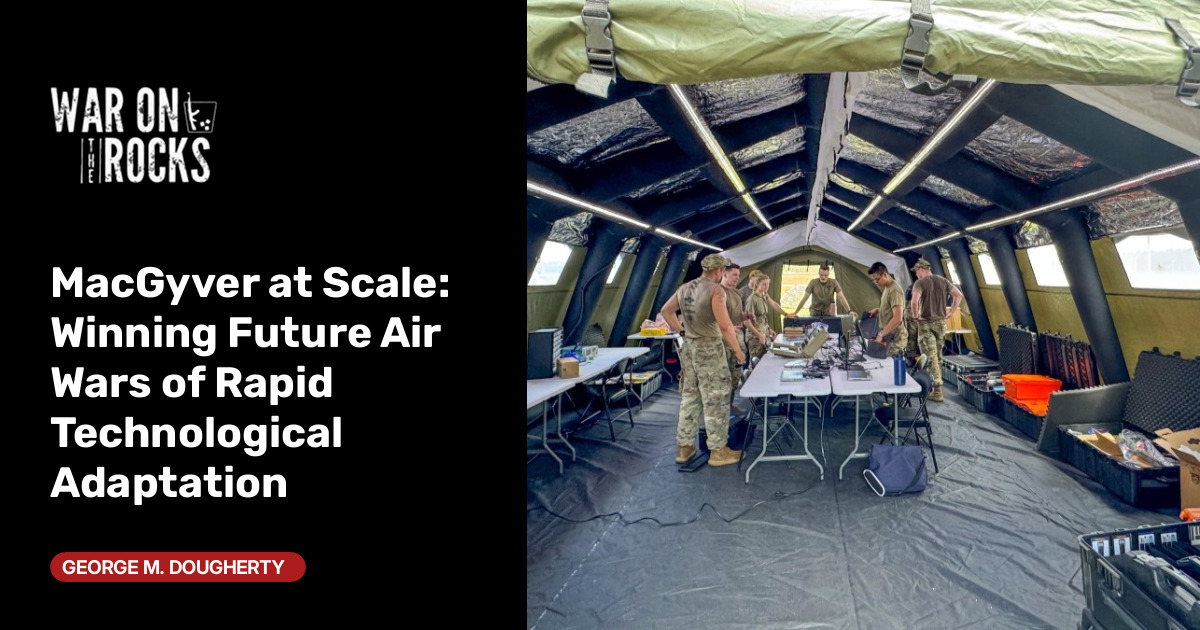
During a recent training exercise in the western Pacific, a small group of engineers single-handedly saved the day.In the scenario, adversary covert forces used first-person view drones to intercept American helicopters that were shuttling between austere forward island airbases. Some helicopters were shot down, and the rest were forced to suspend flight operations, meaning the island bases were cut off from each other and from easy resupply. Fortunately, one of the U.S. bases included a small, forward-deployed team of military engineers and their equipment. They analyzed the adversary radio control techniques and then designed and built custom self-protection radio jammers, fabricating the circuit boards on-site and mounting them to the helicopters using 3D-printed housings. The jammers were software-reprogrammable, allowing them to easily adapt to new radio frequencies. Within days, the U.S. helicopters were back in action, protected by their new jamming pods.This scenario was simulated, but the on-location engineering was real. The team, called the Science and Engineering Demand Force Team, consisted of volunteer junior officers from the Air Force Research Laboratory. Had it been an actual combat situation, their system would have neutralized the adversary’s new threat. It was a powerful, though small, demonstration of rapid technological adaptation in combat.Efforts to transform military acquisition and accelerate innovation have often omitted an element essential to achieving rapid adaptation during active combat: the role of uniformed military technologists. Solving technological problems that emerge suddenly during operations, on timelines of weeks, days, and sometimes hours, will demand engineering capability on-location, not hundreds or thousands of miles away. The Ukrainian military has shown that this not only enables immediate fielding of improvised solutions, but also effective remote collaboration with the nation’s other technical experts and companies.Unfortunately, the U.S. Air Force is not currently organized to do this beyond pilot projects, many of which are eager for wider application. The Air Force has thousands of uniformed military scientists and engineers, but nearly all manage development programs at stateside development centers far from the fight. That won’t be enough to win a prolonged contest of technological adaptation against a fast-moving peer adversary.How to reorganize this force for rapid combat adaptation has been an unanswered question preventing meaningful change. I co-led an Air Force-wide program tasked to determine how to implement rapid technological adaptation at scale across the force. This program yielded a clear six-component framework for practical implementation. Validated repeatedly across conflicts and contexts, military leaders should prioritize these components as they prepare to deploy military technologists to conduct rapid combat adaptation at scale and set them up for success.Sign Up for Our NewsletterA Direction Seeking a RoadmapPlentiful recent studies bestow directional advice for accelerating military innovation. Decentralize it. Identify and communicate operational needs faster. Establish tight feedback loops between warfighters and developers. Prototype quickly and iterate based on operational feedback. Leverage off-the-shelf commercial technologies and agile startups. Standardize to enable scaling of successes. But how should deployed forces be re-engineered to enable all that?In Ukraine, many innovations are first prototyped within earshot of the front, by military teams composed partly by draftees with technology backgrounds. Ukrainian tech companies visit them often. Similar activities support Ukrainian air combat. Ad-hoc U.S. and Ukrainian teams quickly integrated Western weapons and sensors with ex-Soviet Ukrainian aircraft using “MacGyver-like” workarounds including mounting tablet-based interfaces in cockpits. Ukrainian air defenders improvised low-cost air defense sensors, and built realistic decoys to confuse Russian attacks on airfields.But the U.S. military cannot simply copy Ukrainian practices. Ukraine is fighting in its own backyard (in driving distance from civilian innovators), but the United States mostly fights far from home. Remote locations, such as those in the Pacific, limit outside civilian help. U.S. forces are all-volunteer and operate more complex equipment. In addition, the highly decentralized, ad-hoc Ukrainian model has sometimes produced inefficiency and chaos, and shortcomings in mission integration and scaling. These realities require a uniquely American approach to battlefield innovation.After several months of striving to help the Ukrainian Air Force improvise technological solutions, in 2022 the Department of the Air Force quietly launched an effort to determine how to prepare itself. I co-led this effort with Col. Mario Serna, under the joint sponsorship of the chief scientist of the Air Force and the commander of the Air Force Research Laboratory. We named it Project Doolittle, after the famous World War II military innovator Jimmy Doolittle who improvised the surprise raid on Tokyo in April 1942.We assembled a network of dozens of leaders from across the Air Force and Space Force with experience in rapid adaptation. Together, we combined lessons from over twenty past and present pilot programs and ad-hoc activities involved in rapid prototyping, field modification, and technical improvisation. They included support to air combat activities in Ukraine, programs during the Global War on Terror, and innovative projects within Air Force major commands and combatant commands. Its findings, until now, have gone unpublished.Among the wealth of findings, a set of six basic components emerged across different times, places, and operational contexts. Programs that lacked one or more at the start often built the missing component as the deficit became apparent. This “convergent evolution” establishes them as the foundation for all other implementation activities.Establish Forward Presence and RelationshipsTo be effective, technologists must integrate directly with on-site operational units. This lets them understand and solve many problems immediately, without relying on outside support or connectivity. A close relationship between technologists (preferably servicemembers ready to fight alongside their host units) and operators, founded on trust and honed through shared experience, is the foundation for everything else. U.S. operational personnel describe the ideal relationship as like technology Joint Terminal Attack Controllers (airmen embedded with forward units to orchestrate close air support and other offensive air operations). A similar philosophy motivated today’s forward-deployed software engineers or liaison officers who develop new code at military command and control centers.Craft Small, Multi-Functional TeamsAn agile team of five to ten personnel is optimum for forward integration with operators. The teams should contain a mix of technical competencies and favor multi-functional service members who can solve novel engineering problems, understand operational needs, collaborate with distant “reachback” experts at companies and labs when practical, work closely with technically skilled operators, and manufacture working prototypes in austere conditions. These should be specially trained and self-sufficient teams, not ad-hoc collections of host unit personnel. Very different organizations, from the Ukrainian military intelligence service’s innovation cells to the Science and Engineering Demand Force Team (now known as SHADOW Tech), have reached the same conclusion.Organize a Hub for Coordination, Support, and ScalingForward-deployed teams must be paired with a central hub providing coordination and access to larger resources such as industrial production. The force must propagate effective solutions, standardize them where efficient, and deploy them at scale. A higher-echelon “hub” unifies the forward-deployed “spokes,” speeds knowledge sharing, and engages industrial and acquisition support, including via agile commercial procurement offices such as AFWERX and the Defense Innovation Unit. In Ukraine, civil-military organizations like Brave1 help fill this role. The hub also coordinates manpower, training, and other enablement, and provides a single point of contact for coordination with other unit headquarters and functions in the theater.Empower Teams with Pre-Established AuthoritiesTo function at combat speed, some authorities in areas such as system safety, airworthiness, and software authority to operate must be delegated to the field. When improvising the integration of western weapons onto Ukrainian jets, there was no need for approval from a MiG-29 program office, nor a restrictive vendor contract limiting the freedom to modify the aircraft. That is usually not the case with U.S.-made platforms and systems, which may have restrictive tech orders, engineering change approval processes, and data rights. It does not have to be like this. For instance, the engineering teams that conduct aircraft battle damage repair wield many authorities to approve the improvised fixes that get aircraft back into operation. The Air Force can leverage such precedents to empower forward-deployed adaptation teams.Train for the Tech Adaptation MissionHands-on engineering at the tactical edge is a unique skill set developed through training and practice, which most engineers and technicians don’t receive through their academic training. Most military hardware is complex. Specialist teams that conduct rapid technology adaptation, akin to special forces for engineering, must “train as they fight” and become mission-ready well before combat operations begin. The Air Force’s Project Arc, for instance, identified two important levels of selection and training, including baseline training on transferable skills and more specialized pre-deployment training customized to mission and theater. The SHADOW Tech teams and the Air Force Institute of Technology are developing initial training curricula for future rapid technology adaptation practitioners, informed by field exercises.Equip to Enable Rapid Modification in the FieldTo enable effective field adaptation, new weapons and other systems should be built for easy modification. Modular design, easy physical access, open systems software architecture, and other features allow teams to swiftly implement changes and upgrades. In addition, the forward-deployed teams need special supplies and equipment. The SHADOW Tech teams, for instance, deploy with containerized 3D printers, microcontroller boards, antennas, computer-aided drafting and engineering software, and other gear, and are skilled at finding local resources to meet needs. The Air Force Spark innovation program is producing containerized combat innovation labs.Addressing Complications and ChallengesIn short, the Air Force should redeploy some of its military science and engineering workforce into forward rapid adaptation teams, integrate them with deployable combat units at the wing or base level, and establish an integrating hub — potentially one within each theater. It can integrate or expand upon many existing pilot-scale capabilities to accelerate this scaleup. Since 2025, a Technology Maneuver Task Force led by the Air Force Research Laboratory has been refining how to best implement the components — and many other details — in practice.Project Doolittle focused on experiences in the air domain, but they provide a widely applicable starting point for tailoring to different services and domains. For instance, the Space Force launches and operates space systems largely from the homeland where “reachback” support from labs and industry may be closer. Therefore, the way that rapid adaptation teams might be optimally structured and employed could differ.Some components may also be in tension with one another. For instance, if a centralized coordination function becomes too powerful, it could suppress innovation and initiative by the forward-deployed teams. The hub and spokes therefore need clearly written charters that separate their responsibilities. Similar agreements should detail working relationships between the adaptation teams and the combat units and leaders they support.Some other important challenges include the delegation of authorities, designing for adaptability, and talent and manpower, each of which must be addressed in turn.Delegation of AuthoritiesThis issue is complex enough that Project Doolittle established a separate sub-team dedicated to it. Strict requirements in areas such as safety, airworthiness, and cybersecurity exist for a reason. However, current policy contains exceptions that enable flexibility. For instance, the Air Force’s Form 1067 process for approving modifications to fielded systems provides delegated authority for temporary or test modifications, and many rapid combat modifications can qualify. The central hub can then process longer-term approvals for modifications that may become permanent or scale across the force. Delegation of authorities will not be easy, and challenging negotiations lie ahead. However, we found that the pressure of recent conflicts has increased support at the top levels of the military system engineering authorities. For instance, by working with a cooperative program office, the Special Operations Command team that developed new capabilities for the MQ-9 Reaper strike drone implemented a rapid approval cycle that let it invent, approve, and field about 15 upgrades every year.Design for Adaptability Fielding systems whose hardware and software can be quickly modified runs counter to traditional defense contractor practices that favor proprietary architectures and vendor-lock. However, enabling practices such as the modular open systems approach are already required under Pentagon acquisition reform mandates. Emerging defense tech companies are embracing them decisively, and established primes and defense industry groups are advocating them as well. However, issues such as the intellectual property status of field modifications, such as changes to software, remain to be fully addressed in guidance.Talent and ManpowerScaling rapid technological adaptation with the needed training and support across many units and commands could stress limited resources. However, the Air Force has a strong existing corps of thousands of uniformed scientists and engineers, many of which are hungry to apply their skills more directly. While much larger than existing pilot efforts, the modest size of rapid adaptation teams and coordination hubs means that only a few hundred may be needed to integrate rapid technology adaptation capabilities across the several dozen deployable wings. Technically skilled officers from other career fields, enlisted, and newly established warrant officer grades could augment the talent pool. In addition, the Air Force could incorporate and build upon existing structures such as the Spark Cells already present at over 100 units and bases. The resource needs for training, equipment, and other support are relatively small, but will still require careful planning.Winning future wars will depend not only on fielding better technology before conflict begins, but on building deployed military forces capable of evolving faster than the enemy throughout the conflict itself, sometimes literally overnight. As a Ukrainian military innovator observed, in emerging warfare it’s increasingly “not the strongest who survive, but the most adaptable.” Project Doolittle identified how to do this by integrating uniformed military technologists into combat forces at scale. With the right framework and institutional support, adaptation superiority can belong to the U.S. Air Force and its fast-adapting sister services.Write for Cogs of WarGeorge M. Dougherty, Ph.D., is a retired Air Force colonel with over 30 years of service in Air Force development and acquisition. He co-authored the Air Force’s current Science and Technology Strategy. Until June 2026, he served as the director of innovation for the Department of the Air Force’s Program Acquisition Executive for Command, Control, Communications, and Battle Management. A reservist, he also served as an executive in two international management consulting firms advising high-tech and life sciences companies to optimize product development and navigate strategic change. He is the author of Beast in the Machine: How Robotics and AI Will Transform Warfare and the Future of Human Conflict, and many peer-reviewed articles on accelerating disruptive military innovation.The views expressed are those of the author and do not reflect the official guidance and position of the United States Government, the Department of Defense, the United States Air Force, or the United States Space Force.Image: Kacey C Napier via DVIDS.
MacGyver at Scale: Winning Future Air Wars of Rapid Technological Adaptation
Full Article
Original Source
Read the full article at Warontherocks →KhanList aggregates and links to publicly available news content. We do not host full articles from third-party sources. Always verify important information with original sources.