
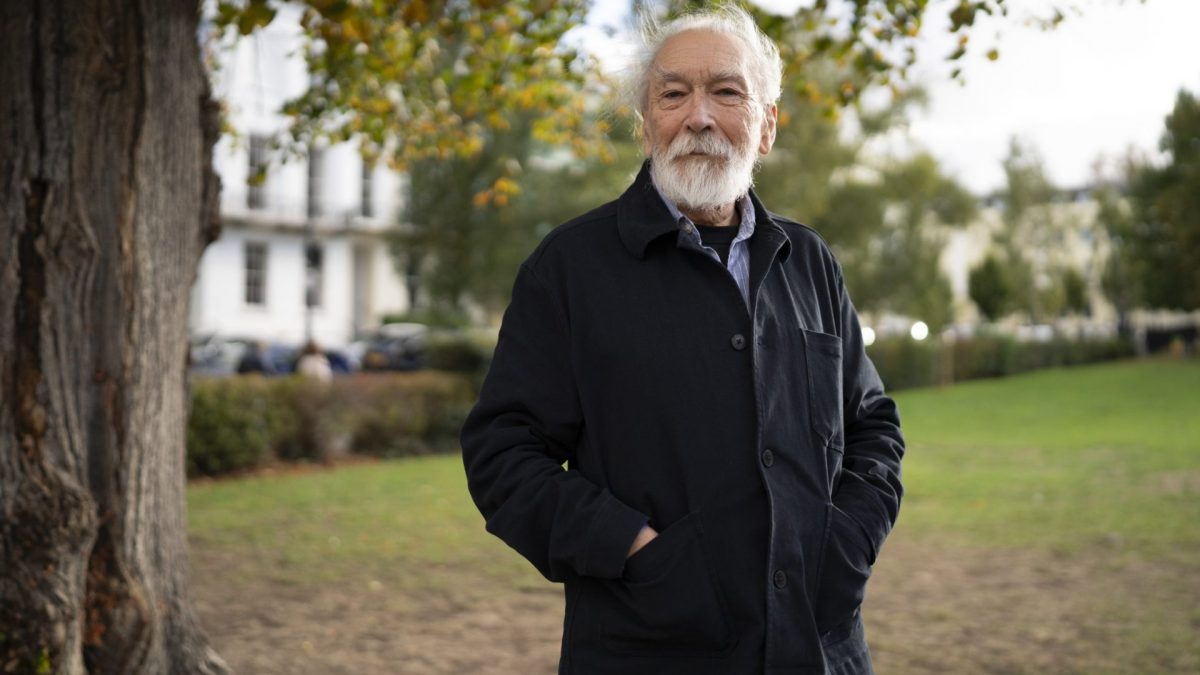
The author M John Harrison didn’t sleep at all on Monday night. “I just lay there in bed thinking, ‘I just won the Booker prize’,” the 81-year-old says with a laugh. This wasn’t, of course, some kind of sleep-deprived hallucination. The author – a science fiction cult genius who has published 13 novels in a career spanning more than 60 years – was indeed awarded the biggest prize in the books world this week, for his daring, disorientating apocalyptic novel The End of Everything. Dressed in a casual black-and-white checked shirt and with his snow-white hair tied back in a ponytail, M John Harrison – Michael, or Mike as I’m told I can call him – is bright-eyed despite the exhaustion when we speak two days after the award ceremony. The Booker has never been bestowed on a science fiction author before, pointing to a snobbery around the genre that arguably explains why Harrison has, until this point, “spent 50 years toiling away in the mines without all that much recognition”. Taking in his victory is “going to be quite a long term process for me”, he says. “Acclimatising takes longer when you get older, anyway. And basically you’re going to be a different person the other side of an event like that, really. If you’re not, there’s something wrong with you.” He shakes his head in bemusement as he remembers the moment after the classicist Mary Beard, chair of this year’s judges, announced he’d won. “As I staggered up to the stage I thought, ‘This is really strange. This is a really strange state to be in.’” He smiles. “But that is now sorting itself out, especially with sleep.”Harrison’s shock is evident on hearing he’d won the Booker Prize during this week’s ceremony (Photo: David Parry) Fittingly, strangeness and bewilderment after a momentous event also sum up The End of Everything, the plot of which is as murky as the seawater surrounding the unnamed Kentish coastal town where it is set. We follow Phillip and his dementia-suffering aunt Marnie, who are living in a near-future post-disaster world, which has been invaded by aliens called the iGhetti. Who exactly are these aliens? Unclear. What was the disaster that has brought about social collapse and created a world of vigilante warfare, where crashed aeroplanes stick out of the ground and robots wash up on the seashore? We don’t know. But if you’re struggling to comprehend what’s going on, don’t worry. That’s the point. Harrison has described the novel – a sly satire on everything from climate breakdown and gentrification to AI, late capitalism and Brexit – as speaking of “the collapse of rationality that comes with Trumpism and the internet”. He has said he wanted readers to be as baffled as the characters are by their surreal, disintegrated disasterscape. “I said to my editor Libby at [the publisher] Serpent’s Tail when I delivered this work, ‘You know, Libby, it is quite weird, this one’,” says Harrison. “She thought about it for a minute and then she said, ‘Mike, we will lean into it’.” Harrison – who is as friendly and open in person as his prizewinner is defiantly opaque – sold his first story in 1965, and three years later became the books editor of the speculative fiction magazine New Worlds. He wrote The End of Everything in fits and starts over the past 15 years, working from the top floor of the “dilapidated” Shropshire terrace he shares with his writer and editor partner, Cath Phillips. Inspired by a friend’s interiors, he asked Cath to paint his study walls red, with a pink trim, so it now resembles “a kind of cave, a blood-red cave, which is long and narrow. It’s like a scene in a David Lynch [film] – it’s really oppressive,” he says cheerfully. Harrison says that at 81 years old, he has become a more audacious and ‘temperamentally reckless’ writer (Photo: David Parry) At 81, he is the oldest-ever winner of the Booker – and he thinks age has injected a certain audacity into his prose. “It brings on a certain recklessness,” he says. “If you’re temperamentally reckless anyway, and I was when I was younger, then I think it brings that back to you. There is a point where you say, ‘It doesn’t matter what I do now, because I’m going to die soon. I can do what I like now.’” The Booker win follows Harrison being awarded the Goldsmith’s prize in 2020 for his novel The Sunken Land Begins to Rise Again. Why is he producing some of his best work in his seventies and eighties? He shrugs. “It’s partly to do with low production. I haven’t written all that many books. I’ve not exhausted myself, as it were. It wasn’t deliberate – I’m just a very slow writer. I haven’t been a particularly confident writer, which means I work and rework the stuff, but I haven’t, as it were, emptied my tank. “I don’t feel as if I’ve finished,” he continues. “I now feel I’ve got close to what I want to say, but I haven’t run out of thinking of new ways to say it. And also I haven’t run out of – I hesitate to call it ambition, but I haven’t run out of aspirations as a writer.” The fact he’s in good nick physically also helps, he says. “I was always quite fit and I did outdoor sport for a long time. Although I’m slowing down now and I do feel a bit fragile occasionally, I don’t actually feel old – yet.” He hasn’t avoided health scares completely, though. A decade ago he had a heart attack while doing a reading of one of his short stories in East London. The story, titled The Crisis, arose from the fury he felt at the austerity-heavy fallout from the 2008 financial crash and formed the basis for The End of Everything. “That was pure political rage,” he deadpans. “I wrote that story out of pure political rage. I didn’t actually publish it. I just read it to people at events, and every time I read it the rage came back.” Harrison’s winning novel is a sly satire on everything from climate breakdown and gentrification to AI, late capitalism and Brexit It’s an extraordinary, bleakly hilarious anecdote. He thought the pain was indigestion from “drinking two glasses of red and eating half a pizza” right before the reading and carried on so as not to let the audience down. A couple of days later, he went to hospital and was told he’d had a heart attack. Whether it was behind this cardiovascular crisis or not, Harrison is still irate about the response to the financial crisis. “I felt [it] was completely unnecessary and victimised a lot of people who didn’t need to be victimised. It repoliticised me. I’d let my politics run down a bit for a decade but suddenly it switched it all back on again. I was furious.” Luckily, it wasn’t a major heart attack – and Harrison said it motivated him to get fitter than ever. Under the direction of his medics, he took up weight training, got back into jogging and climbed Yr Wyddfa (Snowdon) on his 70th birthday. “Since then I have been pretty hard on myself to keep fit. I’m on medication but you get more value from the medication if you stay fit as well.” It gave him a “warning”, which he sums up as, “Come on Mike, you may not have long left, you’d better start writing. You’d better really start doing your job and doing it really well”. He laughs. “So it was great. I thank my heart attack.” Mary Beard got a titter of amusement at the Booker ceremony when she dryly corrected the “misconception” that the shortlisted books “are all about the crisis of masculinity in 2026”. This made me think about wider ideas about men and publishing at the moment; last year, a small press, Conduit Books, was set up to publish fiction by men, in response to the supposed sidelining of male authors in the literary world. Harrison was among four men on the Booker shortlist of six authors. What’s his take on this? Does he think men are being overlooked in the books sphere right now? Harrison pauses. “To be absolutely outright honest with you, I don’t know.” Another pause. “I mean there have been big changes in traditionally masculine genres, such as the thriller, the male thriller. [That] has changed completely.” How? “Well, it’s humanised. The typical male hero, the hardboiled hero, the noir hero has vanished almost completely, or been replaced by a female version. The male character in that kind of fiction now is seen to have a life with something other than being a hardboiled hero at the centre. “Certainly that’s true of television,” he goes on. “I watch a lot of television to relax and that’s what’s happened to male central characters.” He stresses he doesn’t think this is a bad thing. “I have felt that that should happen since about 1975,” he says. Male-only publishers sound a bit much to him, though. “Whether we should be going around making specialist anthologies and books to kind of retrieve the male ego – I don’t know. Is that a good way of doing it? Or should we just wait for a generation of new young male writers to come up doing something different? That might be a better idea, because it would be more organic. It would actually represent some kind of change at the base level.” Speaking of change, has chronicling the apocalyptic dread of the age given Harrison any idea of how to fix things? Can he please provide some tips on how to live amid all this uncertainty and instability? “You could write a book about it. That might ease your fears a little,” he says kindly. Then his voice turns grave. “I don’t know, we have to change. We have to change the way we are.” Like his Booker winner, he has no problem confronting hard truths. “It’s quite obvious that one of the major elements of the polycrisis is the ecological crisis, and we really need to lean into that and do something about it quickly,” he continues. “There’s not a lot of time left, I suspect.” ‘The End of Everything’ by M John Harrison is published by Serpent’s Tail, £16.99
M John Harrison on his Booker win at 81: ‘I’m going to die soon. I can do what I like’
Full Article
Original Source
Read the full article at Inews →KhanList aggregates and links to publicly available news content. We do not host full articles from third-party sources. Always verify important information with original sources.