
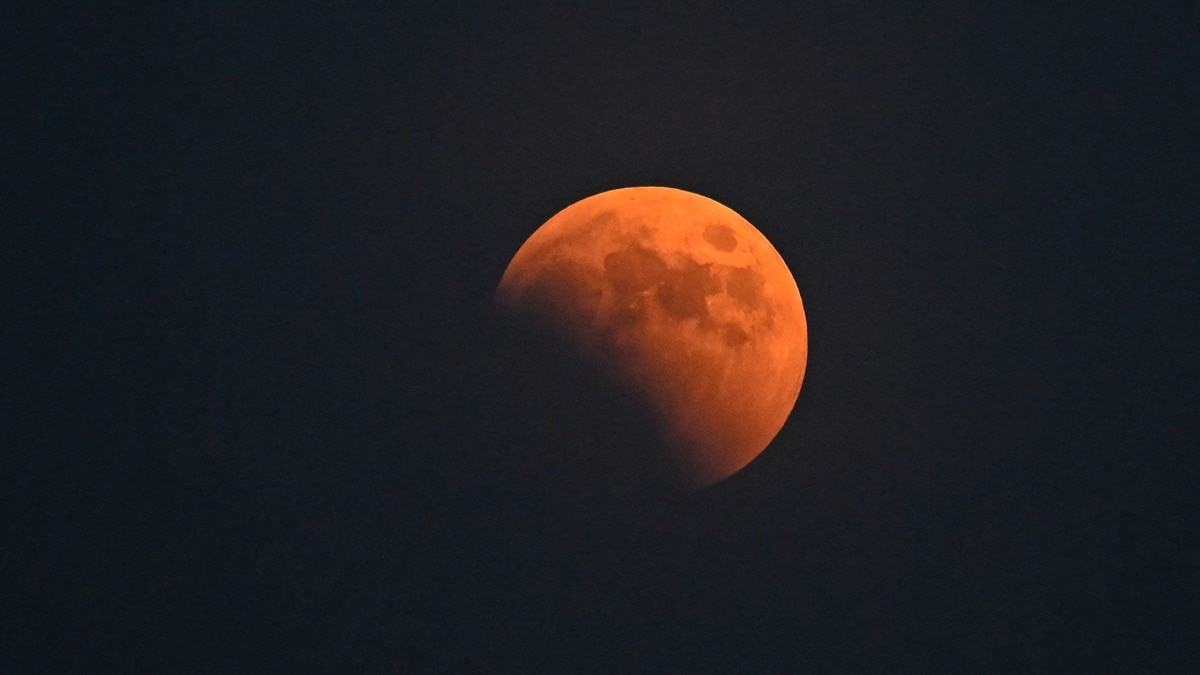
A lunar eclipse is set to unfold on August 28, when Earth will pass almost directly between the Sun and the Moon and push most of the lunar disc into its darkest shadow.The event will be a partial lunar eclipse, but a deep one.At maximum eclipse, about 93% of the Moon's diameter will be covered by Earth's umbra, the dark central part of its shadow. A lunar eclipse seen in Prayagraj, India. (Photo: PTI) About 96% of the Moon's surface area will be obscured, according to Nasa. The Moon will come close to totality, without actually becoming a total eclipse, missing the feat by a mere 4%.WHAT HAPPENS DURING A LUNAR ECLIPSE?A lunar eclipse begins when the Sun, Earth and Moon line up, with Earth between the other two. The Moon, on the other hand, shines by reflecting sunlight. During an eclipse, Earth blocks some of that sunlight from reaching the Moon, and its shadow stretches into space, forming two main regions. Of the two, the outer shadow is called the penumbra, where the Moon becomes only slightly dimmer because some sunlight still reaches it.Deeper inside is the umbra, where Earth blocks direct sunlight.A partial lunar eclipse occurs when only part of the Moon enters the umbra.On August 28, the Moon will plunge unusually deep into this darker region, leaving only a small bright portion outside it.Nasa has said that the partial phase of the lunar eclipse will last for about 3 hours and 18 minutes.When Earth stands between the Sun and Moon, darkness becomes beautiful.During a total lunar eclipse, Earth’s shadow sweeps across the Moon, while sunlight filtered through our atmosphere gives the lunar surface a haunting reddish glow. For a few hours, the Moon becomes a pic.twitter.com/aiy8zX0xBU— Stellarix (@Stellarixorine) August 18, 2026WHY DOES THE MOON TURN RED?The eclipsed part of the Moon can take on shades of red, orange or copper as sunlight passes through Earth's atmosphere before reaching the lunar surface.Earth's atmosphere scatters blue light more readily, while red and orange wavelengths travel through it more easily.Some of that light is bent towards the Moon, producing the reddish glow associated with lunar eclipses. It is the same basic reason sunsets can appear red.But there is a caveat for skywatchers in India. A diagram showing the lunar eclipse. (Photo: Sky&Telescope) The lunar eclipse will occur during daytime in India, with the partial phase beginning at about 8:03 am IST and the maximum eclipse occurring around 9:44 am IST.The Moon will be below the horizon for observers in India, so the event will not be visible from the country.The eclipse, which is the second lunar eclipse of 2026, following the total lunar eclipse in March, will instead be visible from parts of the Americas, Europe, Africa and Western Asia.- EndsPublished On: Aug 21, 2026 15:53 IST
Lunar eclipse next week: What will happen when Moon, Sun, Earth line up?
Full Article
Original Source
Read the full article at Indiatoday →KhanList aggregates and links to publicly available news content. We do not host full articles from third-party sources. Always verify important information with original sources.