
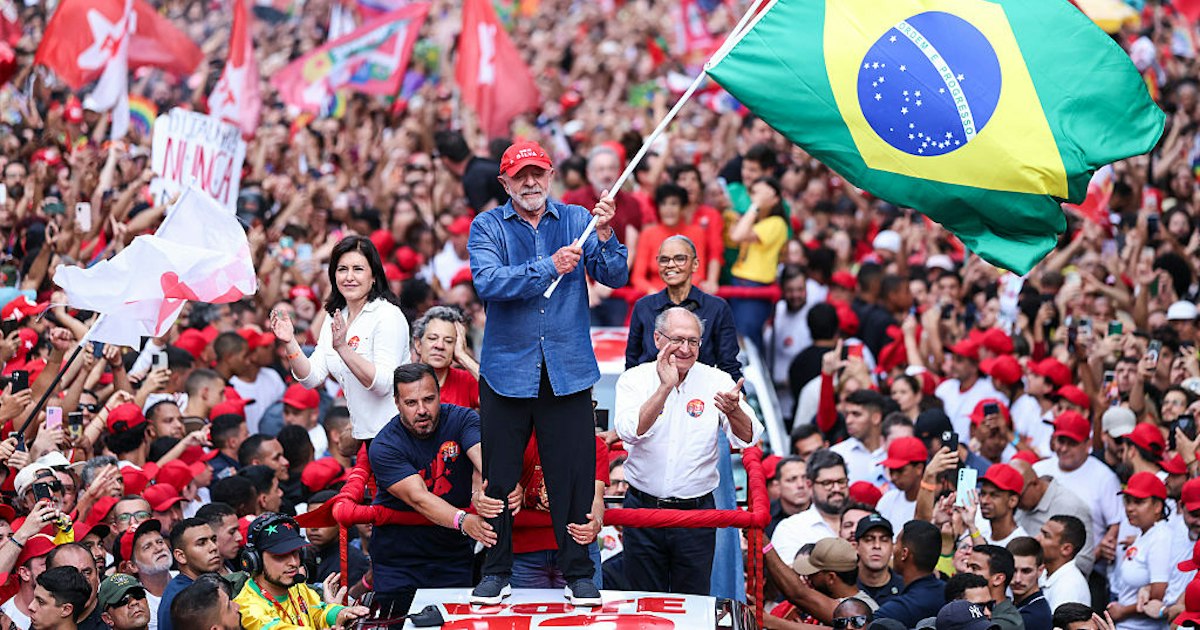
Latin America The left-wing incumbent’s fresh policies were largely reversals of those he implemented previously. Photo by Alexandre Schneider/Getty Images On the eve of the second round of Brazil's presidential election, every major research institute believed that Flávio Bolsonaro would win. Even Lula voters were pessimistic. Things began to change when the Workers' Party (PT) asked the Superior Electoral Court to extend the voting time by two hours (that is, until 7 p.m.) in Salvador and nearby cities, arguing that Bolsonarist mayors had made it harder for residents to vote by reducing the number of buses. This is not an unusual accusation, and the higher courts are generally seen as favorable to Lula. (Even though the president of the electoral court happens to be a justice appointed by Bolsonaro, his decisions were disregarded by fellow members.) Notably, Salvador votes heavily for Lula. But the transit difficulties were caused—at least in part—by the activity of Lula’s partisans themselves. Trade unionists glued PT stickers on buses while they were still in the garage; because such advertising would constitute a crime under Brazil's election laws, city workers had to remove the stickers before the buses could start their routes. By 10:30 a.m., traffic was more or less back to normal. When the PT used this to ask the courts for an extension, Flávio’s campaign did the same, arguing that some southern cities whose voters tilt toward him should have their polling hours extended to account for weather-related issues. The surprise came when the PT went further, and asked not the Electoral Court, but the Supreme Court, to keep the polls open until 7 p.m for the entire country. The Supreme Court, operating under an unaudited system, picked Cristiano Zanin, Lula’s former personal attorney, to decide the matter. And Zanin ruled as his former client wanted. (The decision also created ambiguity around voting machines: Some machines had already been sealed in anticipation of a 5 p.m. closure, and the Court’s decision did not allow these to be reopened). Following this decision, Lula won the election, to the amazement of many Brazilians. What will happen next is unclear. It is worth noting that Brazil elected an opposition-controlled Senate with a penchant for impeaching justices. And we may also see appeals for help from outside Brazil, since Bolsonaro supporters are unlikely to get redress in their own country. Regardless of where such efforts go, it remains to explain why Lula’s performance was so poor up until the second round. A modest but persistent fact sums up Brazil's political reality: Lula’s campaign appealed overwhelmingly to the elderly. After over 16 years of PT rule, Lula failed to persuade Brazil's youth that a fourth term augured an auspicious future. In Brazil, presidents are limited to two consecutive terms but face no limit on the total number of terms. Thus, Lula served two terms between 2003 and 2010, handed things off to a PT successor, Dilma Rousseff, who served until 2016, and then himself returned to office in 2023. The interruption in PT governance consisted of Rousseff’s neoliberal Vice President Michel Temer (2016–19) and Jair Bolsonaro (2019–23), who currently is in prison and barred from running for office. In 2022, older voters compared the good times of Lula’s prior terms to the chaotic, Covid-hobbled Bolsonaro administration and concluded that the elder leftist could bring back the 2000s. Lula’s third term made it clear that he couldn’t. It’s well known in Brazil that Lula lucked out during his previous presidencies. During the 2000s, China became an economic powerhouse with 1.4 billion mouths to feed. Brazil, on the other hand, transformed into an agricultural dynamo, thanks in part to government-sponsored research conducted during military rule (1964–85). The country’s Central-West Region went from a barren land to a global breadbasket. Lula’s administrations have no comparable accomplishment; his most-celebrated feat was the reduction of poverty through an income transfer program called Bolsa Família, in which families received cash payments in exchange for sending children to school. Inspired by Milton Friedman's negative income tax, the program has precedents in the neoliberal administration of Fernando Henrique Cardoso (1995–2003). The key difference between Cardoso and his successor was the latter administration's more bountiful sources of funding. All things considered, one could argue that Lulismo is a neoliberal version of Chavismo. In both cases, the president relies on commodities to transfer income to the poor and win elections. Notably, each administration’s primary goal is maintaining itself in power, as opposed to spurring long-term development. But while Chavismo used Venezuela’s state oil company to raise funds, Lulismo depends on a cozy relationship with financialized agribusiness giants. Neither model worked, of course, and in Brazil the consequence has been the decimation of a once mighty manufacturing industry. The best the average Brazilian can hope for in 2026 is driving an Uber and complementing his income with Bolsa Família. Instead of doctors driving taxis as in Cuba, Brazil has engineers with student debt driving for Uber. In this regard, Brazil is similar to the United States, many of whose factories decamped for China and elsewhere, leaving behind a “basket of deplorables.” Of course, deindustrialization in Brazil came later, much of it happening during Lula’s first term. In 2004, Brazil signed an agreement recognizing China as a market economy, thereby dropping key anti-dumping barriers: a flood of cheap Chinese imports subsequently enraged São Paulo's Industrial Federation. Decades later, Brazilian industry has suffered another blow from the EU-Mercosur agreement, which Lula approved in 2025. Naturally, it benefits Brazilian agribusiness at the expense of manufacturing. What, then, was Lula doing to entice voters? During the campaign, he improvised three big commitments: shortening the work week, ending the so-called “shirt tax,” and banning online gambling. The first was embraced only under pressure from the upcoming vote. As for the shirt tax—a 20 percent import duty on small-value foreign parcels coming into Brazil—Lula himself created it in 2024. The tax was imposed on imports from websites like AliExpress, and was aimed at favoring Brazilian retailers while increasing tax revenue. In effect, Lula lauded undoing his own work as a great victory. Much the same can be said of online gambling, since Lula himself tolerated and regulated the industry following its initial approval by Temer. (Online gambling, of course, was a much appreciated source of tax revenue.) By the end of the campaign, the incumbent was making increasingly desperate attempts to shore up his candidacy. Just twelve days before the first round, he announced a 15 percent increase for Bolsa Família. When asked why he had gone more than three years without raising Bolsa Família despite inflation, he said he hadn’t realized the program had lost buying power. Lula also proposed a $80-a-month stipend for university students, as well as debt forgiveness for micro-entrepreneurs. Who exactly qualifies as an individual micro-entrepreneur? Anyone, potentially; the category was created during Lula’s second term, as a way of recognizing individuals otherwise lacking labor protections. In the end, Lula had nothing to offer Brazilians uninterested in living off of welfare. Voters, moreover, were concerned with many noneconomic issues such as crime, corruption, woke ideology, and judicial abuse. It’s no wonder then that Lula resorted to fear-mongering against his opponent. His campaign went so far as to insinuate that the evangelical Flávio Bolsonaro would dethrone Our Lady of Aparecida as the country’s patroness. (The authority for such a move lies with the pope.) With the legal-electoral outcome somewhat in the air but clearly trending toward upholding Lula’s victory, the question is whether the younger Bolsonaro would have been a better alternative to Lula and the PT. After all, Flávio is a close ally of Argentina’s Javier Milei, whose administration’s economic policies have increasingly subjected Argentines to something approximating a vegan diet. (Brazilians had hoped, however, that Flávio would follow a different path from that of his anarcho-capitalist neighbor.) Subscribe Today Get daily emails in your inbox The younger Bolsonaro’s candidacy also prevailed over that of São Paulo Governor Tarcísio de Freitas, who was favored by market-friendly Milei enthusiasts on the right. Naturally, that faction was supported by financial and agribusiness elites, many of whom embrace the environmental, social, and governance policies abhorred by Bolsonaristas. Adherents of this brand of market fundamentalism are also fond of financial jargon centered on spending cuts and “efficiency.” One such proponent, Flávio-advisor Daniella Marques, floated replacing civil servants with AI—a proposal which was subsequently seized upon by Lula’s campaign. While the elder Bolsonaro’s sons have no history of developmentalist politics, it seems this may have changed. Trump’s tariffs for instance have upended entrenched dogma over free trade on the Bolsonarista right. Last year, Eduardo Bolsonaro shocked both left and right by defending the legacy of the heterodox Brazilian dictator Getúlio Vargas, who, despite governing as an anticommunist, is often celebrated by leftists. More promising, however, was the backing of two of Lula’s former cabinet members, Aldo Rebelo and Roberto Mangabeira Unger, who broke with the president over his subservience to fanatical foreign and environmental lobbies. Rebelo is a former communist, while Unger is a Harvard professor and philosopher. The pair spoke with Flávio for over an hour, and all of them committed to a defense of Brazil’s sovereignty.
Lula’s Victory Is Surprising Because He Has So Little to Offer Brazil
Full Article
Original Source
Read the full article at Theamericanconservative →KhanList aggregates and links to publicly available news content. We do not host full articles from third-party sources. Always verify important information with original sources.