
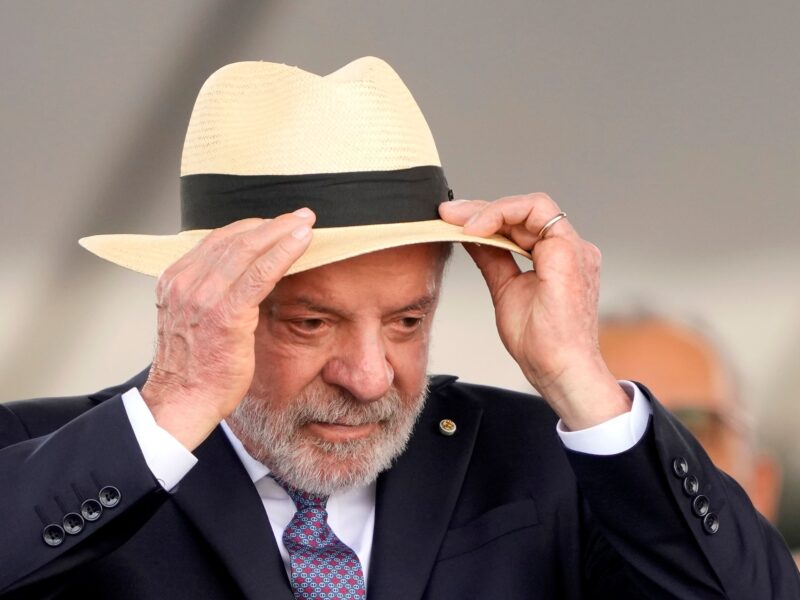
The current president is topping the polls in the Oct. 4 contest, but the son of imprisoned Trump fan Jair Bolsonaro is running a close second.RIO DE JANEIRO (CN) — Four years after defeating Jair Bolsonaro, Brazilian President Luiz Inácio Lula da Silva is seeking a fourth term, with the jailed former president’s eldest son as his main rival.Jair Bolsonaro is serving a 27-year prison sentence for leading an attempted coup after his 2022 loss.João Feres, a professor at Rio de Janeiro State University’s Institute of Social and Political Studies, said the Oct. 4 election will come down to the 80-year-old Lula and Senator Flávio Bolsonaro, son of the brash pro-Trump former leader.Lula, of the leftist Workers’ Party, is a former metalworker and union leader who served two terms as president from 2003-10. He was barred from running in 2018 while imprisoned on corruption convictions the Supreme Court annulled in 2021. His running mate remains Vice President Geraldo Alckmin, a former governor.Maria do Socorro Sousa Braga, a political science professor at the Federal University of São Carlos, said Lula favors state-led economic growth through state-owned companies and banks. His agenda includes strengthening cash transfer programs, raising the minimum wage above inflation and taxing the wealthy.Flávio Bolsonaro, of the conservative Liberal Party, has represented Rio de Janeiro in the Senate since 2019. With his father barred from running, the lawyer and four-term state legislator hopes to return their movement to the presidency alongside running mate Alfredo Gaspar, a federal lawmaker.Opposition presidential candidate Flavio Bolsonaro holds a photo of his father, former President Jair Bolsonaro, as he rides a boat during a campaign rally ahead of the October general elections in Angra dos Reis, Rio de Janeiro state, Brazil, Saturday, Aug. 29, 2026. (AP Photo/Bruna Prado)Braga said Flávio Bolsonaro combines privatization, spending cuts and deregulation with social conservatism. He also supports tougher criminal penalties and easier access to guns.Feres said the far-right movement remains centered on Jair Bolsonaro, whose personal appeal to voters does not necessarily transfer to his son.“On the other hand, Lula’s government has good results, but it has the problem of being in power at a time when politics remains deeply discredited in Brazil,” he added.Feres noted Flávio Bolsonaro faces fallout from negotiating 134 million reais (about $26.8 million) to finance “Dark Horse,” a film about his father, with Daniel Vorcaro, a banker jailed on accusations of leading one of Brazil’s largest banking fraud schemes.“Bolsonaro always staked his political capital on fighting corruption, so corruption allegations against his son strike at the heart of the far right’s agenda,” Feres said. “That doesn’t mean he will lose his loyal voters, but he will have greater difficulty winning over the undecided.”Flávio Bolsonaro also faces challenges building state and local alliances. Feres said competition among right-wing forces hampers those efforts, while the center-left has rallied around Lula.Federal police are also investigating Lula’s son, Fábio Luís Lula da Silva, known as Lulinha, over suspected influence peddling in attempts to secure deals with the Health Ministry. None were signed and he denies wrongdoing.Robson Carvalho, a political scientist and researcher at the University of Brasília’s Institute of Political Science, said scandals could create opportunities for other candidates.“The question is whether voters will be able to distinguish what is fact, what is false content and what is speculation,” Carvalho said. “Scandals, accusations and attacks end up prevailing over proposals.”Among other candidates, only psychiatrist and self-help author Augusto Cury, who presents himself as a centrist alternative, has gained a foothold.A Thursday Datafolha poll put Lula at 38%, Flávio Bolsonaro at 33% and Cury at 8%. The survey of 2,002 voters Sept. 1-2 had a margin of error of 2 points.Brazilian polling firm Quaest Wednesday put Lula at 37%, Flávio Bolsonaro at 29% and Cury at 10%. The survey interviewed 2,004 voters Aug. 30 to Sept. 1 and had a margin of error of 2 points.Presidential and gubernatorial candidates must win more than half the valid votes to avoid an Oct. 25 runoff between the top two finishers.Both surveys showed a close potential runoff: Datafolha put Lula at 46% to Flávio Bolsonaro’s 44%, while Quaest had them at 42% and 41%, respectively.The election will also shape the next administration’s ability to govern. Brazilians will elect all 513 members of the Chamber of Deputies and 54 of 81 senators, along with governors and legislators across 26 states, along with the Federal District, home to the capital, Brasília.Braga said the makeup of Congress will determine the next president’s room to maneuver.“The larger and more fragmented the elected opposition, the higher the ‘cost of governing,’” Braga said.Voting is mandatory for Brazilians 18-70 and optional for 16- and 17-year-olds, those over 70 and people who cannot read or write. About 158.7 million Brazilians are eligible to vote.Courthouse News reporter Marília Marasciulo is based in Brazil.Subscribe to our free newslettersOur weekly newsletter Closing Arguments offers the latest about ongoing trials, major litigation and rulings in courthouses around the U.S. and the world, while the monthly Under the Lights dishes the legal dirt from Hollywood, sports, Big Tech and the arts.Additional Reads
Lula tussles with next-generation Bolsonaro as Brazilian presidential race heats up
Full Article
Original Source
Read the full article at Courthousenews →KhanList aggregates and links to publicly available news content. We do not host full articles from third-party sources. Always verify important information with original sources.