
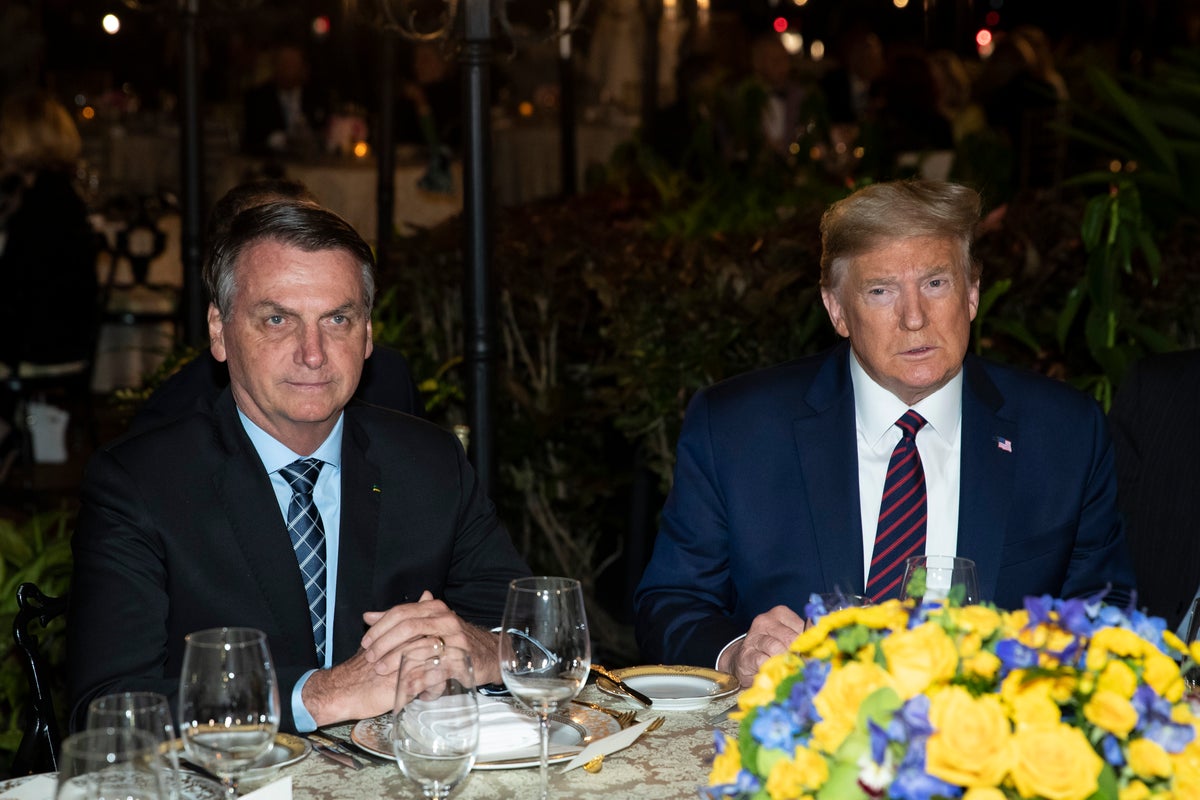
Latin America’s recent rightward momentum has stalled in Brazil, where voters ended an 18-month run of seven consecutive conservative presidential election wins across the region.Incumbent leftist President Luiz Inácio Lula da Silva defeated Flávio Bolsonaro on Sunday, winning 51.8 percent of the vote to 48.2 percent. The outcome limits President Donald Trump's efforts to extend influence over the Western Hemisphere, establishing Latin America's largest economy and most populous nation as a crucial counterweight to Washington. President Donald Trump, shown here alongside Jair Bolsonaro, father of defeated right-wing Brazilian presidential candidate Flavio Bolsonaro (AP)Had Bolsonaro won, Mexico's Claudia Sheinbaum would have remained the sole progressive president leading a major regional power.Analysts note that Lula’s success complicates plans by the Trump administration—which has deployed aggressive tariffs, severe sanctions, and military power to project influence—to recruit Brazil into an anti-cartel military alliance and secure favored access to its vital mineral resources.Despite these friction points, interests still overlap. Washington seeks Brazil's extensive rare earth reserves to lessen defense reliance on China, while Lula is pursuing foreign capital alongside tariff reductions for Brazilian exporters.Will Freeman, a Latin American studies fellow at the Council on Foreign Relations, pointed out that "Lula is pragmatic enough to work out some kind of modus operandi with the Trump administration," noting that allies of the Bolsonaro family in Washington will probably see their influence wane following a second electoral defeat. Flávio’s father, former President Jair Bolsonaro, lost to Lula in 2022.Brazilian president Luiz Inácio Lula da Silva celebrated an historic victory in the presidential elections on Sunday (AP)"I’m not sure anyone in the Trump administration, beyond a few individuals, will want to keep making the Bolsonaros the central issue in the U.S.-Brazil relationship," Freeman added.Frustrated by surging organized crime and financial instability, voters across much of Latin America have increasingly turned to presidential figures offering strict law and order. Conservative leaders recently voted into power—such as Peru’s Keiko Fujimori, Colombia’s Abelardo de la Espriella, and Chile’s José Antonio Kast—have aligned themselves with Trump and drawn inspiration from El Salvador’s President Nayib Bukele, whose heavy-handed crackdown on gangs significantly reduced murder rates through wide-scale detainments and suspended civil rights.Trump has supported this trend through campaign endorsements, financial bailouts, and millions of dollars in military aid."The U.S. is certainly putting its finger on the scale to try to help the more hard-line right-wing elements in the region," said Kenneth Roberts, a professor of government at Cornell University.Right wing leaders such as Peru's President Keiko Fujimori have alligned themselves with Trump in recent years (AFP/Getty)A victory for Bolsonaro would have represented Washington's most strategic gain. He pledged to enter the U.S.-directed security coalition "with great enthusiasm and great honor," putting his relationship with Trump at the heart of his campaign.In contrast, Lula has maintained Brazil's traditional nonaligned posture, fostering relations across competing global powers. His administration expanded commercial ties with China and pushed for greater international stature through BRICS, the alliance of developing nations.The Trump administration's overt support for the Bolsonaro campaign ultimately bolstered Lula's stance. Punitive double-digit tariffs placed on Brazilian imports—meant to retaliate against the prosecution of former President Jair Bolsonaro for an alleged coup attempt against Lula—sparked nationalist resentment that the leftist leader channeled into the rallying cry "Brazil belongs to Brazilians.""To the extent that the regional superpower becomes a threat to Brazil’s democratic institutions, defending Brazilian national sovereignty also becomes a form of defending Brazilian democracy," Roberts said.Brasilia has routinely turned away from joining the Shield of the Americas, the anti-cartel military coalition led by Washington.Supporters of Presidential candidate and incumbent president Luiz Inacio Lula da Silva of Brazil celebrate after the results on general election day (Getty)When the U.S. classified Brazil’s top criminal syndicates—the First Capital Command and the Red Command—as terrorist groups in May, Lula expressed concern that such designations could serve as a pretext for foreign intervention."We don’t accept being treated like children," he declared after the announcement. Addressing the fight against organized crime, he added: "We will fight them here at home."Nations situated along central northbound migration and drug trafficking corridors, frequently reliant on trade with the U.S., have shown far more willingness to cooperate. American forces in Ecuador have participated alongside local officers in counter-narcotics operations throughout coastal lowlands. U.S. Defense Secretary Pete Hegseth said Colombia, Guatemala, and Honduras signed off on collaborative military efforts, though officials in Guatemala rejected the claim."Brazil is not Honduras. It’s a large country with a very independent history and a military that would not look kindly upon foreign troops in its own territory," said Brian Winter, an analyst on Latin American politics and editor-in-chief of Americas Quarterly. "The Trump administration will have to walk a certain line here."Furthermore, Washington may feel less pressure to demand defense participation from Brasilia, as the majority of cocaine passing through Brazil is destined for domestic consumption or export toward Europe and Africa, rather than North America.A supporter of Brazil's right-wing Senator and Liberal Party (PL) presidential candidate Flavio Bolsonaro reacts while watching the results (AFP/Getty)Regarding critical minerals, Lula remains focused on maintaining national control over resources while ensuring open trade outside the U.S.Brazil possesses the second-largest reserves of rare earths globally, which are essential for manufacturing components in electric vehicles, wind turbines, smartphones, and guided missiles.USA Rare Earth, a firm backed financially by the U.S. government, finalized a $2.8 billion acquisition of Serra Verde—a Brazilian mining operation producing four key rare earth elements outside Asia—last month. Spurred by Washington's growing footprint, Lula's government accelerated measures to strengthen state regulation of key mineral assets."Revisiting the Serra Verde–USA Rare Earth deal may not be the first thing that Lula does when he’s reelected, but it’s on his radar," said Monica de Bolle, a senior fellow at the Peterson Institute for International Economics.Data from the U.S. Geological Survey shows Brazil supplies approximately 90 percent of global niobium, an element essential for rocket engines, jet propulsion, and military hardware. Consequently, any restrictions Brazil imposes could hamper U.S. defense production."Brazil has leverage," de Bolle said. "With Lula, the U.S. is on shakier ground."Despite his firm rhetoric, Lula has also pursued pragmatic engagement with Trump. A May visit to the White House to address trade, critical minerals, and organized crime challenged the Bolsonaro camp's assertion that only conservatives could manage relations with Washington.Further negotiations with Trump regarding trade tariffs remain inevitable, alongside difficult maneuvering in Brazil's Congress, where conservative gains in the October 4 elections denied Lula a legislative majority for major policy initiatives. This defeat for a Trump backed candidate comes as the president is traveling across the country in support of conservative candidates in the midterms (AP)Entering a new term following three previous stewardships, Lula faces a populace eager for reduced living costs and improved public safety."Lula has his hands tied," said Guilherme Casarões, an associate professor of Brazilian studies at Florida International University. "Pretty much everything he has tried to do has been blocked in Congress."Throughout Latin America, political alliances formed against shared adversaries have frequently fractured under the strain of governance. Trump’s ideological allies in Peru, Bolivia, and Chile are already seeing public support erode, indicating the broader conservative wave may prove temporary. While Lula resisted the anti-incumbent sentiment sweeping the region, maintaining his standing will depend on his ability to negotiate with political adversaries at home and abroad to meet public expectations.
Lula deals Trump a blow with Brazil election victory that ends Latin America’s right-wing streak
Full Article
Original Source
Read the full article at Independent →KhanList aggregates and links to publicly available news content. We do not host full articles from third-party sources. Always verify important information with original sources.