
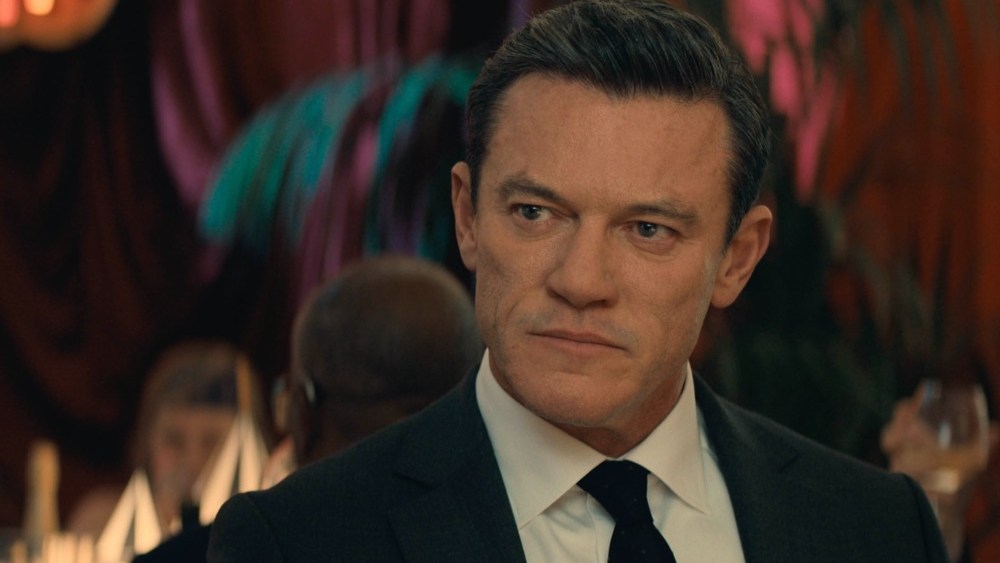
Luke Evans is among the rare cadre of British actors who regularly balance Hollywood blockbusters with more modest British dramas. Not to mention the actor, who has starred in movies as diverse as “The Hobbit” trilogy and the live-action “Beauty and the Beast” opposite Emma Watson, also recently came off a five-month stint Broadway stint as Frank-N-Furter earlier this year, for which he was nominated for a Tony. His latest project is “The Party,” an adaptation of a psychological thriller by Elizabeth Day, which he also co-produced, for ITV. (The five-part series, which is repped for global sales by ITV Studios, is currently available to watch on ITVX). The show deals with class, hidden sexuality and the nature of both romantic and platonic love all wrapped up in a tense drama. Popular on Variety Evans, who first came across Day’s novel as a lockdown read during the Covid pandemic, was instrumental in bringing the series to screen and in getting Sarah Solemani to adapt it (Solemani also plays his wife, Lucy, in the show). Evans sat down with Variety to talk about the differences between the novel and the series, his recent experiences on Broadway and whether Tolkien fans can expect him to reprise his role as Bard the Bowman in Andy Serkis’s upcoming feature “The Hunt for Gollum.” How much did you and Sarah discuss the changes between the source material and the screenplay? When you bring somebody on who has the capability of someone like Sarah, you have to let them run with it, and it was exciting and also daunting to know what she was going to change, but also we knew things would change. The fact that Lucy is pregnant adds another major layer of weight to what is going on in Martin’s head, and also that you know they had a physical relationship, and I think that informs something more about how messed up the life Martin has chosen to live is. There is a love there, and I think that’s another reason why we expanded on their relationship. You see much more of Lucy and Martin together because you want to see that they are a functioning, if slightly unconventional, relationship. I know couples like Martin and Lucy. The other big difference is that Martin in the screen version serves time and he doesn’t in in the novel. What was the thinking behind that change? Putting him into detention to pay the price for someone else, it’s a scar that — he’s tarnished for life. He has a criminal record and lives his life knowing he didn’t do it, I mean it’s huge. It’s massive. What did you want to bring to the character of Martin? Sarah and I had very, very long Zoom calls where she just asked me lots of questions about my upbringing, and of course I started saying I can relate to Martin. I’m a gay man. I’ve come from a very working-class background, and I was presented with opportunities that I took that put me in very alien situations where I didn’t feel comfortable or an insider, but I kept watching, learning, adapting, and trying to fit in. I basically spent my whole life doing that, and that’s who Martin is. I talked about the fact I’m an only child, a very religious background, and Sarah took a lot of those ideas from my life or real things that happened to me and turned them into Martin’s story. So of course, there are slight parallels, which is interesting and it works. Elizabeth revisits the characters in another book, “One of Us.” Does the show lend itself to potentially being returning series? Yeah, absolutely. There is closure for sure within this arc, of course there needs to be, but there are lots of unanswered questions. “One of Us” came out during the end of the shoot, which was exciting and teased us with lots of new ideas. Who knows? As well as “The Party,” there have been a number of shows recently, like Richard Gadd’s “Half Man” and Russell T Davies’ “Tip Toe,” that have explored male relationships and homophobia. Do you think there’s a reason these stories are being told now? As much as we live in a more progressive society, and I think we’re very lucky — I’ve just been in New York and America for seven months, and of course, New York is this little world of its own where everybody can do what the hell they want, and everybody’s accepted — I know that’s not how the country is. I feel that we have progressed in the United Kingdom very far when it comes to equality and it comes to being yourself and an acceptance of each and every one of us. But it’s not by a long shot safe. What we have right now is not safe. You only have to look at the politics, and you have to look at the parties, and some of them, what they’re saying, it’s scary. And I think those kinds of whispers of threat to your life and your existence and your authenticity and your identity can suppress people and can make people hide away, and I do think people do. In my industry I know for a fact that happens. I couldn’t because I was already an openly happy gay man before my movie career began, and so I knew it would become a public knowledge/gossip column idea for a period of my career because I knew people would find out and there was nothing I could do about it and I had to accept it. And then we’re talking about Martin’s industry and the political world, and on top of why Martin suppresses it or hides is because Ben has chosen a certain life, and for Martin to be in Ben’s life, Martin has to be a certain way also. On the other end of the spectrum, you recently played Frank-N-Furter in the Broadway revival of “The Rocky Horror Picture Show.” How was that? It was nuts. It was not what I was expecting. In a wonderfully colorful, big way. It delivered on so many levels I wasn’t expecting. I absolutely loved it. Probably one of the hardest things I’ve ever done. After not doing a musical for 18 years, to set foot on a Broadway stage with a Broadway audience in six-[inch] stiletto boots, eight times a week, was a cross-country marathon, I would say, but I loved it, and it was so rewarding. And then to get a Tony nomination, it was — it just kept delivering. Tim Curry, who originated the role and of course played him in the iconic film adaptation, died just after you finished the show. Had you spoken to him about it? I wrote a letter to him two weeks before I finished the show, and I sent it to him, and his team gave it to him, and he said he was very appreciative of the letter, and then two weeks later I finished the show, and a day after that he died. I was part of that final show that was associated with him and him with us. And he was in my mind every day. I had a picture of him in my dressing room, and so I’m just so grateful I sent the letter and that I was part of that incredible show. It was magical. Another cult project you’ve been involved with of course is Peter Jackson’s Tolkien adaptations, having starred as Bard the Bowman in “The Hobbit” trilogy. Are you returning for Andy Serkis’ sequel, “The Hunt for Gollum”? Well, if I’m correct, Bard is a human. I don’t think he would have been born, or is he dead? Is it in between? It’s in between. But how far after “The Hobbit” is it? I think there’s approximately 60 years between “The Hobbit” and “The Lord of the Rings” and “The Hunt for Gollum” will be set in between – so Bard could come back. Yeah, I think Bain, my son, could be in it. But I think Bard doesn’t. Take me back to Wellington. I’d love to go! This interview has been edited and condensed.
Luke Evans on His New ITV Drama ‘The Party,’ Starring in ‘The Rocky Horror Picture Show’ on Broadway and Whether He’ll Return as Bard in ‘The Hunt for Gollum’
Full Article
Original Source
Read the full article at Variety →KhanList aggregates and links to publicly available news content. We do not host full articles from third-party sources. Always verify important information with original sources.