
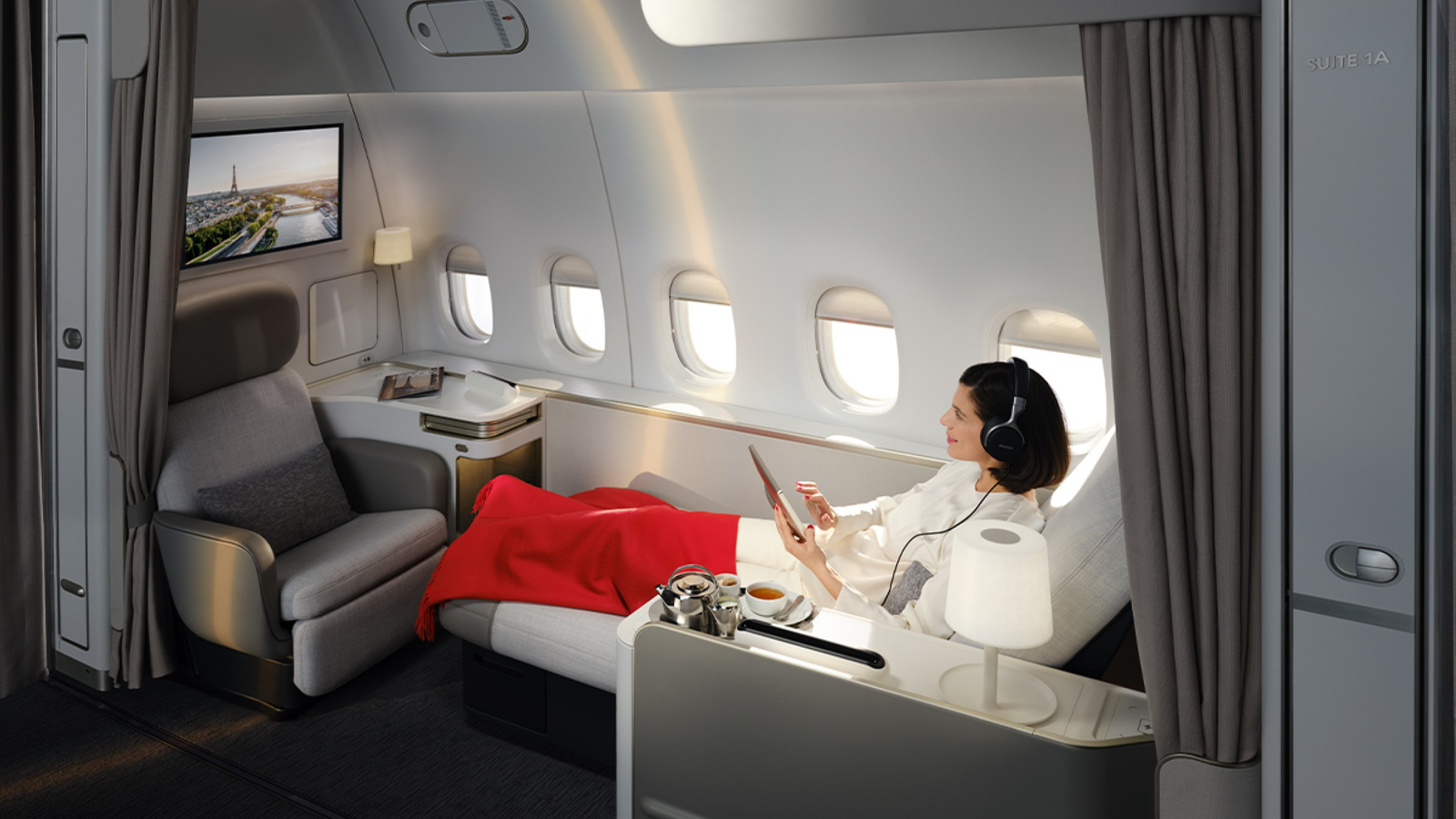
Published Aug 25, 2026, 11:00 AM EDT Ethan is an aviation professional with a degree in Aviation Management with Flight from the Florida Institute of Technology. He previously wrote aviation and tourism features for Florida Tech’s student newspaper, The Crimson, where he developed a clear, reader‑focused reporting style. Aviation journalism has remained a consistent priority throughout his career. He currently holds a Restricted ATP and Commercial Multi‑Engine Pilot certificate and works in aviation supply chain and aircraft component repair. Alongside his industry role, he is pursuing his Certified Flight Instructor rating and actively building flight experience. A lifelong aviation enthusiast, Ethan spent countless hours at Raleigh–Durham International Airport’s observation deck studying air traffic and practicing amateur photography and videography. Privacy is the top benefit for travelers choosing to fly in business or first class in today's premium cabins; for years, premium cabins were simple and scaled down compared to most of today's offerings. Pan American World Airways was famous for its glamorous brand of flying, and they configured their first class cabin in an open seating layout, typically 2-2 or 2-2-2. Lie-flat seats did not yet exist in this market segment; rather, seats provided recline only. The days of 2-2-2 international first class on keystone trunk routes have effectively ended in 2026, aside from niche routes on equipment that has not been dubbed flagship. While Air France's product has been a pioneer in the modern first-class international product in many ways, they are differentiated from other products in one key way: Air France refused to install doors on their La Première first class products. Most notably, Air France's largest competitor, Lufthansa configures its Allegris product with a solid door rather than a curtain, per its website. What Air France Actually Built Credit: Air France | Simple Flying The national airline of France has configured each La Première seat with ample space. According to Aircraft Interiors International, the seat features five windows, measuring at 37.7 sq ft. This is 25% larger than the existing 777 seats on non-La Première equipped aircraft. The pod itself also gives passengers a separate seat and chaise lounge which can be configured into a two-meter bed. Finally, each aircraft, 777-300ER only per Air France, includes only four suites. While each suite can accommodate up to two passengers, the product is still associated with extreme exclusivity. Other notable features of La Première include dedicated check-in, security, lounges, and transfers directly to the aircraft, most of which are separate from economy passengers. The suite debuted in 1933 with its original first class, whereas the suite known today was announced in 2014. 2025 brought a refresh to the product, including enhanced Michelin-gourmet dining and extra privacy via a fabric curtain enclosure. As announced in 2026, the product's success will include expansion to Hartsfield-Jackson Atlanta International Airport, Houston George Bush Intercontinental Airport, and Boston Logan International Airport as reported by Aeronautics Magazine. La Première is a leader in physical size for its segment. Measured at 37.7 sq ft, this is a size leader in the transatlantic segment. If the suite is this large, why avoid the sliding doors that competitors consider essential for privacy? Why Air France Rejected Sliding Doors Credit: Lufthansa The presence of a curtain may create privacy without claustrophobia. With comfort and aesthetics in mind, Air France may have been aiming to offer breathing room rather than a sealed pod. One can also speculate that the curtain adds a sense of theatrics, as privacy between the center suites is provided at the touch of a button by a full-height, electric sliding partition. Air France also highlights that the 25% increase in space over the previous 777 suite gives back to the passenger space that would otherwise have been lost to door installation. Fodor's reports that Air France has eliminated an abundance of plastic fixtures in the suite with the omission of doors and overhead bins: "Overhead bins are also gone, with carry-on bags being fitted into a sliding drawer that comes out of the bedside table." Lufthansa, however, has fully committed to the sliding door structure used by many other carriers, such as Etihad Airways and Singapore Airlines. If Europe is split on privacy philosophy, what caused this divergence? Further, why is Europe reinvesting in first class at all — and why now? The European First Class Reinvestment Credit: Air France | Simple Flying International flying has seen a prominent post‑pandemic shift: high‑net‑worth leisure demand surged. As stated earlier, with Pan Am's simple 2-2-2 layout, the evolution of first class as it is today is dramatic, and recently due to an uptick in premium travel demand post-pandemic. As reported by Conde Nast Traveler, a select "cadre" of premium airlines still offer small premium cabins on international flights, such as Emirates' Premium Economy; many features of this service could be similar to a 1990's TWA first class. As reported by Aviation Week, Airbus' head of cabin market insights—cabin marketing Stefan List states there is a “high demand” for first-class travel. Now, airlines are slowly reintroducing it, driven by three factors: passenger segmentation for high‑value brands, fleet renewals that favor widebody aircraft like the A350, and specific high‑premium routes where first class still performs well. Top‑tier airlines are expected to maintain first class offerings to uphold their brand prestige. A new surge in first class demand is the main driver of enhanced first class features and also boosts the confidence for carriers to experiment with fundamentally different features, such as the curtain. If Europe is reinvesting, how does Air France’s open-plan approach change the competitive landscape? The Strategic Split Inside European First Class Credit: SWISS The divide inside European first class becomes clearest when you look at the physical architecture of the cabins themselves. Lufthansa’s Allegris program is built around hard‑door suites that create a sealed micro‑environment, a design that requires reinforced door tracks, additional latching mechanisms, and compliance with stricter certification rules. Air France, by contrast, engineered La Première around open-plan privacy, using floor‑to‑ceiling curtains that eliminate the structural weight and certification complexity of doors while preserving a sense of spatial continuity. This is not only a cosmetic difference, but rather a fundamental divergence in how European carriers believe luxury should feel at 35,000 feet. The hard‑door philosophy is anchored in quantifiable decisions. Lufthansa’s Allegris suite doors reach nearly full height and add measurable mass to each seat module, contributing to the program’s €2.5 billion investment. Air France’s curtain system, however, reduces weight, simplifies certification, and allows the cabin to maintain a long, uninterrupted visual line across its five‑window suite length. This architectural split creates a strategic question that goes beyond design: if Europe’s flagship carriers are now building two incompatible visions of ultra‑premium travel, which one will shape the next decade of first‑class development? The answer depends on how passengers respond to the tension between privacy through enclosure and privacy through space, a tension that becomes sharper as more airlines commit to one side of the divide. What Air France’s Bet Means for the Future of First Class Credit: American Airlines Air France’s open-plan luxury could reshape future cabin design. While first-class cabins are not meant to be a cost-cutting area amid strong premium travel demand, other airlines may take note of Air France's reduced weight and installation costs for curtains. Claustrophobia concerns, space-first luxury, and emotional comfort are also possible reasons for the implementation, although unconfirmed. Aviation Week also reported that American Airlines' CCO Vasu Raja does not see the same uptick in demand for first class specifically; rather, business class demand has been growing in the wake of the post-pandemic travel boom. However, as American Airlines is in the worst financial position of the "big three" United States-based legacy carriers, something like a curtain may help reduce costs in a potential first class retrofit. The comparison between doors and curtains may come down to this: Will ultra-premium travelers ultimately choose space or enclosure? Do the solid doors on Lufthansa Allegris pull some passengers away from the product because of the perceived privacy they offer? Or will Air France succeed with the new curtains, proving the value of a creative alternative? The Open Question That Will Decide First Class’s Future Credit: Shutterstock The deeper implication of Air France’s curtain‑first philosophy is that the future of first class will be shaped not by who builds the biggest suite, but by who correctly predicts what ultra‑premium travelers actually want. If Lufthansa and other competitors are betting that privacy means enclosure, Air France is betting that privacy means space, reflecting a fundamentally different definition of luxury that challenges the industry’s assumptions. The next decade of cabin design will hinge on which interpretation proves truer at 35,000 feet. The clearest test will come from decisions already in motion: Lufthansa’s full Allegris rollout timeline, British Airways’ 777 First retrofit pace (currently in progress, as reported by PrivyTrips Blog), and Air France’s next long‑haul fleet order; this will determine whether the curtain‑based La Première architecture scales beyond the 777‑300ER, to a potential retrofit of the A350, 787, or even smaller A330 fleets. These hard, measurable milestones, such as delivery schedules, certification filings, and cabin layout disclosures, will all reveal whether the market rewards enclosure or openness. Designers are increasingly talking about apartment-style first-class suites, a movement toward cabins that feel like private homes rather than sealed pods. If that philosophy continues gaining traction, Air France’s contrarian bet may prove prescient. But if the industry’s door-installation habit remains prevalent, the curtain suite could become a meaningful outlier. Air France's legacy La Première product will most likely not fail as a whole if the curtain does not resonate with customers.
Lufthansa Spent $2.8 Billion On Hard-Door Suites — Air France Bet On Curtains Instead
Full Article
Original Source
Read the full article at Simpleflying →KhanList aggregates and links to publicly available news content. We do not host full articles from third-party sources. Always verify important information with original sources.