
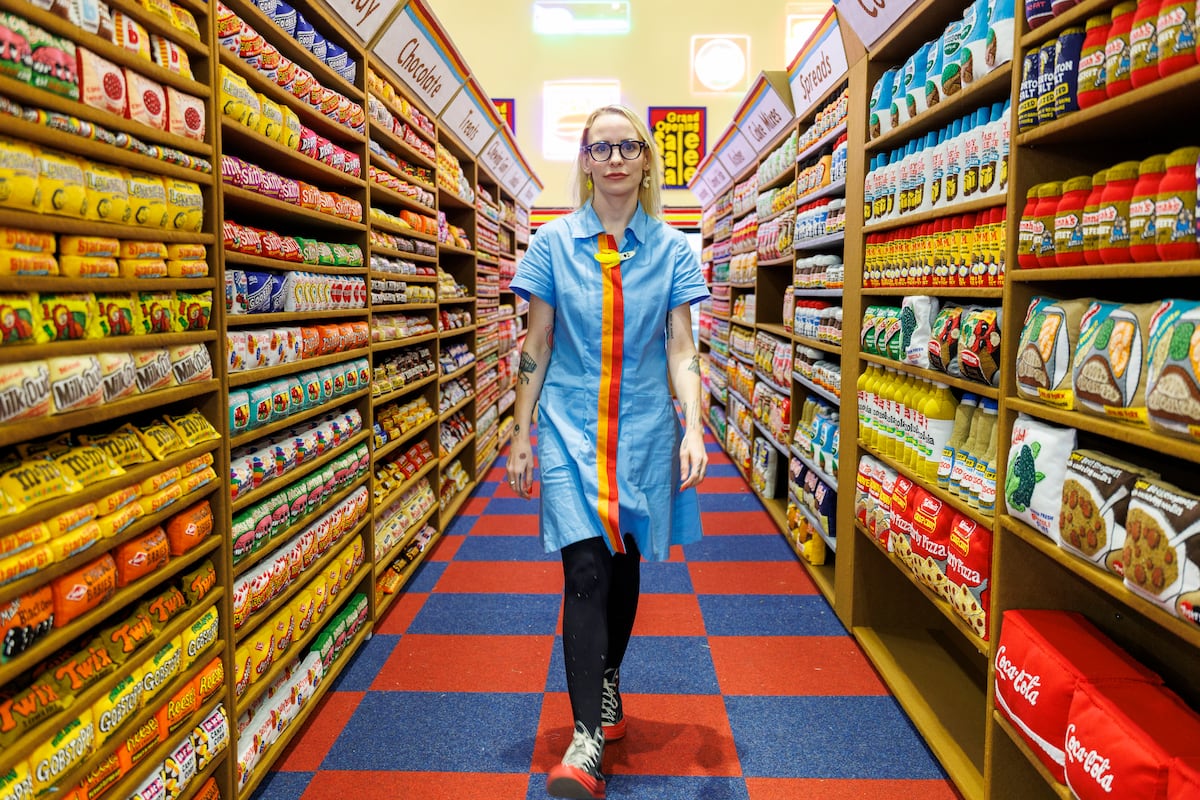
Lucy Sparrow, 40, is one of the world’s most disruptive creators. Her works — set in everyday, communal environments in order to be “immediately recognizable to any audience” — have grown in ambition, scale and scope since her first installation, Corner Shop, in 2014.“It was a traditional British neighborhood shop that I filled with 4,000 handmade felt objects,” Sparrow tells EL PAÍS. “After the success of that exhibition, I took on the challenge of bringing my artistic practice to ever-larger, more complex shows, culminating in the 1,000-square-meter installation currently on view at The Momentary museum in Bentonville, Arkansas.” The installation in question is a supermarket in which every single product has been handmade by Sparrow. It contains more than 20,000 felt pieces replicating all manner of items, from food packaging to films stocked in a 1980s video rental store.“I describe my practice as creating parallel universes made of felt,” she says. “These spaces, universally recognizable and familiar, allow me to make work that is intimate, nostalgic and playful. My first job was restocking shelves in a supermarket in the United Kingdom, so I like to think this is a natural evolution.” The exhibition is called The Beginning of Convenience, and the artist admits that the title may be somewhat misleading. “Because I hand-make absolutely every piece in my installations, the process requires an enormous amount of work,” she explains. " When I have to complete a large-scale project, I often work extremely long days — I start at 6:00 a.m. and continue until about 10.00 p.m. So in the studio we have an ongoing joke: saying that putting together The Beginning of Convenience was anything but convenient.”Sparrow is presenting the largest exhibition of her career to date and was determined to make a real impact. The supermarket alone covers more than 1,200 square meters and contains far more detail than any of her previous installations: the aforementioned video rental store, a pharmacy, a snack bar, a Kodak counter, as well as the refrigerators, freezers and shelves one would expect to find in a conventional supermarket.“Not only that, but there is also a documentary we made to show the behind-the-scenes process, as well as three vintage American adverts we shot with my studio team in the United Kingdom,” she says. “The final room is a recreation of my U.K. studio, featuring a banana wall as an homage to my banana room, which is filled with 3,000 plush bananas.”The work required 18 months of production and four weeks of installation, which is why Sparrow says finishing it felt special: “I felt absolute euphoria seeing the work completed,” she says. “It is hard to describe what you feel when the exhibition opens and the first members of the public enter the space. Seeing how my work can transport them to a playful, nostalgic place is incredibly rewarding.”Despite the many interpretations viewers may draw from the installation, Sparrow is keen to stress that she does not see it as a sociopolitical statement. “My work has never been intended as a comment on consumerism,” she says. “It is a celebration of the communal spaces where we all spend a large part of our lives. It’s about creating joy and nostalgia in an environment that feels familiar to everyone.”Sign up for our weekly newsletter to get more English-language news coverage from EL PAÍS USA Edition
Lucy Sparrow, the woman who sewed a supermarket: ‘I create parallel universes made of felt’
Full Article
Original Source
Read the full article at English →KhanList aggregates and links to publicly available news content. We do not host full articles from third-party sources. Always verify important information with original sources.