
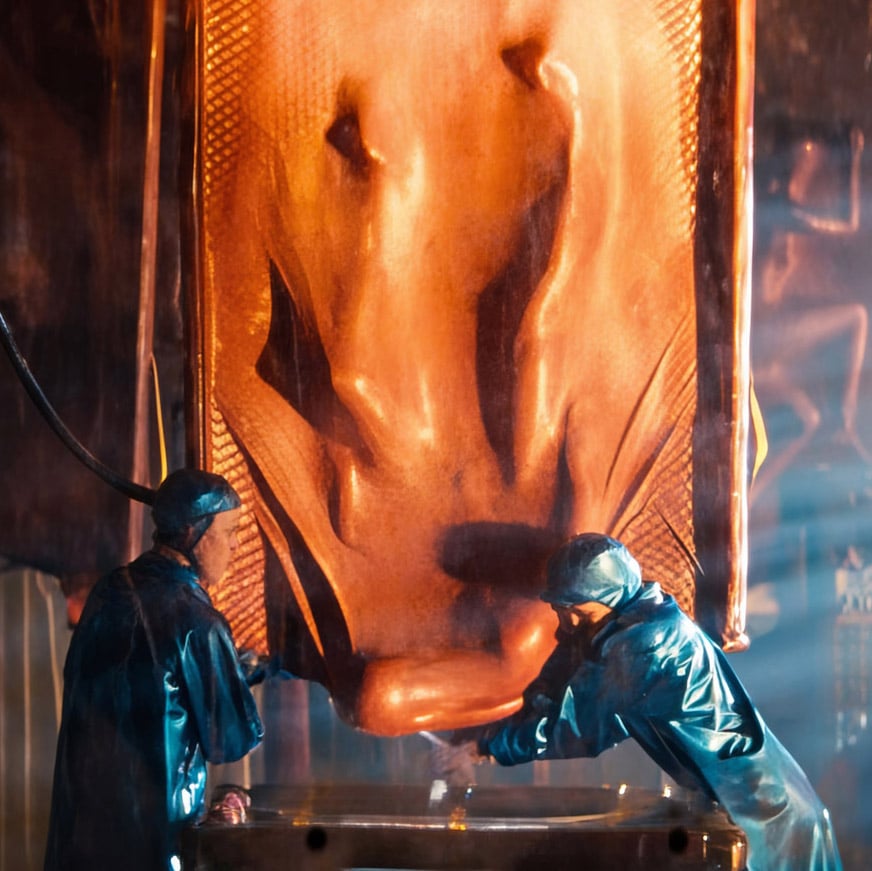
Los Angeles-based artist Lucy McRae has created tactile, custom-made designs for sci-fi mini-series Blade Runner 2099 that veer away from the traditionally cold and metallic aesthetic of the films. The show, which premiered on Wednesday on Amazon Prime, is the latest in the Blade Runner universe and follows Cora, a human fugitive played by actor Hunter Schafer. She goes undercover as a replicant – a synthetic human – blade runner with veteran replicant Olwen, played by actor Michelle Yeoh, to track down a runaway carrying a secret that could destabilise the city. Lucy McRae designed a healing machine used in Blade Runner 2099 McRae joined the production in 2022 as the official futurist of the show, after showrunner Silka Luisa saw her previous work exploring the relationship between emerging technology and human biology. Her speculative work on body futurism later became direct visual references for the show and McRae was asked to speculate on human consciousness in 50 years’ time, with a specific focus on memory, bio-engineering, replicants’ sensuality, sex and family. “I created a world-build of those questions, through scale models, building concepts through physical materials,” McRae told Dezeen. “These ideas begin to transpire within the show.” McRae created a series of future-oriented speculative design McRae designed the film’s birth bags, which are incubator-like sacks used to birth or transform replicants. She also made the crèche set, the facility and replicant birth system that support the birth bags, as well as a skin polymer traction machine that was used for healing the protagonist Cora. McRae also designed the material and colour palette for replicants, which includes pipes, quilting and industrial materials that fit the interiors of Olwen’s spacecraft and the padding around the traction machine. The birth bag is a new iteration of McRae’s Compression Cradle, a project presented at the 2019 Milan Triennale exhibition Broken Nature. It was a machine that offered a simulated hug to a person craving intimacy using an inflatable device. Her previous work, Compression Cradles, directly informed the replicants’ birth bags In Blade Runner 2099, the design scale expanded dramatically, with nine vertical Compression Cradles created inside the Tyrell building where they functioned as birth bags in the show. McRae often describes herself as a “body architect”. At Future Sensitive, the art-research lab she leads, her work revolves around using the body as a means to speculate on the future. A few of her recent projects have explored what McRae calls the touch crisis – the idea that, with the rise of technology, digital devices might start to vie for human affection, and physical contact with other humans might suffer as a result. The concept of Heavy Duty Love was also referenced in the show Her Heavy Duty Love, for example, created for the Venice Architecture Biennale 2021, imagines a machine replacement of a parent’s embrace in a world where humans are grown in artificial wombs. With The Future Day Spa, meanwhile, she presented a machine that could replace human contact altogether. McRae’s says her focus on material tactility – such as creases, wrinkles, and squishy textures – adds a femininity to the show. The series is built on the sci-fi intellectual property that followed from the original 1982 film and its aesthetic was historically labelled as metallic, cold, slick and masculine. “The physicalisation of the work I do, the texture, achieves the femininity the show was after,” said McRae. “It’s an absolute masterpiece where both violence and femininity coexist.” McRae explored various conditions of skin covering the human body, a pregnant body and the ageing body She also believes that by domesticating science and rendering technology malleable and wet, it creates a positive future that feels within human grasp and participation. “It feels positive because it feels within my grasp. I feel I can participate and I can contribute,” said McRae. “Whereas if it’s a future that doesn’t look or feel or belong to something that I understand, then it feels like it’s a closed door.” The designer said her work for the series, and in general, aims to focus on plausible futures rather than pure fantasy, while raising open-ended questions and encouraging audiences to navigate uncertainty with hope. “What’s important for Silka and for my work is that anything I’m dealing with is never fantasy,” said McRae. “I think physicalising possibility allows us to wear it, touch it and be able to get close to something that is far away but then allows us to see if it’s a fit, see if it belongs.” “What I’m trying to do is create opportunities for people to ask these questions themselves and for me to not answer them. It’s going to be open-ended and unanswered because we don’t live in a world where one answer or many answers fit.” Read more
Lucy McRae creates replicant birth bags for Blade Runner 2099 show where "violence and femininity coexist"
Full Article
Original Source
Read the full article at Dezeen →KhanList aggregates and links to publicly available news content. We do not host full articles from third-party sources. Always verify important information with original sources.