
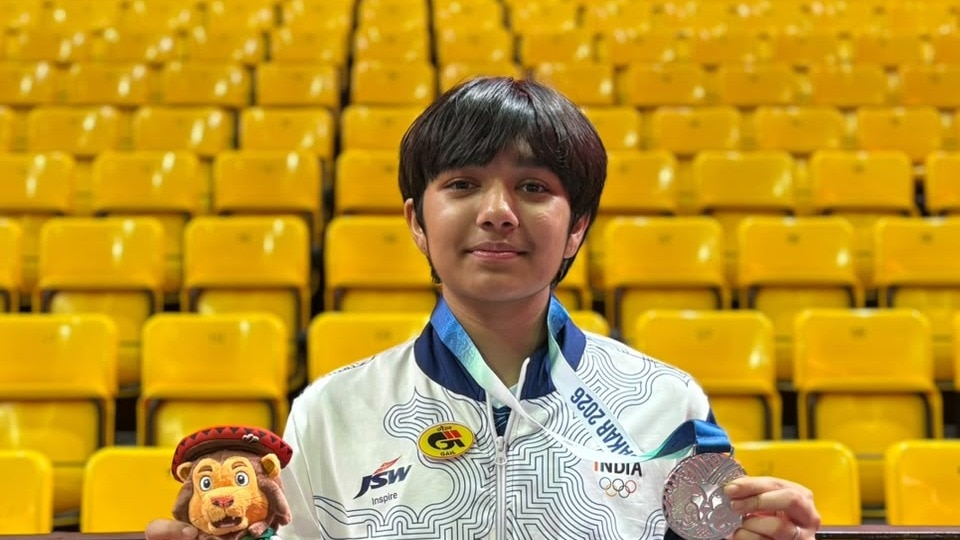
The badminton coach in China had two students to look after. One was a little girl from Odisha, discovering the joys of badminton. The other was her father, Rabinarayan Patri, who was getting a chance to fulfil a childhood wish of his own.While the coach worked with Tanvi, he would also correct her father's technique. He would ask Rabinarayan to practise at home so that he could play with his daughter outside their training sessions."When he was training the kid, at the same time, he was making me rectify my skills. He used to tell me, 'You practise at home sometimes.' That helped," Rabinarayan recalls, speaking to IndiaToday.in.By 2026, that little girl was standing on the podium at the Youth Olympics in Dakar, having pushed the reigning junior world champion to the very edge in an 82-minute final. Her father watched from the stands, carrying with him the memories of all those years, all those journeys and the sacrifices that had brought them here. But there was a flight to catch. The two who had once learnt the game side by side had come a long way.At 10-19 down in the deciding game against China's Zhang Yi Xin, Tanvi Patri appeared to be running out of energy. She had taken the opening game, but the physical demands of the contest were beginning to show. Zhang, two years older, was pushing her towards the back of the court, drawing her forward with deceptive drops and making her work for almost every point. There were moments when Tanvi appeared to rush her winners. But she found a way to stay in the contest. She stopped looking for quick finishes, adjusted her length and began trusting her ability to sustain rallies. From 10-19, she fought back to 20-20, saving five gold-medal points in the process. Zhang saved three of her own before a net chord and the finest of margins eventually separated the two teenagers.The Chinese shuttler won 21-15, 13-21, 24-26. At the end, the two embraced. A final fought till the very end! Tanvi Patri and Zhang Yi Xin put on a thriller in the women's singles final at #Dakar2026 #YouthOlympics https://t.co/Z9SlEmFmTe— Olympic Khel (@OlympicKhel) November 6, 2026Tanvi had come within touching distance of the title, but there was no shame in the silver. At 15, she had taken the reigning junior world champion through 82 minutes of badminton and made her fight for every point.It was Tanvi's biggest medal yet. She had become the first Indian girl to reach a badminton singles final at the Youth Olympics. For the coaches at the Centre for Badminton Excellence (CB) in Bengaluru, formerly the Prakash Padukone Academy, it was a moment they had been waiting for. They had seen the promise since she joined them as a 10-year-old in 2021.Dakar was a long way from where it all began. Long before the medals and the packed tournament schedule, Tanvi was a little girl in China, learning to hold a racket and find her way around a badminton court. It was a beginning that neither she nor her father could have known would lead them here.THE BEGINNINGS IN CHINARabinarayan had wanted to play badminton himself. Growing up in Odisha, however, he did not have the financial means or access to the kind of infrastructure that could have allowed him to pursue the sport seriously. Like many others, he had to prioritise education and finding a job.Years later, work took him to Jiangsu, a province in eastern China, where he found himself in a country with a very different relationship with badminton. Courts and clubs were easy to access, coaching was affordable and children had plenty of opportunities to play.He also had the financial stability he had lacked when he was younger. There was now an opportunity to introduce his daughter to a sport he had once wanted to play."So it all started from China, actually. Because I was in China for a long time because of my job. And when I had an interest in playing some sports, especially badminton, I couldn't pursue it because of financial conditions and infrastructure not being available in many places in India. You had to focus on studies and learn to earn money," Rabinarayan says."Then, when I had some financial support, I thought about my kid. Luckily, we were in China for a long time."He was struck by how easily children could access badminton facilities there."In China, if you see badminton, it is everywhere. Every two kilometres, you will find a very good academy, which we can call a club. And you pay very minimal, like maybe Rs 10,000, and every day you can get a court to play. Infrastructure was not a constraint," he says.Tanvi's first few months in China did not go entirely to plan. Rabinarayan initially tried enrolling her in an English-medium school, but she struggled to follow the lessons, which were being taught in Chinese. He eventually looked for another way to keep her occupied and found a badminton club.The coaching was not confined to the children. Rabinarayan says the coaches also encouraged parents to learn and practise, so they could help their children outside training hours. He remembers the warmth with which older players treated the younger ones, too. They were willing to share the court and play with children, regardless of the difference in ability."Many people in China came forward and played with my kid. There was no feeling like, 'I am a senior player, I will not play with these kids.' That was not there. It helped," he says.Tanvi was finding her feet in the sport, and she was beginning to look up to its biggest names. Lin Dan, the two-time Olympic champion, became her idol. She also had the opportunity to meet Xia Xuanze, the former Chinese international who went on to coach the country's national team.By 2019, she was already competing in provincial and national-level tournaments in China. Rabinarayan remembers her playing around 10 events that year and winning nine. For a young girl who had only recently picked up a racket, it was an encouraging start."She was there with me for around three years, two-and-a-half to three years. Basically, she learnt the basics there, and from that seed, it was pushed forward," Rabinarayan says."Out of 10 tournaments, nine tournaments she won. When you reach the podium, and the kind of recognition you get, that boosts your motivation. You think, ‘I have to go to the next level, I have to go to the next level’."He also remembers the importance attached to sporting achievements in China, even at the junior level."From the beginning, they build the mindset like the Olympic mindset. When you win, the medal looks beautiful and it is really worth winning. Even the medal feels like, yes, I have achieved something and that is why I have it."Tanvi had found her feet in China. But the next stage of her development would require a difficult decision from her family. Tanvi Patri competed in age-group tournaments in China (Courtesy: Instagram/TanviPatri) A FATHER’S LEAP OF FAITHWhen the Covid-19 pandemic disrupted life, the Patri family returned to India and settled in Bhubaneswar. Tanvi continued playing, but the environment was not quite the same.Her father remembers a phase when she struggled to find players willing to practise with her regularly. Initially, older children at the academy would play with her. But as the difference in their abilities became apparent, those opportunities became fewer.One day, Tanvi spoke to her father about it.Rabinarayan realised that if his daughter was to make progress, she needed a more competitive environment. He had seen what she could do in China and did not want her development to stall because she lacked the right training facilities."I was getting a very good package in China, but when I saw her performance in 2019, it was at a top-class level. She missed me, and then I realised I could not do otherwise. The job was okay, whatever I had done was okay. Let's take a risk, quit that job and come to India," he says.He was fortunate that his Chinese employers helped him find a way to continue working after returning. But the decision came with financial uncertainty."If I lose my job also, I have to sell one piece of land. Luckily, I have some property. I will sell it and take it forward. That is how you have to be. Otherwise, it won't work out."The family eventually approached the Prakash Padukone Academy. Tanvi underwent a trial and was inducted into its programme in 2021, when she was 10.It was a significant step. She had found an environment where she could train regularly, compete and develop under coaches who understood the demands of elite badminton. Olympic Gold Quest (OGQ), a non-profit organisation that supports India's elite athletes, has been backing her development ever since. Screengrab from X/@virenrasquinha Her father's decision was only one part of the family's contribution. Tanvi's mother, who had also worked in the IT sector, eventually left her job as the demands of travel and competition increased.The couple's working schedules had made it difficult to manage Tanvi's food and everyday requirements. Rabinarayan asked his wife to leave her job so that she could look after their daughter's nutrition and routine."Because Tanvi likes what her mom cooks," he says.There were other adjustments, too. The family had to work around Tanvi's training and competition schedule, with her father travelling to tournaments and her mother looking after her everyday needs.Rabinarayan, however, does not want his presence to become something his daughter depends on."I always tell her, never try to compete with others. Don't try to compete with her. Whatever you are doing this year, try to improve yourself. That is the only thing I tell her," he says.His approach was evident even after the Youth Olympics final. He was happy with the silver and told his daughter to enjoy her game. Gold, he said, would have been a bonus.Rabinarayan had booked his flight for shortly after the final, knowing he would not be around for the medal ceremony. It was a conscious decision. He wanted Tanvi to experience the occasion on her own, without having her father beside her every step of the way. He wanted her to learn to be self-dependent, to handle such moments by herself."If I make her independent from now, then she will be mature enough to handle the bigger pressure. I always tell her to be self-dependent. Don't complain, don't try to depend on others. Try to depend on yourself," he says.MOULDING IN BENGALURU Tanvi Patri with her silver medal at Youth Olympics in Dakar (BAI Photo) Tanvi's arrival at the Prakash Padukone Academy in 2021 marked the beginning of a different phase. The early foundation she had received in China was now being developed through a structured programme.Vimal Kumar, co-founder of the academy, made it clear that the coaches had identified her potential after a trial."Tanvi joined our Academy in 2021 at the age of 10, following a trial after her family returned from China during the Covid period. We identified potential in her and inducted her into our programme," he wrote on the eve of the Youth Olympics final.Sagar Chopda, who has worked with Tanvi since her arrival, remembers being struck by her footwork."When she came with us, one of the good things was that her footwork was very good. At that age, having that kind of footwork... maybe not many players, I would not say Indian players, but in general at that age, many players... there is something extraordinary in Tanvi that she picked it up very well," he tells IndiaToday.in.It was not merely about being quick around the court. Sagar noticed the way she moved towards the forehand backcourt, where she would sometimes use a jump that he felt was unusual among girls of her age."If you see a kid play, you can make out that, okay, there is something different from the other players. On the forehand corner, if you see her move on the forehand backcourt, she takes a jump there, which not many girls do. Boys probably do it more often. But girls normally don't take that jump. Tanvi tries to do that whenever she is able to."He believes the systematic coaching she received in China played a part in that development."One hundred percent, the coaches in China have a very systematic way of teaching, and that helped Tanvi. Her footwork was very good. Her strokes, her timing were very, very sharp, very, very precise," he says.Sagar does not see her as an out-and-out attacking player or someone who relies primarily on defence. He describes her as an all-rounder who is beginning to understand when to use different strokes."She's not like an attacking player or a very defensive player. She knows when to use her smashes and her downward strokes well, which probably made a difference yesterday," he says, referring to her Youth Olympics semi-final.There is also an understanding that her game will evolve as she grows physically. At 15, her smashes do not have the power of more developed players, but she makes up for it with accuracy and shot selection."Her smashes are not very hard, but it is the accuracy that made the difference yesterday."Tanvi's ability to retrieve and find the right length was evident in Dakar. When Zhang tried to stretch her across the court, the Indian teenager had to rely on more than power. She kept the shuttle in play, adjusted her game and forced the Chinese player to earn her points.The academy, now called the Centre for Badminton Excellence, has around 65 players in its programme. There are different training groups and routines, but Sagar says the coaches also try to account for individual requirements."We cannot make 65 tailor-made programmes. But if somebody is doing well, based on their requirements, there are certain skill-practice sessions where we ask the players what they would like to work upon, and then the coaches devise some drills. So it's not that there is a standard programme, but yes, we will have to make changes for a few athletes based on their requirements," he says.Tanvi is part of a larger group of young players at the academy, with Umendra Rana and Sayali Gokhale among the coaches involved in her development. Rana travelled with her to the Youth Olympics in Dakar, while the academy also ensured that a female physiotherapist accompanied the team.Sagar also points to the benefit of training alongside established players. PV Sindhu's presence at the academy offers younger shuttlers an opportunity to watch a champion at work."When you see Sindhu train at the age of 30, 31, she's still having that kind of fire. I think that makes a big difference for an academy like us to have Sindhu train," he says.FROM CAIRO TO DAKARTanvi's 2026 season had its share of setbacks. At the World Junior Championships in Cairo, illness disrupted her campaign. Her father recalls that she contracted a viral fever and ran a temperature of around 102 degrees for nearly a week. It was a disappointing end to a tournament for which she had travelled with high hopes.But there was plenty in the season to suggest how far she had come. Having won the Asian U-15 title in 2024, Tanvi added the Asian U-17 crown in 2026, underlining her progress through the junior ranks. She was also beginning to test herself on the senior circuit, stepping into International Challenge events where the physical demands and level of competition were considerably higher.At the Pontianak International Challenge in Indonesia, Tanvi produced a particularly emphatic performance in the women's singles final. She defeated South Korea's Kim Min Sun, ranked World No. 71, 21-5, 21-6 to claim the title.It was another step in her transition to senior badminton. She was no longer only competing successfully against players in her own age group. She was beginning to find her feet against senior opponents as well.In Dakar, she made it count.The semi-final itself was significant. Tanvi beat Japan's Yuzuno Watanabe, a player she had lost to a couple of years earlier in Thailand. Sagar considered that victory particularly creditable."She had lost to her a couple of years back in Thailand. So it's good progress; we just have to be patient with her. She's got a lot of years of badminton left in her," he says.The final against Zhang was another step up. Tanvi could not quite get across the line, but the performance showed that she could compete with the best players in her age group even when the physical demands became difficult.For a teenager who had experienced disappointment in Cairo only months earlier, the silver medal was a significant response.NO RUSH TO THE NEXT MILESTONEThe attention around Tanvi has grown considerably. Her Youth Olympics performance has invited comparisons with established Indian stars, and there is already curiosity about how far she can go.Vimal Kumar, however, had made his position clear even before the final.In a post on social media, he spoke about the need to understand the years of work behind her development and cautioned against comparing emerging players with champions such as Saina Nehwal and PV Sindhu too early."Talent and early success are important, but long-term success in individual sports demands physical development, competitive maturity, resilience and the ability to handle pressure," he wrote.Sagar is careful not to get carried away by what Tanvi has achieved so far. He likes the game she has developed, the way she reads situations and the fact that she does not appear overwhelmed when a match enters its closing stages. But there is work to be done before she can consistently compete at a higher level."First, the most important priority for her would be to build her strength and remain injury-free. These two aspects, once they are taken care of, then she has the game to succeed," he says.Tanvi is 15 and still growing. Her father says injuries have interrupted her progress over the past couple of years, forcing her to spend long periods away from training. The challenge for her coaches is to build her physically without putting too much strain on a young body. Strength and conditioning, recovery and managing her workload will be as important as the hours she spends on court.What Sagar particularly likes, though, is how readily she puts what she learns into practice."She's very young, but she's a quick learner and she's street smart. So she picks up things very, very quickly and executes it. That is more important. You tell a kid something and they are able to execute it, that's very good to see," he says.Sagar believes she is comfortable when matches reach 18-all or 19-all, when a couple of points can change the course of a contest. Her fightback against Zhang Yi Xin in Dakar, when she clawed her way back from 10-19 in the deciding game, offered a striking example of that resolve. But these situations also require experience, and that is something only more matches at higher levels can bring.For now, the focus remains on building her strength, keeping her fit and giving her the time and competition needed to mature as a player. The silver in Dakar has raised expectations, but there is still plenty of work ahead.Rabinarayan, meanwhile, remains committed to the philosophy he has followed since her early days in China."Never try to compete with others. Whatever you are doing this year, try to improve yourself," he tells her.There will be more difficult tournaments, defeats and periods when progress does not come as quickly as expected. Her coaches know that. Her father knows that, too.It began in China, with a little girl, a racket and courts that were never too far away. India gave her a home, a family willing to make difficult choices and a coaching team that saw enough in her to invest years in her development.At 15, Tanvi Patri has already travelled across countries, continents and countless badminton courts to reach the Youth Olympics podium. It has been quite a journey. And yet, in the larger scheme of things, it is only the beginning.- Ends
Love-all in China, moulded in India: The making of Tanvi Patri
Full Article
Original Source
Read the full article at Indiatoday →KhanList aggregates and links to publicly available news content. We do not host full articles from third-party sources. Always verify important information with original sources.