
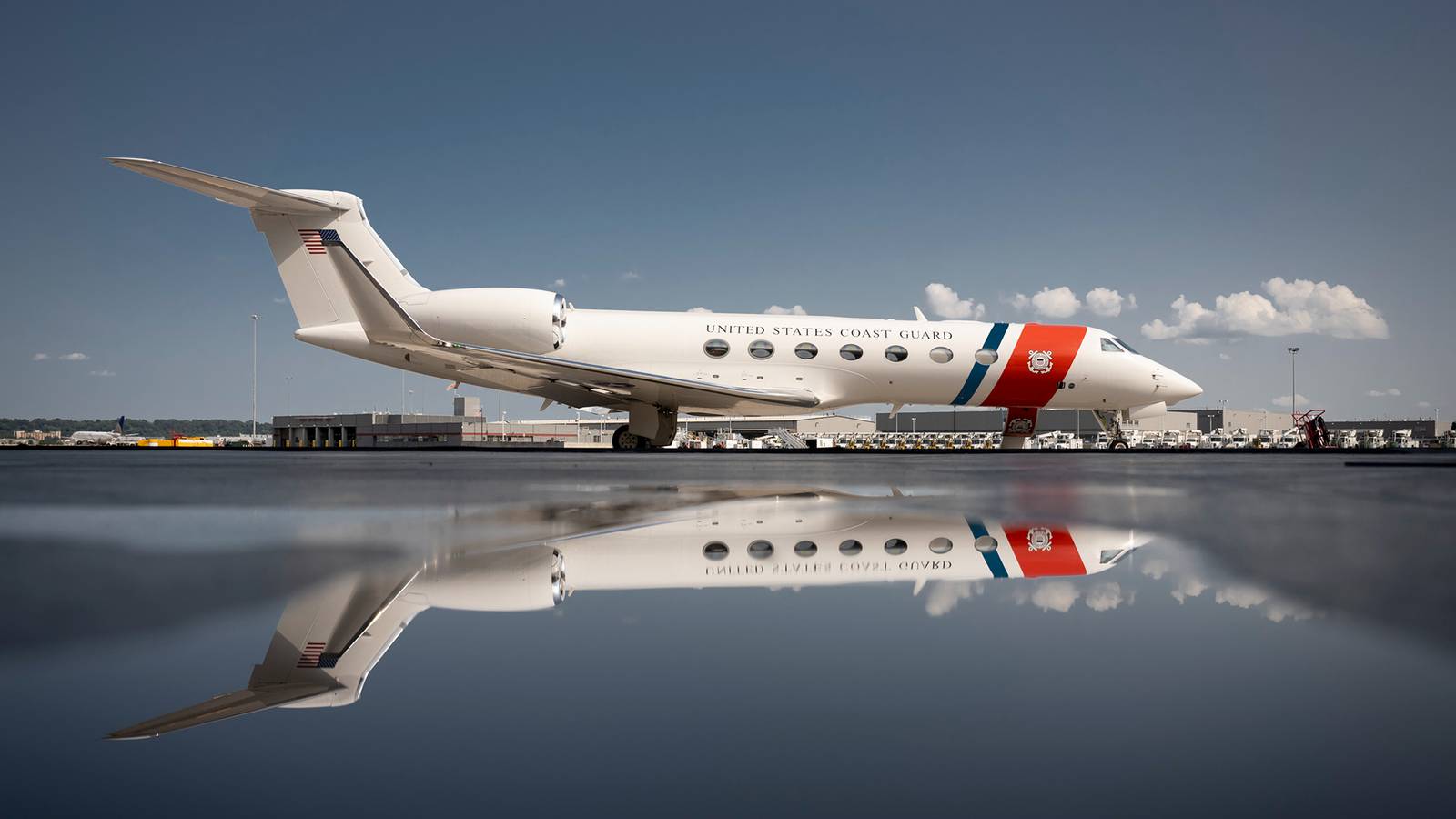
Published Sep 3, 2026, 2:13 AM EDT Luke has over a decade of experience as a travel writer and aviation analyst. As a passionate traveler based across the Middle East and Asia, Luke offers strong insights into the industry. Based in South East Asia. Sign in to your Simple Flying account A United States Coast Guard Gulfstream G550 carrying DHS Secretary Markwayne Mullin and 13 others declared an emergency after suffering an in-flight engine failure. The aircraft diverted to Ronald Reagan Washington National Airport (DCA) on Wednesday afternoon as it carried Mullin and other officials from Georgia to Washington. One of the pilots told air traffic control (ATC) "we just lost our right engine" before declaring an emergency and requesting an immediate landing at DCA. The Gulfstream landed safely before it was inspected by Airports Authority Fire and Rescue, with no injuries reported. Coast Guard Gulfstream Right Engine Failure Near DCA Credit: Picryl The Metropolitan Washington Airports Authority (MWAA) said the flight crew reported the problem to ATC at around 1:35 PM ET, citing "a possible mechanical issue" and asking to divert to Reagan National. Flying under the call sign C101, the aircraft is a military variant of the Gulfstream G550 known as the C-37A and is used by the DHS as an executive transport aircraft. The jet completed a safe single-engine landing at DCA, where it was inspected by airport authorities before taxiing off the runway. According to MWAA, there was no disruption to other flights at DCA, which is home to the busiest single runway in the United States. Wednesday's emergency is the second incident in a month involving a government aircraft at Reagan National after Marine One, with US President Donald Trump onboard, was involved in a loss of separation event with an Envoy Air Embraer E175 on August 4. In a post to social media, DHS Secretary Mullin said, "The United States Coast Guard pilots made the single-engine landing feel routine. No panic, just straight professionalism. After we landed, the pilots told me that was a first for them! We could not have been in better hands." An Aging Gulfstream Jet Credit: Picryl The jet involved in Wednesday's incident has been in service since 2002 and is powered by two Rolls-Royce BR710 turbofan engines. It is assigned to Air Station Washington — a unit based at Reagan National — and is responsible for executive transport, along with the capability to perform as a long-range command and control aircraft to keep DHS leadership connected during a national crisis. Its age and declining condition have previously been raised by DHS, which described the jet as operating beyond Gulfstream's recommended service life and "well beyond operational usage hours for a corporate aircraft." The agency is replacing it after ordering two Gulfstream G700s in a controversial deal worth up to $200 million, one of which was delivered in January. It also wants to establish its own "deportation airline," which would consist of a mix of Gulfstream business jets and Boeing 737s. The US Coast Guard currently operates a small fleet of three Gulfstream jets, each assigned to Air Station Washington. One of the two other airframes is a C-37B based on the G550, which was delivered in 2022. Its second G700 is scheduled to be delivered by the end of 2026, with both newer jets intended to replace the two aging C-37A and C-37B platforms. How Serious Is An Engine Failure? Credit: Shutterstock Losing an engine in flight is a serious event, although twin-engine aircraft like the Gulfstream V are designed to handle such a situation. Aircraft with two or more engines are designed to continue flying safely if one engine fails, although it will require crews to divert to a suitable airport and land as soon as possible. At this stage, the Coast Guard has not revealed what caused the failure. With Wednesday's flight originating in Georgia, the engine loss occurred at the end of the flight and within proximity to a suitable airport like DCA. In-flight engine failures are rare, which Mullin highlighted when he said the pilots told him it was their first-ever single-engine landing. FAA data puts the failure rate for commercial jet engines at roughly one failure per 375,000 flight hours.
"Lost Our Right Engine": Coast Guard Gulfstream Carrying DHS Chief Mullin Declares DCA Emergency
Full Article
Original Source
Read the full article at Simpleflying →KhanList aggregates and links to publicly available news content. We do not host full articles from third-party sources. Always verify important information with original sources.