
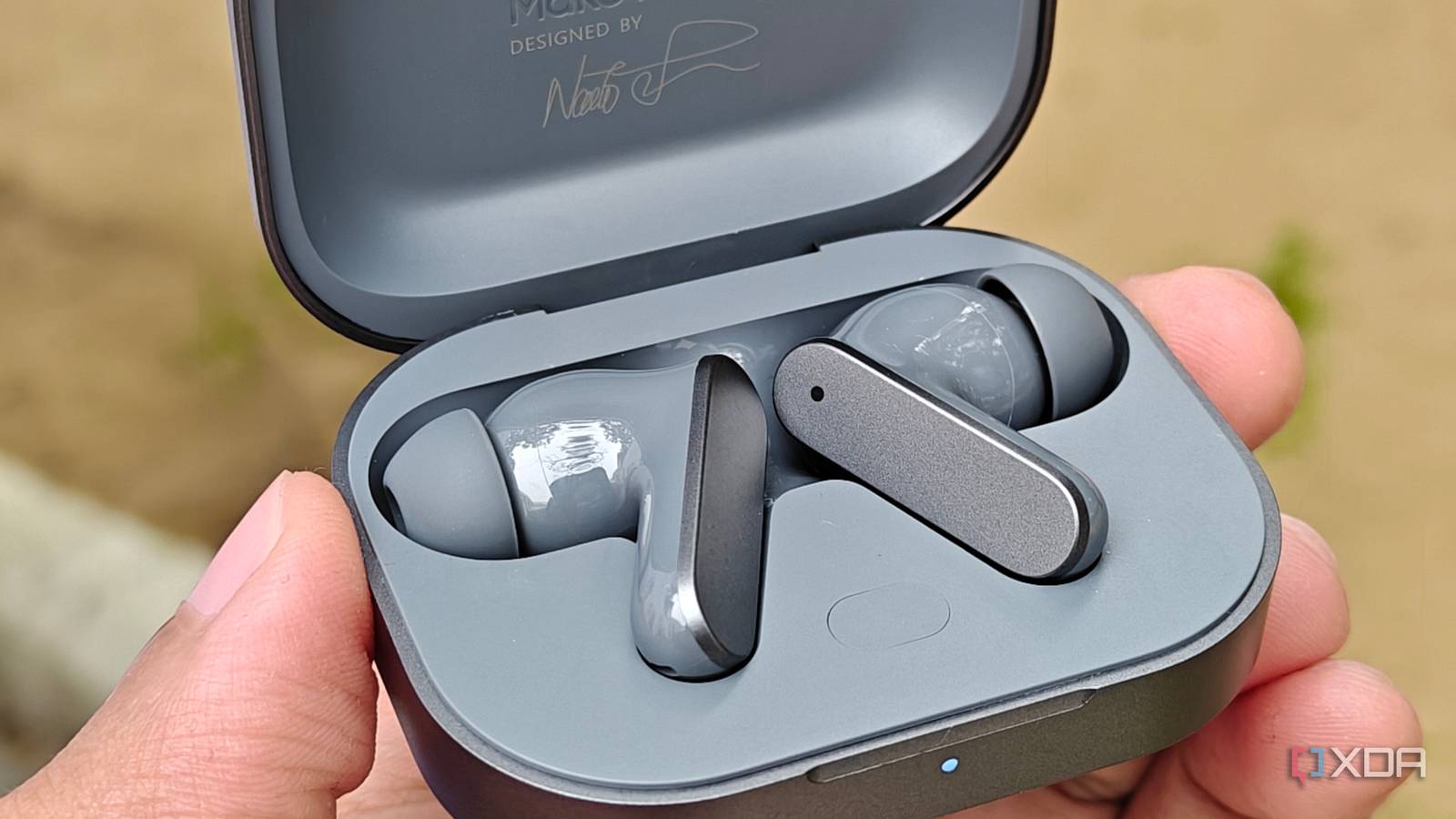
Published Nov 13, 2026, 6:00 PM EST Shivansh began his tech journey as an avid reader of tech publications, which inspired him to launch his career in video media at Sillycorns. He has led content across multiple tech YouTube channels and Instagram accounts, crafted go-to-market (GTM) strategies for Vivo, and consulted on digital growth. Coming full circle to his roots in written media, he now delivers deep-dive tech journalism. Outside of his professional work, Shivansh loves watching movies, riding bikes, and playing cricket. I was invited to Realme's 16 Pro launch event back in January 2026. There, I received the Realme Buds Air 8 as a farewell gift, and when I saw the box, it had two logos in the corner: LHDC and a gold Hi-Res Audio badge. That's a lot of audiophile branding for just $43. Then I paired them with my OnePlus 13R, and saw the available Bluetooth codecs. Every one of those Bluetooth codecs squeezes a FLAC file before it leaves the phone. The best of them tops out at 1,000 kbps, and CD-quality audio needs 1,411 kbps. Spotify itself steers lossless listeners toward wired headphones. I wanted to know if I'd hear the difference anyway, so my sister and I went all in on a blind test. Every common codec is lossy Lossless goes in, lossy comes out Most people assume FLAC is uncompressed audio. It isn't. It is compressed but in a way that doesn't throw away any data. When you play it, your phone unpacks it back to its original form. But Bluetooth can't transmit that much data directly, so your phone has to encode it again using a Bluetooth codec. And that's where some data gets lost, as the codec compresses the audio to make it easier to transmit wirelessly. Codec Top bitrate Lossless? CD-quality 1,411 kbps (uncompressed) Yes SBC 328 kbps No AAC About 256 kbps No LDAC 330, 660, or 990 kbps No LHDC 5.0 Up to 1,000 kbps No LHDC Lossless About 1,000 to 1,400 kbps Yes, almost CD quality aptX Lossless About 1,100 to 1,200 kbps Yes, almost CD quality If you read the table above, you now know that the "Hi-Res Audio" badge on the box doesn't mean "lossless" audio. It certifies that a codec can carry high-resolution audio at a high bitrate; in this case, LHDC. Earbud makers sometimes talk in a way that doesn't clarify whether the output is lossless or "nearly" lossless. That's where the confusion comes from. My OnePlus 13R has three HD switches, and none is lossless Realme even warns you about the best one Tap the Buds Air 8 on the 13R's Bluetooth list, and Media Audio offers two choices: HD (AAC) and Standard (SBC). Another such toggle in developer options offers some more codecs. And if you want the "proper" high-definition codec, earbuds' own app has it. Sorry HD AAC, I am just stating facts here (refer table again). Anyway, if you turn on the proper HD codec, Realme triggers a warning that's more honest than its box. It says high-definition sound may cut listening time, can add latency when there's interference, and works best somewhere like your home. It also turns off Spatial Audio, so you cannot use both. Developer options show what the phone actually sends AAC is stuck at 44.1 kHz and 16 bits Tap Build number seven times under Settings > About device > Version, and the Bluetooth section of developer options shows the real readout. With Media Audio on HD, mine said Streaming: AAC. The sample rate menu greyed out everything except 44.1 kHz, bits per sample stayed locked at 16, and the phone's own note explains that grey means the phone or headset doesn't support it. The codec list is long, running from SBC through LDAC, LHDC, aptX Adaptive, and aptX TWS+. That's what the 13R can speak, though, not what the earbuds can. The Buds Air 8 only answer to LHDC 5.0, AAC, and SBC. With high-definition sound on, the same screen read Streaming: LHDC and unlocked 96kHz and 24 bits. It looks like a leap, but LHDC 5.0 tops out at 1,000 kbps and slides lower when the signal weakens. Even at full speed, it carries about 71% of what uncompressed CD audio needs. Savitech, which makes LHDC, does offer an LHDC Lossless mode at 1 to 1.4 Mbps, but neither OnePlus's spec sheet nor Realme's lists it for this pair. I couldn't hear lossless in a blind test And I am sure most people can't My sister ran the test on an evening in exchange for me doing the dishes until I win. The music came from a name-your-price album on Bandcamp, downloaded in 16-bit FLAC for $0. On my MacBook Air M2, I installed ffmpeg with brew install ffmpeg and made 320 kbps MP3 copies of three tracks with one line in Terminal: ffmpeg -i track.flac -b:a 320k track.mp3 On Windows, winget install Gyan.FFmpeg installs the same tool, and the conversion command works unchanged in Terminal. Each round, she played the FLAC and MP3 versions in VLC on the 13R with LHDC on, then replayed one for me to name. Over LHDC, I got just 13 right, out of 30. Before you judge the methods, I was sitting still at my desk, there wasn't any noise, etc. Since the test was well-controlled, we ran 30 more rounds on my wired pair. Each round still compared FLAC with MP3 on the same connection. I scored 18 out of 30 here, and interestingly, seven of those points came from just one track. The reason? It had one element that made a clear, noticeable difference in clarity, but the point is: just one track with just one element. This settles the best argument for lossless on Bluetooth: an MP3 gets compressed twice and FLAC once; over LHDC I couldn't tell them apart. This also confirms to me that rematches for working the dishes aren't going to stop anytime soon. Lossless wireless is a 2027 problem The real fix needs new radios Qualcomm's aptX Lossless does work today, but only with Snapdragon Sound on both the phone and the headphones. The 13R's developer menu lists aptX Adaptive, not aptX Lossless, and the codec skips Pixel, Galaxy, and iPhone users entirely. At an October 15 briefing in Tokyo, the Bluetooth SIG announced that High Data Throughput would be added to the Bluetooth specification in November. It raises Bluetooth LE's maximum data rate from 2Mbps to 7.5Mbps, paving the way for standardized lossless wireless audio in 2027. However, HDT requires new radio hardware, which means neither the OnePlus 13R nor the Realme Buds Air 8 can gain support through a software update. AAC for the street, FLAC for my desk The Buds Air 8 now stay on AAC when I'm out, since Realme's own warning calls LHDC a stay-at-home mode. The FLAC album lives on my MacBook through a wired connection, and the 13R gets the 3x lighter MP3 copies. Here's my verdict: if you listen mostly over Bluetooth, don't pay extra or burn storage for lossless. If lossless is why you're shopping for earbuds, wait for 2027 hardware. Till then, I am doing the dishes.
Lossless audio is wasted on Bluetooth headphones, but 2027 might bring the solution
Full Article
Original Source
Read the full article at Xda-developers →KhanList aggregates and links to publicly available news content. We do not host full articles from third-party sources. Always verify important information with original sources.