
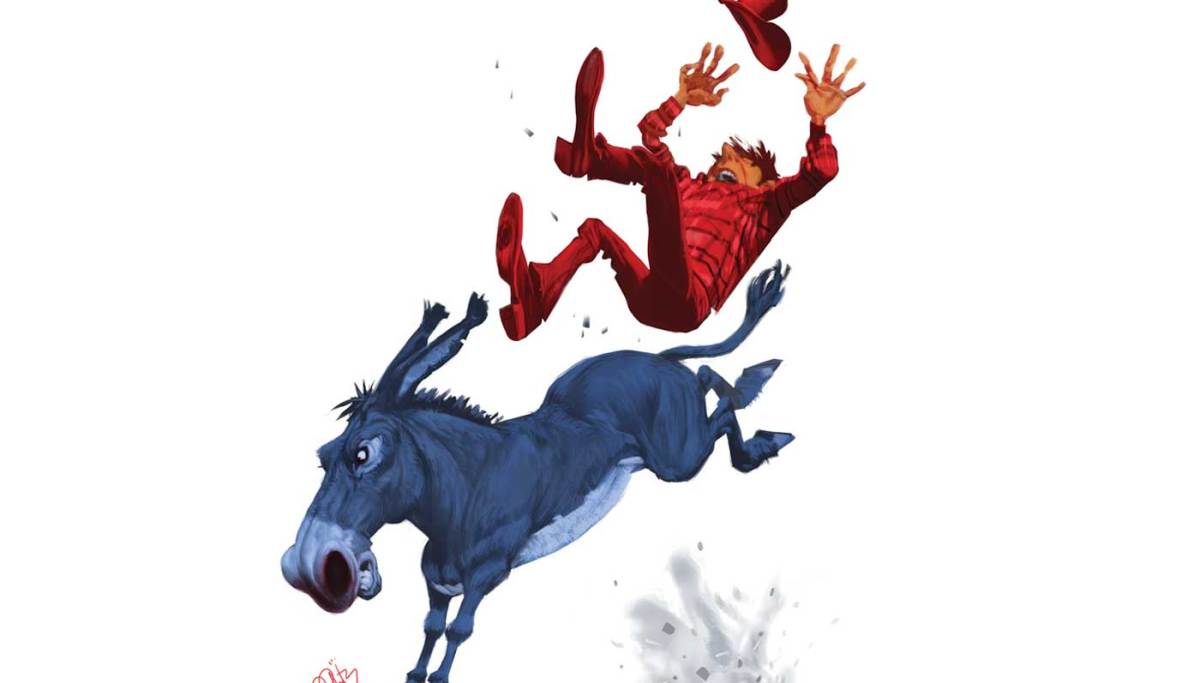
Voters across the country rebuked President Donald Trump and the Republican Party in the Nov. 3 midterm elections, producing a powerful blue wave in the first major electoral test since his sweeping victory in 2024. The results were expected in battleground states, but not in Texas, a longtime bastion of conservatism that has maintained a Republican trifecta since 2003. This year, Democrats flipped every statewide office.“Nowhere are the consequences of this election greater than Texas,” Sen. Ted Cruz (R-TX) said on his podcast. Cruz made the remarks after Democrats swept Texas’s statewide races for the first time in more than 30 years.Sen.-elect James Talarico (D-TX) won the Senate race by 55% against the corrupt, but MAGA-affiliated, Texas Attorney General Ken Paxton. Polls had often shown Talarico ahead, but most political observers in the state thought if he won, it would still be a narrow victory. The former schoolteacher-turned-seminarian won by over 1 million votes, garnering a total of 5.4 million. The last time a Democrat won a U.S. Senate race in Texas was 1988. It stings even more given the race became the most expensive in history. Tesla CEO and Texas resident Elon Musk gave $445 million to Republican candidates, political action committees, and outside spending organizations to help Republicans keep Congress and, particularly, this race.(Thomas Fluharty for the Washington Examiner) But the biggest surprise — and disappointment for conservatives — was the governor’s race, thought to be a sure bet. Gov. Greg Abbott (R-TX) had fundraising prowess, three terms under his belt, and led Texas to become the eighth-most powerful economy in the world. Yet Gov.-elect Gina Hinojosa (D-TX) snatched Abbott’s seat with about 52.8% of the vote, becoming the first Latina governor of Texas — all this despite raising less money and running on a platform against data centers, eliminating the STAAR test in Texas public schools (the state’s year-end testing system) and “economic populism.”As if that weren’t enough, Democrats won every other statewide office down the line, too. The shellacking was such that, had Cruz been up for reelection, I’m not sure he would have survived it.Texas losing its conservative stronghold status just two years after Trump won the state by a margin of over 1.5 million votes is disappointing, but more so, puzzling. It raises questions about what’s really happening in voters’ minds across the country and in the Lone Star State. Did the nation’s red beacon suddenly abandon conservatism, or did it get swept up in voters’ disgust with Trump and a Republican-led Congress? What happened, why did it happen, and will Texas turn red again?Texas Republicans’ weak spot The 2026 midterm elections were clearly an indictment on Trump, but some of his weaknesses were magnified for the Republican Party in Texas.The election exposed several vulnerabilities in the Texas GOP’s coalition, particularly among Latino voters, who had helped Trump make significant gains in 2024. Approximately 58% of Latino voters said they disapprove of Trump’s approach to immigration, according to an October 2025 survey done by the Hobby School of Public Affairs at the University of Houston and the Executive Master of Public Administration Program in the Barbara Jordan — Mickey Leland School of Public Affairs at Texas Southern University. In particular, they didn’t like certain enforcement tactics, such as ICE workplace raids.At left, supporters of Democratic Texas Gov.-elect Gina Hinojosa pose in Austin, Texas, Nov. 3, 2026; at right, a victorious Democratic Sen.-elect James Talarico thanks voters at an election night event in Austin, Texas, Nov. 3, 2026. (Ashley Landis/AP; Eric Gay/AP) In the midterm elections, there was as much as a 50-point swing among Hispanic voters from red to blue. This was most obvious in Starr County — it flipped red for the first time in a century in 2024 but reverted back again in 2026 to vote for Democrats. This is a marked difference from 2024, when Trump won an estimated 55% of the Texas Latino vote, according to exit polling.Immigration wasn’t the only issue that weakened Republicans. The Texas GOP’s legislative priorities may have alienated voters, too.In the Nov. 6 issue of Texas Monthly, Christopher Hooks suggested that the state party became extreme. “The Texas GOP Went Too Far, and it Cost the Party Everything,” the headline reads.“And so it is even stranger to look back on what they did with the last legislative session of the solid-red Texas era (2003–2025). There was no attempt to moderate in any meaningful sense — or any attempt to do anything, really, that would be popular with Texas voters,” Hooks writes. He said the GOP focused too much on cultural issues like keeping “smutty books” out of school libraries and predicts that one of Abbott’s big wins — private school vouchers — backfired and will be nixed by Hinojosa.Having lived in Texas since 2018, I’ve watched the state GOP become hyper-focused during legislative sessions on issues that matter most to the most conservative elements of its base. In doing so, Republicans risk alienating more traditional conservatives and centrists. I’ve written extensively about Texas’s restrictive abortion law and dismal K-12 education performance. I had hoped Abbott’s school voucher plan would help address the latter, but it has generated considerable controversy, particularly in rural areas.Paxton, Talarico… and Beto Texas Republicans had another problem: the quality, or lack thereof, of their candidates, particularly in the U.S. Senate race. It simply cannot be overstated how poor of a candidate Paxton was. His political career had been dogged by scandals and legal troubles, including a federal indictment and an expensive impeachment trial from which he ultimately emerged politically intact. It didn’t help that his wife of over 30 years filed for divorce on “Biblical grounds,” and he’d long been plagued with allegations of infidelity. A CNBC poll found corruption was one of voters’ top issues prior to the election, and an August Texas Pulse poll found 55% of likely voters said Paxton is corrupt.“[D]on’t nominate a crook to be the leader of your ticket,” former President George W. Bush’s political strategist Karl Rove told The New Yorker, calling it an “elemental rule of politics.”Sen. Ted Cruz (R-TX) — after the Nov. 3 election the only statewide Republican lawmaker left in Texas — stumps for a GOP candidate in Grosse Pointe Woods, Michigan, Oct. 28, 2026. (Paul Sancya / AP) On the campaign trail, Paxton seemed lazy, reluctant, and unsure during speeches, relying on his record of suing the Biden administration over 100 times to rally a crowd that was already two years past a Biden presidency. If he believed himself to be relevant, he failed to make his case as to why.Paxton was a poor candidate regardless, but matched against Talarico’s strengths, he hardly stood a chance. Talarico is a progressive who successfully presented himself as a centrist, but he is also a skilled orator who ran a solid ground game. I couldn’t stomach either one of them, but Paxton’s presence at the top of the Republican ticket was particularly embarrassing. He had enough of a fanbase to beat the incumbent Sen. John Cornyn (R-TX), garnering nearly 64% in the May runoff, but it didn’t carry over to Election Day at all.In retrospect, the warning signs were there long before 2026. The biggest Senate race when I moved here was Cruz’s against Robert “Beto” O’Rourke, a Kennedy-esque media darling who had been a state representative for a few years before running for statewide office. As I reported then for the Washington Examiner, “O’Rourke could not pull this election off, largely due to the demographics in Texas, demographics of folks who eschew the very thing O’Rourke represents: outside influence and progressive identity politics.” But even then Cruz only narrowly won, defeating the charming, underqualified Democrat by just under 215,000 votes.Ironically, another pivotal player was sworn into the Texas House of Representatives that year: James Talarico. Eight years later, Talarico benefited from some of the political lessons Beto’s campaign left behind. He had the charisma, fundraising, and progressive appeal that made Beto competitive, but he also avoided Beto’s most politically damaging mistake: overtly threatening to take Texans’ guns away.A perfect storm created an ideal environment for a strong candidate, piggybacking off Beto’s wake: Be charming, be moderate, and never threaten to take Texans’ guns away (Beto didn’t learn the last one). Americans’ dissatisfaction with Trump, cost-of-living woes, and Texas GOP missteps were the perfect conditions for a stronger candidate like Talarico to win. In fact, his win was so sound, I’m convinced that if Santa Claus had run against Talarico, he too would have lost.Trump tainted Texas Still, even if Texas Republicans had resolved their state-specific problems — unhappy Latino voters, the party’s ideological extremism and Paxton’s damaged reputation — I’m not convinced it would have prevented the state’s political reversal. Democrats have won at least 254 U.S. House seats and five governorships in what Vox described as the biggest blue wave in 50 years. CNN reports that three-quarters of Americans will now be governed by Democrats. Even Texans, who have long favored Republican control, weren’t immune to growing dissatisfaction with Trump and a Republican-controlled Congress.Voters repeatedly identified affordability as a top concern, but neither Trump nor Congress addressed it or made attempts to alleviate it. Trump’s tariffs and the war in Iran created unusually high gas and diesel prices — and the cost of living remains elevated, too. Americans are feeling the pinch, including Texans.While Mark Jones, a political science professor at Rice University in Houston, believes that Republican congressional redistricting could have mobilized some Democratic voters, he didn’t think that was the whole story.“[W]hen we’re trying to think about why Democrats won, it’s one man in the White House and his policies — Donald Trump,” Jones told the AP.Even with voter dissatisfaction with Trump, many political observers in Texas are still shocked. James Henson, a professor at the University of Texas at Austin and director of the Texas Politics Project, says that even based on their polling, he wouldn’t have predicted this outcome.“Choose your metaphor. This was a major hurricane or a major earthquake,” he told KVIA, a Texas station. “And the Republican infrastructure that had withstood, you know, other challenges over the last couple of decades just couldn’t withstand the onslaught this time.”Democrats’ sweeping victory has left Texans asking one question: What comes next? How will Democrats govern Texas, now that they have power? Republicans still maintain narrow control of the Texas Senate.“You’re going to have a governor who not only can, you know, make a policy herself, but she’ll have a friendly Texas House, and they can get laws at least pushed through to the Senate and see what happens there,” J. David Goodman, Texas bureau chief for the New York Times based in Houston, told the Texas Standard.JAMES TALARICO’S EXTREMISM AND THE TEXAS SENATE RACE THAT SHOULD NOT BE CLOSEThe next legislative session, which begins in January, will give Texans their first real indication of how much Democrats intend to change the state — and what a Democratic-led government might mean for the people who voted them into power. So far, Hinojosa has said she plans to use her emergency powers to freeze residential electricity rates, a proposal that has already frustrated conservatives. If this is any indication of what’s to come, Texans who traded their Republican statewide leaders for Democrats may soon learn a valuable lesson in the old adage: Be careful what you wish for.“Texas will be red again,” Cruz said on Fox News on Nov. 8. “We haven’t fundamentally changed who we are as a state. And I think this country remains a center-right country… In many ways, the silver lining is the Democrats are going to overreach.”For Texans’ sake, I hope he’s right.Nicole Russell is an opinion columnist for USA Today. She lives in Texas with her four children.
Losin’ Texas: Why the Lone Star State turned blue
Full Article
Original Source
Read the full article at Washingtonexaminer →KhanList aggregates and links to publicly available news content. We do not host full articles from third-party sources. Always verify important information with original sources.