
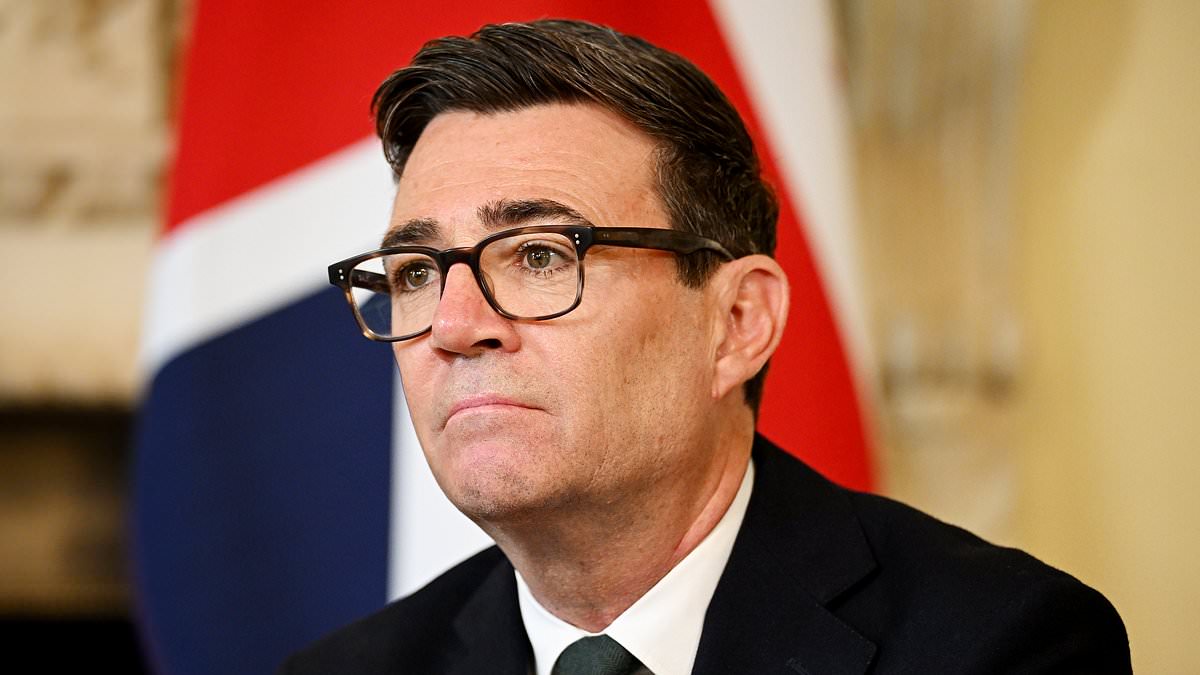
For many years, Britain paid less to borrow money than most other major countries. Now we pay more. This is because while international investors once saw the UK as a comparatively safe bet, they no longer do.The bond markets have a colourful expression for the higher interest rates they demand when lending to governments they consider imprudent: they call it the 'moron premium'.This is not a personal reflection on Andy Burnham. But it does say something about the way Labour have managed our finances, and the economy more widely.Ministers like to remind us of the interest rate spike after the Liz Truss mini-Budget of 2022, but as Burnham addressed Parliament for the first time as Prime Minister last Wednesday, our long-term borrowing costs rose to their highest level for nearly three decades.More worrying still is that it's not just the fundamentals of our economy that are shaky – the fact that we tax, spend, borrow and regulate too much, making it more expensive to employ people, produce things, build things, do business and create the wealth that pays for our public services. So far, things are going well for the Prime Minister Andy Burnham, writes Lord Ashcroft The latest polling by Lord Ashcroft shows Labour in the lead, followed by the Tories and ReformIt's that we are going in the wrong direction – and the signs are that rather than change course, Burnham seems to want to accelerate.So far, things are going well for the PM. People like him, think he seems normal and approachable, and credit him with more grit and common sense than his predecessor. My survey finds him comfortably ahead of his rivals as the best available Prime Minister, and he has single-handedly revived Labour's poll standing as more of its disgruntled 2024 voters say they could see themselves backing the party again next time. Burnham's early initiatives on energy bills and bus fares might seem small fry ('clickbaity-type politics', as one focus group participant said), and cynics might wonder if he is trying to distract people's attention from bigger issues or lower their expectations about what governments can do about them.But it is surely smarter to ensure people's early memories are of small attempts to help them out than, say, scrap the winter fuel allowance (a blunder whose effects Keir Starmer never really shook off).But there is a sense that a reckoning is coming. Like the markets, the voters know it can't go on like this. 'I think the time to judge is when something happens and he has to make critical decisions,' as someone else in my groups put it. 'That's when we'll be able to see whether he swims or sinks.' Reform UK leader Nigel Farage addresses delegates during day two of the party's conference in Birmingham on September 5Barring unforeseen dramas (of which there could be any number by teatime on Tuesday, let alone the next two months), one of the first of those will be the Budget on October 28. Already, I hear voters talking about this as the event that will really tell them what the Burnham era will be all about. But many think they already know what to expect. My poll found a majority saying that Labour shouldn't put taxes up, but they will. Further hikes will clash against any claim to working people that Burnham is on their side – the most precarious of his positive attributes in my poll.At the same time, and to be fair to the Government, voters don't always make these things easy. Those on the Right complain about the ballooning benefits bill, and with good reason.But one of the most expensive state commitments is the pension triple lock, which I found a majority want to keep – Conservative and Reform supporters more than most, and pensioners (the group most likely to turn out and vote) by a 68-point margin. That illustrates just how hard it is for ministers to hold spending down – especially leaders such as Burnham who, as I find many voters shrewdly intuit, has an innate need to be liked. On the other side of the fence, a reinvigorated government has once again raised the question of how to 'unite the Right', despite Kemi Badenoch and Nigel Farage ruling out any kind of pact.I found a Conservative-Reform alliance would poll less than the sum of the two parties separately, because fewer than half of Tories and only a bare majority of Reform supporters would back it (indeed Reform-leaning voters said they would be more open to considering Restore Britain than the Conservatives).This means the parties will have to slug it out the old-fashioned way. Tory Leader Kemi Badenoch MP responding to Andy Burnham during his first appearance in the House of CommonsI found that while Reform are seen as stronger and more united than the Conservatives (despite some vigorous internal spats over the summer), the Tories are regarded as more reasonable, responsible and credible.But while the two words most often chosen to describe Badenoch were 'sensible' and 'competent', those for her party were 'out of touch'. 'Kemi is speaking well at the moment,' said another focus group member. 'But I'm annoyed with the Conservatives. They had a chance and they blew it.' Such a sentiment will take time to shift.For Reform to expand their support, meanwhile, they will need to dispel the lingering idea that they are too harsh or extreme, demonstrate credible policies on issues beyond their familiar agenda, and present a responsible team ready for government.The advent of a new PM has made the case for getting rid of Labour seem less immediate. It has also made it harder for the opposition to get a hearing. But people have consolidated, if only for the time being, behind a leader, not a party; there has been no resolution to the things that drove their discontent – immigration, tax and the cost of living, to name but three.The Burnham honeymoon will end, and when it does, his rivals must be ready. Successful opposition requires a tricky combination of urgency and patience.Lord Ashcroft is a businessman, philanthropist, author and pollster. His research is at LordAshcroftPolls.com.Find him on X/Facebook at @LordAshcroft
LORD ASHCROFT: For now, Burnham has steadied the ship, but a reckoning is coming. When it does, his rivals must be ready to strike
Full Article
Original Source
Read the full article at Dailymail →KhanList aggregates and links to publicly available news content. We do not host full articles from third-party sources. Always verify important information with original sources.