
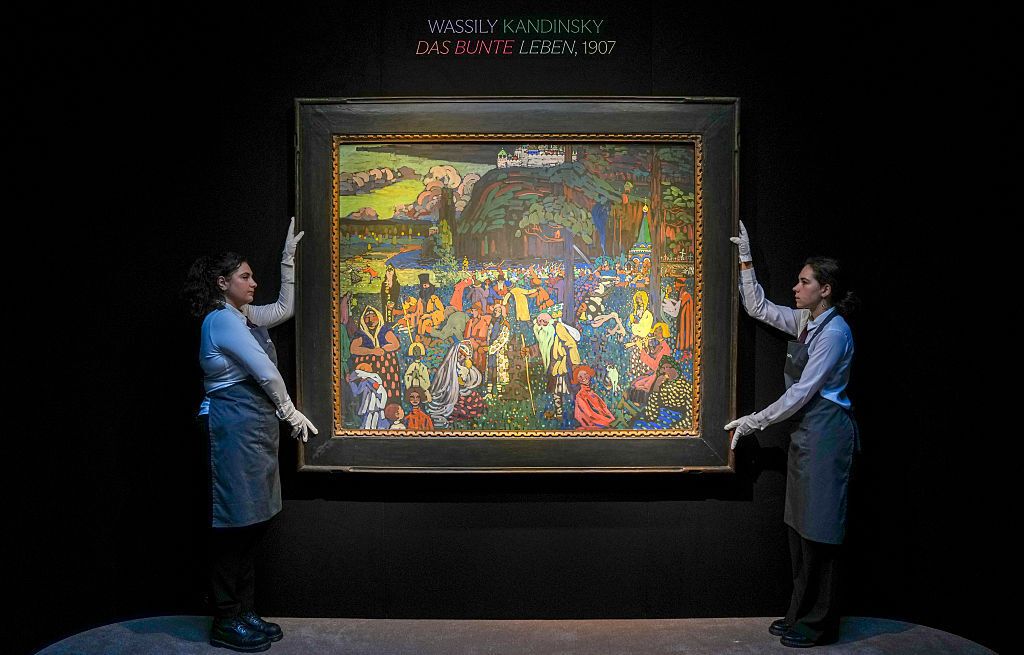
“Das bunte Leben,” the Russian artist’s dreamlike panorama, bridges folklore and early modernism. The sale follows a 2023 ruling concluding that the work was seized from its rightful Dutch Jewish owners October 27, 2026 4:49 p.m. Das bunte Leben, 1907, by Wassily Kandinsky seen ahead of its auction at Christie's in London Carlos Jasso / AFP via Getty Images A 1907 painting by Russian artist Wassily Kandinsky was stolen by the Nazis during World War II and spent half a century hanging in a German museum before its restitution to its original owners’ heirs in 2023. Now, the painting titled Das bunte Leben, or The Colorful Life, has sold at auction for about $42 million. During Christie’s 20th/21st Century: London Evening Sale earlier this month, auctioneer Adrien Meyer introduced the painting as “the most important early work by the artist to ever come to auction,” Daniel Cassady and Hikmat Mohammed report for ARTnews. Over six tense minutes, bids flooded the packed saleroom and telephone banks. The final price went far past the painting’s pre-sale high estimate of $33 million. The auction house did not disclose the buyer’s identity, per the New York Times’ Claire Moses. A closeup of the auctioned painting Christie's Kandinsky completed the painting during a stay in Paris with his partner, the German painter Gabriele Münter. Measuring over five feet wide, Das bunte Leben was his largest painting at the time of its creation. Influenced by both French Fauvism and traditional Russian folklore, Kandinsky said he wanted to “let the viewer take a stroll within the picture” and “become absorbed” in it, according to the Christie’s website. Against a dark background, Kandinsky’s luminous pigments depict an assortment of wanderers, monks and revelers, including an elderly traveler whose beard glows mint green and lovers embracing, oblivious to a distant funeral procession. “This is an iconic piece,” art dealer Daniella Luxembourg told the Guardian’s Holly Watt in 2017. “He painted this at a key point in his life, just before he moved to pure abstract works. It is one of his most important works.” Discover the story of Kandinsky's monumental work - The Colourful Life | Christie's In the 1920s, the masterpiece entered the private collection of Emanuel Lewenstein, a Dutch Jewish industrialist, and his wife, Hedwig Lewenstein-Weyermann. Following Lewenstein’s death in 1930, Lewenstein-Weyermann loaned the piece to the Stedelijk Museum in Amsterdam for safekeeping. After her death in 1937, the couple’s art collection passed to their adult children, who in turn fled Europe amid the rise of Nazism. In May 1940, Nazi troops invaded the Netherlands. Just five months later, works from the Lewenstein collection were auctioned off in Amsterdam. Das bunte Leben went under the hammer for a meager 250 Dutch guilders, roughly 10 to 20 percent of its market value at the time, per the Guardian. The family never authorized the transaction, nor did they receive any proceeds. Did you know? The Blue Rider Among the figures in Das bunte Leben is an armored knight on horseback, inspired by Russian folk epics. Kandinsky transformed the motif into the official emblem of Der Blaue Reiter, the pioneering expressionist group he helped established in 1911. After changing hands privately, the canvas was eventually purchased in 1972 by the German bank Bayern LB and placed on long-term loan at the Lenbachhaus museum in Munich, where it hung for nearly fifty years. The Lewenstein descendants waged a decades-long campaign to recover the work, filing a lawsuit against the bank in 2017. The legal impasse finally broke in 2023, when Germany’s advisory commission on Nazi-looted art recommended that the painting should be returned to the family. The government panel affirmed that “there are numerous indications that this was a case of a seizure as a result of Nazi persecution,” the New York Times’ Catherine Hickley reported in 2023. While Das bunte Leben did not surpass Kandinsky’s all-time auction high—set in 2023, when Murnau With Church II sold for $45 million at Sotheby’s—the sale brought a triumphant close to a family’s multi-generational pursuit of justice. “The restitution of Das bunte Leben … represents an important moment in the painting’s history,” Marc Porter, the chairman of Christie’s Americas, says in a statement. “Its return to the market marks the beginning of a new chapter for a work that holds such a significant place in modern art.” You Might Also Like Get the latest stories in your inbox every weekday. More about: Art Art History Auctions Holocaust Judaism Nazis Netherlands Painting
Looted by Nazis and Recently Restituted, a Kaleidoscopic Kandinsky Painting Just Sold for Nearly $42 Million
Full Article
Original Source
Read the full article at Smithsonianmag →KhanList aggregates and links to publicly available news content. We do not host full articles from third-party sources. Always verify important information with original sources.