
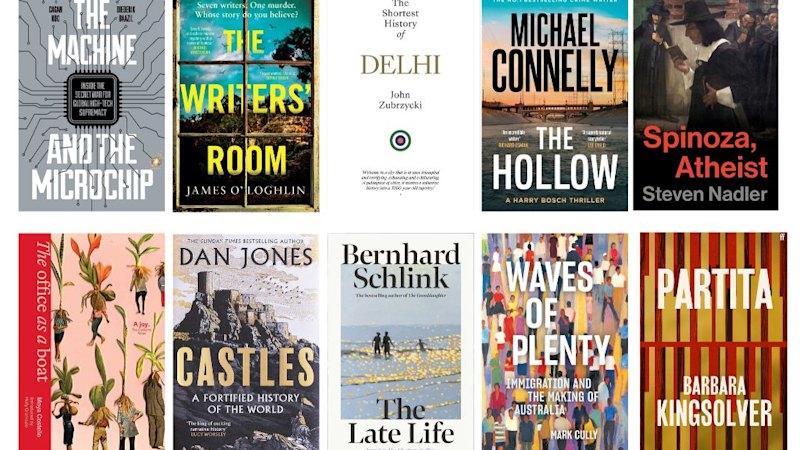
From a Pulitzer Prize winner to medieval history specialist, this week’s books range across crime fiction, a tender story about ageing and legacy, to histories of castles and Australian migration.Fiction Partita by Barbara Kingsolver (Faber, $35)A partita is a sequence of musical variations, a composition with different paces and moods. It’s an apt description of Barbara Kingsolver’s latest novel. Not only is its protagonist, Livia, an accomplished pianist, but the book itself is rich with a full suite of emotions: from the giddy crescendo of first love to the swirling depths of despair. It follows country girl Livia after the death of her beloved older brother, as she thwarts her mother’s expectations, leaves home, and takes a scholarship at Indiana University of Music. Her life takes another turn when she meets Sigurd, an idealistic revolutionary. Kingsolver explores a range of themes and devices, moving deftly from romance to tragedy to family dynamics, with skillful transitions between Livia’s past and present life. It’s a book that fully leans into the transporting powers of music – not only do the chapters have titles with musical terms (Sarabande, Toccata, Fugue) but there’s also a listening list, so the reader can hear the symphonies and requiems Livia is grappling with as she pounds the ivories. This is a worthy successor to Demon Copperhead. The Late Life by Bernhard Schlink, translated by Charlotte Collins (Hachette, $33)When Martin Brehm, 76, is diagnosed with pancreatic cancer and told that, if he’s lucky, he has only about half a year to live, he “didn’t know where he belonged – to the living, or already to the dead.” His worries extend to his young wife, Ulla, and his six-year-old son, David. The Late Life explores the convoluted mental pathways of Martin as he processes his emotions and prepares for his final season on earth. It sounds like a grim premise, but Schlink’s latest work is a clear-eyed and unsentimental portrayal of a man reassessing life. It’s imperative for Martin to reconsider his plans, obligations and appointments, and to free his calendar for quality time with his small family. The most tender parts of the novel are the quiet moments he spends with his child – hiking, building a dam and a compost heap, and illustrating a birthday card together for Ulla. He also starts to type letters to David about matters of love, religion, justice and fairness, in an attempt to leave some kind of moral and intellectual legacy behind. The Office as a Boat by Moya Costello (Pink Shorts Press, $33)This book was first published in 2000; its author died last year. This new edition has been reprinted with an introduction by Holly Gramazio, who says Moya Costello’s books are “short and strange and invent their own genres as they go.” The Office as a Boat fulfils this brief, but it’s also whimsical and funny. It’s ostensibly about a group of women in Adelaide during a summer heatwave, but the narrative is digressive. Both individually and collectively, the women’s preoccupations are explored, with the book following the rhythms of office life in the CBD, as well as the distractions outside. Whether it’s monitoring the tearoom gossip, noting the different screensavers favoured by the staff, or following the great coffee mug heist, Costello’s novel is full of the camaraderie and frustrations between people who necessarily spend hours together. At times, and unexpectedly, the thrum of realism is leavened by surrealist flashes – the title, for instance, sounds metaphorical, but when a storm finally hits, it becomes literal. This book deserves a new audience. The Hollow by Michael Connelly (Allen & Unwin, $35)When he was a teenager, after the murder of his mother, retired LAPD homicide detective Harry Bosch became a ward of the state in a notorious children’s institution. There, he befriended Charles “Chops” Lamb, who subsequently died in suspicious circumstances: his body was found in “the hollow”, an isolated space used as punishment. A lawsuit against the facility decades later acts as a catalyst for Bosch to delve into the cold case. But while investigating his friend’s death, he inadvertently stumbles into a much larger, federal case involving organised crime and stolen missiles. There’s a reason Michael Connelly is a global bestseller; his novels are a propulsive read, and this one is no different. The usual police procedural is elevated by the ballsy character of Bosch, who’s a bit of a rogue element, preferring to go his own way rather than to defer to his superiors. In this iteration, he may have had a recent knee operation, but his fighting spirit and deep desire for justice make The Hollow a satisfying read. The Writers’ Room by James O’Loghlin (Echo Publishing, $35)Two decades ago, Clara drowned after a night out, leaving behind a semi-autobiographical novel of five mates navigating the messiness of life and love in their 20s. Now, her screenwriter and producer friends Pauline, Nick, Henry, and Ingrid, her son Xavier and Pauline’s daughter, Alex, have assembled in a mansion in the Southern Highlands, planning to draft the novel into a TV series. With them is the network lead, an enthusiastic advocate of AI and data story creating ideas, who will decide whether the show will be commissioned. But the writers’ room soon becomes an interrogation room when one of the team is found dead at a nearby cliff. Enter Barb, the housekeeper and amateur sleuth, who teams up with Neville, a police clerical officer who has always wanted to be a detective. This mystery novel canvasses the challenges and ego of the writing and TV businesses and pits commercial success against artistic integrity while offering the requisite twists and turns of crime fiction. Non-fiction Castles by Dan Jones (Head of Zeus, $37)You wouldn’t think it would be difficult to define a castle, but as medieval history specialist Dan Jones points out in this highly informed, engaging history of castles, the Oxford Dictionary alone has 17 definitions. His study – a story of humanity seen through the motif of the castle – takes what he calls an “ecumenical” approach, from the earliest Bronze Age fortifications to the 20th century. Woven into this are tales of the people who designed, built or lived in them, including some fascinating figures like Renaissance author Christine de Pizan, whose The Book of the City of Ladies was written as a “literary super fortress” to document the achievements of women throughout history. Walls, such as China’s, qualify as castles, as does France’s famously ineffective Maginot Line, a vast row of underground forts along the French-German border that the Germans simply ignored and went around in May 1940. A rare combination of the entertaining and erudite. The Machine and the Microchip by Cagan Kog and Diederik Baazil (Scribe, $37)In what is called a “cleanroom” on a small Asian island, highly trained IT specialists stare into the screen of a machine about the size of a bus and known as the “white bus”, hour after hour. The island is Taiwan and the workers of the company, TSMC, are producing the world’s most efficient microchips (smaller than a virus), which are made using extreme ultraviolet lithography machines (EUV, or white bus), manufactured by a company called ASML. Without these chips, the IT world could basically shut down – not just your iPhone, but AI technology, drones and military communications, to name a few. Not surprisingly, these chips are the hottest property on earth, to the extent that the US banned China from getting them, and so far, the companies have agreed. Integrated into the tale are the constant military exercises by China which regards Taiwan as its own, while the US military stands ready. “Each successive Chinese simulation,” say the authors, “inches closer to Taiwan’s shores”. What happens when “exercise” becomes reality? That’s the question – and all over a chip! Spinoza, Atheist, by Steven Nadler (Princeton, $40)In 1656, a Dutch Jewish merchant was ex-communicated from his community in the most damning way, citing, among other things, his “horrifying heresies” – his atheism. The recipient of the ban, Baruch Spinoza, would go on to become one of the most famous of philosophers. But was he an atheist? US academic Steven Nadler examines this question in lively, sometimes ironic prose. To many, Spinoza was a pantheist, his key argument being that there is only one substance in the world from which all forms of life are derived, and, if there is a God, that’s it; not the transcendent creator and ultimate judge of good and evil. Nadler, unconvinced by the pantheist arguments, comes down firmly on the side of Spinoza’s atheism, calling him a “virtuous” atheist for whom doing good was a virtue in itself. The study also gives the reader a sense of the strength of Spinoza’s character, and, as much as anything else, is a portrait of a mind well ahead of its times. The Shortest History of Delhi by John Zubrzycki (Black Inc, $28)Whenever we choose to say Delhi was founded, it was not until the 11th century that a “city called Delhi appears on the historical record”. By the 1300s, it was being hailed as “paradise on Earth”. John Zubrzycki, who first experienced the city as a nine-year-old and returned to work there as a diplomat and foreign correspondent, has formidable knowledge of the place, and it shows in this impressively condensed portrait of Delhi and its complex history. The city emerges as a site shrouded in mystery, myth and romance, Zubrzycki suggesting that it “helps to temper romanticism with a dose of reality”. The tales of rulers, invaders, colonialist powers, poets and more are incorporated. Zubrzycki also vividly captures the city’s spirit, visible in the “maze of its laneways”, temples, forts and monuments to a history both “glorious and inglorious”. Waves of Plenty by Mark Cully (La Trobe University Press, $40)At one point in this sweeping history of migration to Australia, Mark Cully (former economic advisor for the Department of Immigration and Citizenship), invites the reader to take a stroll along Lygon Street, Carlton. The stroll not only takes in some of the most iconic establishments on the Australian cultural landscape but also throws up a synoptic portrait of the impact of immigration on the country – including the early Jewish presence, the Italian and the dazzling array of cultures there today. In short, it is a street transformed by migration, still evolving and re-inventing itself – like the whole country. Cully – who begins his study with British colonisation and its disastrous impact on the indigenous population – covers the six waves of migration that followed from the 1830s to the present day. He doesn’t see it as a “pro” migration book, rather a history. At the same time, it is also an inspiring tale. And with migration a key issue in forthcoming elections, it’s perfectly timed.What else is happening in the book world?Did The Time Traveler’s Wife author predict the 2020s?Bonnie Garmus delivers another screwball classicMin Jin Lee takes on the tyranny of ambitionMagda Szubanski’s memoir is full of tender truthsPulitzer Prizewinner Barbara Kingsolver on her new novel and Appalachian prideHe lasted 11 days in Trump’s White House. Now the Mooch has a warningThe Booklist is a weekly newsletter for book lovers from Jason Steger. Get it delivered every Friday.
Looking for your next book? Read our critics’ takes on the latest releases
Full Article
Original Source
Read the full article at Smh →KhanList aggregates and links to publicly available news content. We do not host full articles from third-party sources. Always verify important information with original sources.