
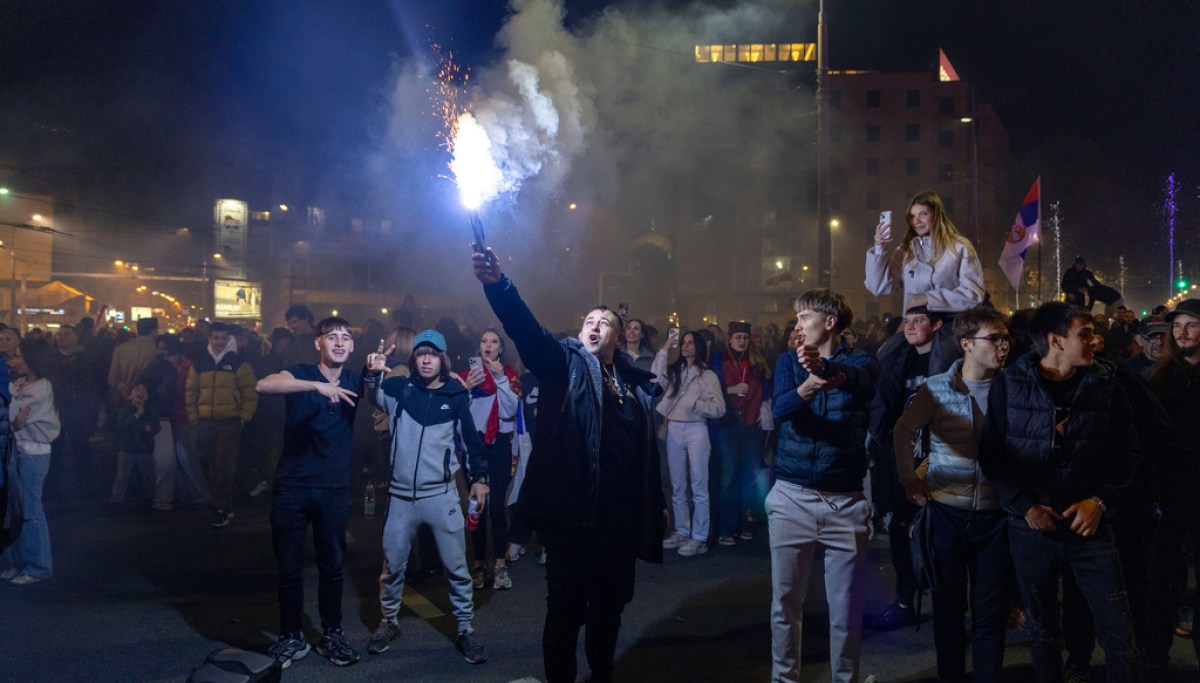
In a shocking upset, a student movement resoundingly beat longtime Serbian leader President Aleksandar Vucic, ending his time in power after 14 years.Vucic dominated Serbian politics since becoming president of the Serbian Progressive Party, or SNS, in 2012, then becoming prime minister in 2014, then switching over to president in 2017. Serbia occupies a unique position in Europe, as a longtime pro-Russian, Orthodox country lying in a Europhile sea. Under Vucic, it struck a balancing act between Russia, the European Union, China, and the United States. The former president had increasingly focused on a relationship with the U.S.Vucic’s courtship of President Donald Trump and his inner circle reached new heights during the latter’s second administration, however, and was of a much different nature than the first. A man holds a flare as people celebrate on a street a day after the student-led opposition won at the parliamentary elections in Belgrade, Serbia, Monday, Oct. 26, 2026. (AP Photo/Marko Drobnjakovic) Vucic’s courtship of Trump While relations during Trump’s first administration “focused on securing concessions in the Kosovo dispute, this time the emphasis was on securing external support for his political survival,” Dr. Vuk Vuksanovic, a lecturer in foreign policy and grand strategy education in the Department of War Studies at King’s College, London, and author of Serbia’s Balancing Act: Between Russia and the West, told the Washington Examiner.Trump won his second term in office just days after the collapse of a new concrete canopy at a train station in Novi Sad, killing 16 people. The disaster triggered a surge of student-led protests that would rock the nation for the next two years, focused on corruption and Vucic’s long rule. He desperately searched for a way out of his predicament ahead of the end of his second presidential term in 2027, viewing Trump as a possible savior. But the relationship was bound to disappoint, given Vucic’s high hopes.“Vucic’s courtship of Trump’s inner circle paid off mainly in short-term relief and symbolism. On the one hand, the relief came through energy, when Washington granted a series of short-term waivers that kept the NIS refinery running while Hungary’s MOL negotiated to buy out the Russian stake. These moves averted an imminent fuel crisis in the middle of the protests, and gave Vucic more maneuvering space while under pressure,” said Dr. Sinisa Vukovic, director of the Global Policy Program at Johns Hopkins University.An even bigger win came in the form of a strategic dialogue he launched with the U.S. in July, the first such format in the history of U.S.-Serbian relations. Vucic held up the dialogue as a great triumph, but Vukovic argued it was more of a symbolic victory, with its concrete achievements amounting to “an energy memorandum, pledges of military cooperation, and a Serbian request to buy American defense equipment.”Of much greater value, he argued, was the good favor it bought to keep the U.S. disinterested in the protests.“Throughout two years of protests, police violence, and arrests, Washington remained rather distant and treated the unrest as an internal Serbian matter. For Vucic, who was under mounting domestic pressure, this posture of noninterference was unquestionably worth more than any agreement, since it left the protesters without an influential external ally,” Vukovic argued.As he approached the conclusion of his final term limit as president, Vucic undertook a gamble by resigning as president and calling snap elections to become prime minister, a move similar to what Russian President Vladimir Putin did to stay in power after he was term-limited out in 2008. This gamble failed miserably, with the grassroots student opposition movement, coalescing into the Student List, winning 52.7% of the vote, compared to Vucic’s SNS winning just 39.2%.The results were particularly surprising as most polls had either SNS ahead or locked in a dead heat. Vuksanovic credited the surprise to the determination of the student movement.“The student movement broke the cycle of apathy, cynicism, and indifference towards political life that had developed among many Serbians following the traumas of the 1990s and the disappointments of the post-Milosevic transition,” he said. “The student movement not only defeated the government but also pushed the established, compromised opposition below the electoral threshold. This was not simply a change of government but a fundamental reconfiguration of Serbia’s political landscape.”Nebojsa Vladisavljevic, professor at the University of Belgrade, called the election campaign the “tip of the iceberg,” representing “a culmination of a two-year massive mobilization of hundreds of thousands against Vucic’s authoritarian rule and extreme corruption.”“In terms of its scale, intensity, and length, the mobilization went well beyond any protests in Europe in the last half century, having in mind the size of the small country’s population,” he added.Vucic conceded the election, defusing fears of a contested election. The end of Vucic’s reign now ushers in a period of uncertainty as the disparate Student List seeks to establish a new order in the country.Seeking to acquire as wide a tent of support as possible, Student List purposefully left its position on most critical issues outside of corruption vague and noncommittal.“The parliamentary elections were fought exclusively over domestic issues,”Vladisavljevic told the Washington Examiner.“The opposition covered a broad spectrum of ideological views, from conservative and patriotic to progressive and internationalist, but was fully united in demanding the renewal of democracy, the introduction of rule of law and fight against corruption which had become rampant under Vucic,” he added.What now for Washington? The Trump administration had built its relationship with Serbia around personal connections to Vucic, something that worked well with Trump’s noted personalist style of diplomacy. Vucic’s ousting shows the downside of that approach, as the whole relationship will have to be rebuilt from the ground up.“What survives this transition will depend on its form and utility. The strategic dialogue, the energy agreements, and the NIS ownership change remain state-to-state arrangements, and in principle the new government has every reason to keep them,” Vukovic said.“The personal access Vucic cultivated through his key contacts in Trump circles will most likely leave with him, and part of it had already become a liability. So, moving forward, the new government will inevitably have to build its own channels, and it may be reluctant to court the same people whose deals it now has a mandate to investigate,” he added.While the Trump administration obtained direct access to the halls of power in Serbia through Vucic and his inner circle, Washington has no counterpart in the Student List, which was without a leader and kept its candidates secret until late in the campaign.The purposeful vagueness from the Student List on the issues the U.S. cares about, mainly Russia sanctions, NIS, Kosovo, and China, is certain to create a state of uneasiness at the State Department.When reached for comment, a State Department spokesman struck an optimistic tone, saying they “welcome the Serbian people’s participation in their parliamentary elections,” and acknowledged the “preliminary results, including former President Vucic’s concession.”“We look forward to expanding our partnership with Serbia and working with its newly elected members of parliament as we continue to build on the momentum created in the last year, including with the launch of the Strategic Dialogue,” he added.The Trump administration is also now presented with an awkward situation — Vucic has gone into overdrive over the past few months building ties with the conservative movement in the U.S., cognizant of the vacuum created by Hungary’s conservative government’s fall. Just before the Serbian elections, the Conservative Political Action Conference announced it would be holding its first-ever CPAC Balkans conference in Belgrade, Serbia, next month, with Vucic as the headliner. In the week before the elections, groups of U.S.-based conservative influencers descended on Belgrade to boost Vucic.His concession speech, while acknowledging his loss, positioned himself as still the conservative movement’s biggest ally in the Balkans, and put himself explicitly in Trump’s camp.“One should not overlook the fact that Vucic spent two years describing the protests as a foreign-directed attempt to destroy Serbia, and his concession speech took this much further, when he called the result a revolution carried out with direct support from several European countries and the American deep state, which he described as the one opposing President Trump,” Vukovic said.In Vucic’s version of events, he was taken down by the same nefarious forces battling Trump in Washington, positioning himself as a ride-or-die member of Trump’s camp, even as he goes into opposition.The matter of Russia The Student List barely touched on the matter of Serbia’s position in the world, and when it did, it was usually in support of the conservative order. Vladisavljevic explained that the Student List strategically “fudged” foreign policy issues to get support from all sectors of the population.Vukovic described the foreign signaling of the Student List as “mixed … at best,” committing to no sanctions against Russia, preserving its neutrality, and being lukewarm about EU accession.Vucic’s tenure saw Serbia go in a more pro-Western direction than previously, playing a delicate balancing act between a plethora of actors often directly at odds with each other.Nowhere was his balancing act viewed more extremely than with Ukraine. He was often bashed as the most pro-Russian figure in Europe outside of Belarus and repeatedly refused to institute sanctions. Despite this, he shipped massive quantities of shells and ammunition to Ukraine, frequently drawing Moscow’s ire.Vuksanovic, Vukovic, and Vladisavljevic all disagreed on the most likely direction Russian influence will take in the new order, a disagreement reflecting the uncertainty kicked up by the Student List. Vladisavljevic said it would likely decrease, Vukovic said it would likely continue as before, and Vuksanovic said it would most likely decrease slightly, though not to any notable extent.“Unlike Vucic, the new government will likely engage in less hyperbolic glorification of Russia in the media and less EU bashing. Cooperation between Serbian and Russian security services may also be downgraded. Nevertheless, the new government is unlikely to see much value in joining EU sanctions against Russia or adopting the more confrontational policies towards Moscow pursued by Poland and the Baltic states,” he said.Vladisavljevic predicted that whatever their success would be, Moscow is “likely to try to get close to the new ruling party,” using pressure points such as Serbia’s need for cheap energy.Vukovic argued that the only way Russian influence could decline is via indirect means. Moscow enjoys a fair amount of influence through institution capture and security cooperation, so if anti-corruption investigations target these, Russia’s influence could naturally decline.So far, the initial signs point to continuity.“Within a day of the election, one of [Student List’s] prominent figures expressed gratitude to Russia in Russian state media and promised a more sincere relationship with Moscow than Vucic had offered. That the first foreign policy message after the victory went to Moscow, and through a Russian state outlet, says a good deal about where the new government’s instincts lie. Moscow will work through these channels, much as it did with Vucic,” Vukovic said.Moscow may even find some relief in its wary ally losing. The August meeting with Ukrainian President Volodymyr Zelensky enraged many senior Russian officials. The Serbian leader had long been seen as an unpredictable annoyance, and his balancing act wasn’t particularly subtle.TROUBLE IN BELGRADE: SERBIA’S EMBATTLED PRESIDENT LOOKS TO TRUMP FOR A LIFELINE“Moscow has little reason to see the outcome and the fall of Vucic as a loss. Leaders of the Student List and most likely figures in the new government have committed to the policies the Kremlin cares about most, namely no sanctions, military neutrality, and no NATO membership. Russia’s sources of influence in Serbia, from media and civil society, the Church and energy, remain in place regardless of who governs in Belgrade,” Vukovic said.“The early signals from the winning list suggest Moscow will find willing partners, possibly more predictable ones than Vucic ever was,” he added.
Longtime Serbian leader Vucic’s defeat at the hands of student movement leaves Washington in awkward position
Full Article
Original Source
Read the full article at Washingtonexaminer →KhanList aggregates and links to publicly available news content. We do not host full articles from third-party sources. Always verify important information with original sources.