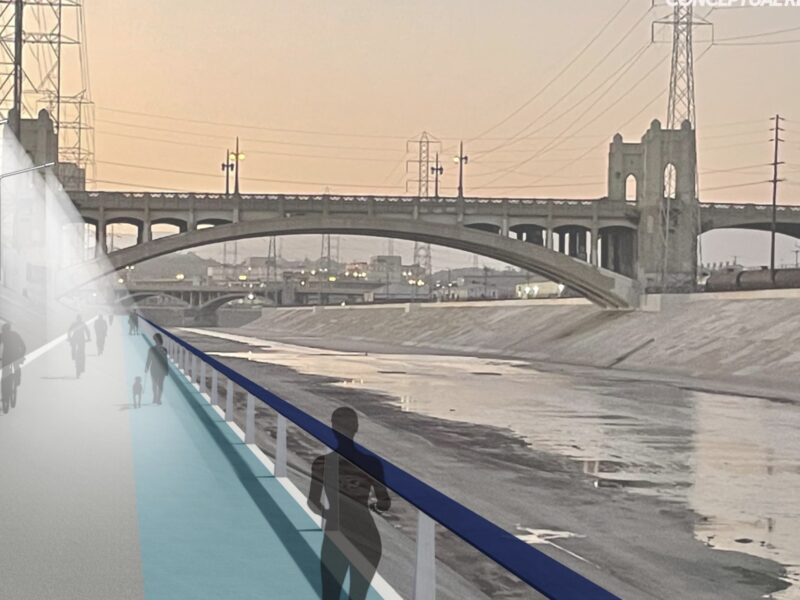
LOS ANGELES (CN) — In the 30 years since Los Angeles County first created an LA River master plan, much has changed along the 51-mile, mostly concrete-encased river that winds it way from the mountains in the northwest county to the port of Long Beach.Sections of the river have became popular recreation spots for local residents, with parks, tree-shaded paths and coffee shops, and numerous projects are underway to integrate the river in the surrounding communities by making it more accessible to pedestrians and cyclists and by restoring some of its natural character.One segment of the river, however, has remained a dystopian landscape — the 8-mile stretch that passes through the industrial zone east of downtown LA, where the concrete channel is boxed in by rail yards, warehouses and electricity towers.A safe and accessible bike path along the river through downtown will be a huge benefit to the Latino working class communities east of the channel, such as Lincoln Heights and Boyle Heights, as well as those further south along the river, said Laura Cortez, co-executive director of East Yard Communities for Environmental Justice.“A lot of our community members have family that work in Vernon,” Cortez said, referring to the industrial hub along the river just south of downtown LA. “They have to carpool now because there are no bike lanes and it’s not safe to ride a bicycle because there’s too much traffic from trucks.”As bicycles are getting more popular in historically car-centric LA, and with the increased availability of electric bicycles and scooters, a bike route that provides a safe commute from both the east and the south to Vernon — an exclusively industrial city where 55,000 people come to work everyday from around the region — would mark a significant improvement for the those workers and the environment, Cortez said.The Los Angeles River south of the 1st Street bridge in downtown LA. (Edvard Pettersson/Courthouse News Service)Plans to build this bike path along the downtown river channel, and thereby create a seamless 32-mile bicycle and pedestrian route from the San Fernando Valley to Long Beach, are moving forward, if slowly. This year, the LA County Metropolitan Transportation Authority solicited public input on a draft environmental impact report for the LA River Path.The draft report considers multiple options, with as many as seven new bridges and 11 new access points to the path from the surrounding streets. All options include a combination of an elevated path, an incised path in the sloping concrete walls of the channel, and where there is space, a street-level path on top of the riverbank.The route would bob and weave around utility towers and over and under the existing bridges so cyclists and pedestrians don’t have to worry about cars and trains. And while the options with most access points for bicycle commuters would bring the greatest benefits to the surrounding neighborhoods, they also are the most expensive to build.Metro expects its board to decide later this year which of the alternatives envisioned in the draft report to advance. At that point. the agency will start preparing a final environmental report. So far, there’s no timeframe for the actual construction of the project.Funding for the LA River Path was included in Measure M, a massive transportation infrastructure improvement initiative approved by LA County voters in 2016.While Measure M earmarked $365 million for the bike route through downtown LA, it was one of dozens of projects — including a subway extension, bus and light rail improvements as well as freeway overhauls — to be funded over 40 years by a 1/2 cent increase in sale tax, and it has had to wait its turn.Map with the proposed LA River Path through downtown. (Source: LA County Metropolitan Transportation Authority)A further wrinkle is who will oversee construction and maintenance of the LA River Path given it spans multiple jurisdictions. In May, Metro’s board voted to commission a governance study for the project that will look, among other things, at the option of establishing a new agency in charge of the entire LA River.“Metro owns less than 1% of the LA River corridor right-of-way in the downtown Los Angeles segment,” the agency said in a response to an inquiry from Courthouse News. “For this 8-mile segment, responsible jurisdictions include the city of Los Angeles, the city of Vernon, the county of Los Angeles, and the U.S. Army Crops of Engineers.“The May board motion identified the LA County Flood Control District as a lead agency for overseeing the governance study due to its long-standing expertise on the LA River and its relationship with the U.S. Army Corps of Engineers,” the agency added. “At this time, the timeframe of the governance study had not been established.”The idea to set up a new agency to oversee the project isn’t unusual for large infrastructure projects that involve several municipalities and government entities. And it may even make more sense for a bicycle route along a river channel said Eli Lipmen, executive director of Move LA, a nonprofit that has been advocating for public transit investments in traffic-clogged LA County for the past two decades.Move LA, Lipman said, has been working with Metro board members, including LA Mayor Karen Bass and LA County Supervisor Hilda Solis, on the idea to create a joint powers authority for the LA River Path because Metro has enough on its plate as it is.“They’re very good at building stuff, but they are essentially a bus and rail agency,” Lipman said.A newly established agency would also have the unenviable task of finding funding for the project. While the $365 million set aside for the bike path 10 years ago has accumulated value in the interval, the current projections are that it would take well over $1 billion to build the bike path.The exact costs are contingent on how many access points and bridges will be included in the project and whether, and how, the path will incised in the concrete walls of the channel given that there’s little or no space on the banks of the channel that are occupied with rail tracks and utility infrastructure.The staggering costs for an 8-mile bike path have proponents divided on what shape it should take.Move LA would prefer the most cost-effective version — a bike route smack on the concrete river channel — even if that means it’s unusable on days when the river is swollen by heavy rains during the winter.“If this was two years ago and we were under the Biden administration, we would have a different conversation,” Lipman said.The Los Angeles River Greenway Trail in the Elysian Valley neighborhood north of downtown LA. (Edvard Pettersson/Courthouse News Service)The Festival Trail, an organization that wants LA to use the 2028 Olympics as an opportunity to invest in lasting transportation alternatives to cars, likewise is more interested in Metro using the available funding to build a bike path in the river channel sooner rather than later.Unfortunately, that alternative isn’t part of the options envisioned in the draft report for the LA River Path.“We want them to go back to the drawing board,” said Dave Snyder, a bicycling advocate with Festival Trail. “We don’t want to wait forever.”Bike paths in flood channels are common around the world, according to Snyder, and with the dry Southern California climate, the path through downtown LA could only be closed 10 to 15 days a year.Damian Kevitt, executive director of Streets Are For Everyone — a nonprofit that advocates for safer streets for pedestrians, cyclists and drivers alike — also said Metro should scuttle its ambitious and currently unaffordable plan for the bike route and use its available funding to build a path in the flat river channel.“People are dying,” Kevitt said, noting that there had been as 1,800 accidents involving bike riders, including 15 fatalities, in the downtown area near the river since funding for the LA River Path was approved 10 years ago.He also noted that, unlike in places like Seattle and Portland, Oregon, people don’t ride bicycles in LA when it rains and that it wouldn’t make much of an impact to close the path in the flood channel on the handful of days that it’s unsafe.East Yard Communities for Environmental Justice, however, is more concerned that the bicycle route through downtown be available to commuters year round.“While expeditiousness is important, it is of utmost importance to get it done right,” Cortez said. “The purpose of this route is to create access, and that shouldn’t be restricted to a portion of the year.”About 1 million people in LA County live within one mile of the river. In the 20th century, as the population of LA County grew rapidly and the sometimes massive flooding of the rain-swelled river became more devastating, the Army Corps of Engineers encased the river in concrete.That left the river disconnected from the surrounding neighborhoods and made it a grim if familiar backdrop for chase scenes in dozens of Hollywood movies, from “Grease” to “Terminator 2” to “Transformers.”Since the 1990s many local projects have sprouted up along the river to reintegrate it in the neighboring communities with parks, trails, environmental cleanup and ecological restoration. Along the Los Angeles Greenway River Trail just north of downtown LA in Elysian Valley, popularly known as Frogtown, small businesses have started to pop up.The shaded path along the west bank is now a popular destination of young families, dog owners, cyclists and those wanting to enjoy a drink and bite to eat while overlooking the river.Joe Linton, a longtime river and cycling advocate, visits the Frogtown stretch of the river to ride his bicycle two to four times a month, sometimes with his young daughter. He’s been involved with efforts to revitalize the river since the early 90s and said that there had been worries that the bicycle path in Frogtown was too far out of the way. But it’s proven to be popular with people from communities on both sides of the river.“On a good day when it’s not too hot and not too cold, you get lots of people walking and riding bicycles here,” he said.“It looks like a river here. It gives people a good picture of what’s possible.”Spoke Bicycle Cafe in the Frogtown neighborhood north of downtown Los Angeles. (Edvard Pettersson/Courthouse News Service)Subscribe to our free newslettersOur weekly newsletter Closing Arguments offers the latest about ongoing trials, major litigation and rulings in courthouses around the U.S. and the world, while the monthly Under the Lights dishes the legal dirt from Hollywood, sports, Big Tech and the arts.Additional Reads
Long-awaited LA River bike path through downtown pedals ahead — slowly
Full Article
Original Source
Read the full article at Courthousenews →KhanList aggregates and links to publicly available news content. We do not host full articles from third-party sources. Always verify important information with original sources.