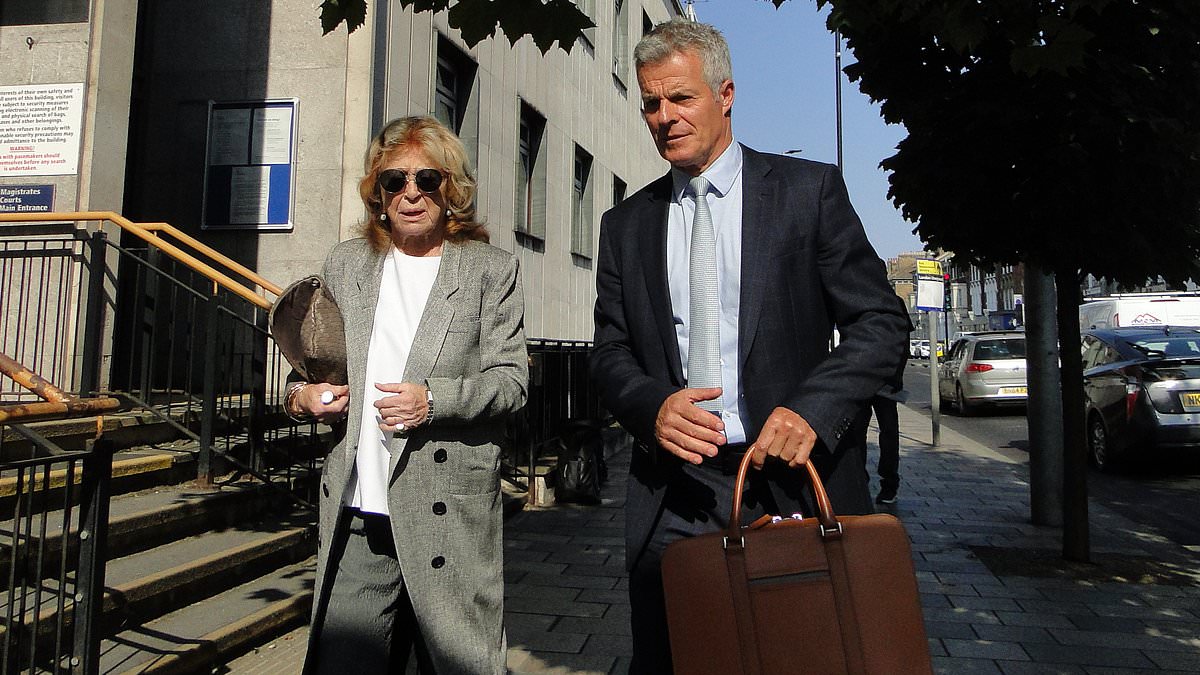
The expansion of 20mph speed limits across London is making roads less safe and unfairly targeting black cab drivers and disabled people, critics warned today.Sir Sadiq Khan's so-called 'war on motorists' means over half of the capital's roads now have the limit, with two thirds of boroughs applying it on most of their roads.It marks a doubling in the low-speed zones over the past decade given 25 per cent of London's road network had 20mph limits in 2016, up from just 11 per cent in 2008.Transport for London (TfL) is aiming to go further over the next few years, imposing the limit on more than 80 per cent of roads in central and inner London by 2030.TfL claims the limits are playing a critical safety role in achieving Sir Sadiq's 'Vision Zero' goal to end deaths and serious injury on the transport network by 2041.But the implementation continues to draw criticism, with location technology firm TomTom blaming it for London being the world's 'slowest capital city to drive in'.Danny O'Gorman, general manager of Freenow by Lyft UKI, a mobility app through which people can book London black cabs, told the Daily Mail today: 'Road safety is crucial, and we fully support making London's roads safer for everyone.'However, professional taxi drivers on the front line see first hand that 20mph limits slow traffic down, making it harder to get passengers where they need to be efficiently. This heavily impacts passengers who rely on taxis, including those with disabilities and people trying to get home safely late at night.'We believe policymakers and drivers need to work closer together to find the right balance, prioritising safety while keeping the city moving.'City Hall Conservatives' transport spokesperson Thomas Turrell also condemned the policy, telling the Mail: '20mph zones have served to greatly extend journeys across London, inconveniencing motorists and clogging up roads as a result.'If Labour had their way, every road in London would be 20mph, and we'd never get anywhere. The Mayor has made these schemes a requirement of any grant of funding for road repairs and he exploits the need to fix London's roads to force his anti-car agenda on motorists. It's not on, and it's not what motorists are paying tax for.'Crime writer Lynda La Plante became the latest victim of 20mph zones yesterday as she was banned from driving for six months for a string of speeding offences.La Plante, 83, pleaded guilty to breaking the 20mph speed limit near her home in Kingston-upon-Thames five times between November 2025 and April this year.She admitted driving at 24mph twice, 25mph, 26mph and 27mph but her lawyer Nick Freeman - who is known as 'Mr Loophole' and has represented a string of celebrity clients - said she inadvertently broke the limits while concentrating on driving safely. Speaking today, Mr Freeman told Channel 5's Storm and Alexis: 'The problem with this area [where she was speeding] is it's a very complex route. There are something like eight schools, a university, numerous pelican crossings, pedestrian crossings.'There are so many hazards that actually it requires far more concentration to drive along this particular stretch than a normal stretch at 20mph.'And because we're so obsessed with speed observance, what we're doing is prioritising speed observance over road safety. And that is the perverse irony.'He added: 'If you're concentrating for example on a child that's standing on the road, thinking 'is he going to cross', in that second, your car automatically is going to increase beyond 20mph and bingo, you're stopped for speeding, the camera flashes.'So what do you do? Do you think "Oh, I'm going to look at my speedometer, that's what I'm going to focus, I'm not going to focus on that child because I've got to make sure under no circumstance do I do more than 20mph".'It comes after actor Eddie Redmayne was handed a £1,530 court bill in April after being caught doing 28mph in a 20mph zone along the A4 through Earl's Court last October. The stretch of road where he broke the limit became a 20mph area in 2023.In January, fellow A-lister Sir Idris Elba was given a court bill of £316 for speeding at 28mph on his BMW moped in a 20mph zone along the Chelsea Embankment.Real Housewives of London star Amanda Cronin was in court in February after taking her £250,000 Bentley to 4mph above the 20mph limit on the A4 in South Kensington.She received three penalty points for the offence, but due to a history of speeding offences this took her to a total of 12 - triggering an automatic six-month ban.EastEnders star Colin Salmon however was spared a driving ban in January after he was caught speeding at 24mph in Acton close to his £1.2million home.He already had nine points and received three more which usually trigger a six-month ban. But he only received a £1,062 court bill after a magistrate accepted that Salmon was the 'main breadwinner and carer' for his family, many of whom have 'life-limiting conditions'.London's first 20mph speed limit was introduced in Kingston – where La Plante was caught speeding – in January 1991. Other zones were also rolled out elsewhere in the UK in Sheffield and Norwich that month.Around 450 zones were installed in the 1990s before they began becoming more widespread after 1999 when a change in the law meant traffic authorities no longer needed to obtain specific consent from the Secretary of State to implement one. Lynda La Plante and her lawyer Nick Freeman, known as 'Mr Loophole', outside Lavender Hill Magistrates' Court in south-west London yesterday where the author was banned from driving Sir Idris Elba was caught speeding at 28mph on Chelsea Embankment on his BMW mopedData provided to the London Assembly shows that in 2008, about 11 per cent of London's road network had 20mph speed limits. This rose to 25 per cent in 2016, 42 per cent in March 2020 and 52 per cent by October 2023.The rollout of 20mph zones has accelerated in recent years amid a four-phase TfL programme. This started in 2020 with a limit of 20mph being imposed on all central London roads managed by the transport body.By December 2023 the limit had been lowered by 10mph on 87 miles of TfL's roads.Phase three saw the speed limit lowered by 10mph on another ten miles of TfL's roads, including sections of the A23, A24, A1, A214, A10, A2213, A306, A316 and A312 – which was completed in March this year.It means 166 miles of TfL's roads are now subject to a 20mph speed limit.The final phase involves lowering speed limits on at least a further 40 miles of the TfL road network by 2030, meaning more than 80 per cent of roads in central and inner London will have a 20mph speed limit.Other roads are managed by individual councils, and the first London borough to impose blanket 20mph speed restrictions on its roads was Islington in 2013. Police there began handing out on-the-spot fines the following year.TfL said 21 out of 33 London boroughs now have a default 20mph speed limit.The highest total of 20mph breaches between January 2022 and October 2024 was recorded in Westminster with 88,192, according to Metropolitan Police data.This was followed by Islington with 60,807, Hackney with 56,294, Ealing with 48,444, Lambeth with 41,710, Southwark with 40,021 and Tower Hamlets with 39,234.Reducing speed limits to 20mph is becoming increasingly common across the UK and other parts of Europe.Wales has already adopted a 20mph default in built-up areas and the Scottish Government has committed to implementing the same limit 'where it is appropriate to do so'.Some 62 out of 153 local authorities in England have also adopted similar policies.Real Housewives of London star Amanda Cronin was banned from driving at Bromley Magistrates' Court in February after taking her £250,000 car to 4mph above the 20mph limitFor example in Leeds, the council's 'Vision Zero 2040' strategy means residential roads and streets around all schools will become 20mph over the coming years.Last year 32,548 motorists were caught at 30mph or more on 20mph roads, according to figures from 28 police forces published by the RAC last month.A separate study in 2013 found almost one in every four cars registered in London had received a speeding fine for breaking a 20mph limit in the capital over a six-year period.The Metropolitan Police issued around 595,000 tickets to drivers between 2018 and 2023, equivalent to 85 per cent of the 700,000 fines handed out across the UK over that period.Fines for drivers breaching the 20mph limits were also found to be up 700 per cent since 2018.A spokesperson for 20's Plenty for Us, an organisation campaigning for a default 20mph speed limit on residential streets, told the Mail: 'There are always serial offenders who have clocked up multiple speeding fines, often in the same place and we tend to not comment on these individual cases.'Londoners know that the speed limit is 20mph on the majority of the capital's roads now, unless there is a sign saying otherwise. Kingston-upon-Thames is one of 21 of the 33 London boroughs that has made the vast majority of its roads 20mph in recent years.'The really encouraging news is that Transport for London has found out that where 20mph limits have been brought in by boroughs serious and fatal road casualties have fallen by 34 per cent and people feel a lot safer when getting about.'Keeping within the 20mph speed limit is a sure fire way of avoiding paying a fine for speeding and helps keeps us all much safer.' EastEnders actor Colin Salmon at Lavender Hill Magistrates' Court in January, where he was spared a driving ban despite being caught doing 24mph in Acton near his £1.2million homeLast year TfL said a study of more than 150 20mph schemes implemented between 1989 and 2013 revealed the number of people killed or seriously injured on borough roads reduced by 34 per cent following implementation of these speed limits.However it also acknowledged other road safety improvement measures brought in over that period and that 20mph schemes were not the sole cause of improved road safety.A spokesperson for Sir Sadiq told the Mail: 'While the latest data show that we're making London's roads safer, every death or serious injury is one too many, and lowering speed limits is one of the most important ways to reduce danger.'Boroughs across the capital are leading the way with bold, evidence-led action to help make London's streets safer. 'More than half of London's roads now have a 20mph speed limit and research shows this has helped to save many lives, with 40 per cent fewer people killed and 75 per cent fewer children killed when these limits are introduced.'The Mayor remains committed to eliminating death and serious injury on the transport network, and will continue working closely with partners to deliver his recently updated Vision Zero Action Plan as we build a safer, fairer, better London for everyone.'And a TfL spokesperson told the Mail: 'Speeding remains one of the biggest and most preventable causes of road danger in London, with provisional data showing it was a contributory factor in more than half of the capital's fatal collisions in 2025. 'The evidence is clear that 20mph speed limits save lives, with TfL's latest long-term research showing a 34 per cent reduction in the number of people killed or seriously injured on borough roads following the introduction of 20mph schemes. 'Any changes to speed limits are supported by clear signage and may use radio and digital advertising to help ensure road users are aware of the new limits in place.'TfL also claims that the higher the speed of the vehicle, the higher the risk someone involved in a collision will die - saying that if a person is hit at 30mph they are five times more likely to die than if they are hit at 20mph. Sir Sadiq has been accused of carrying out a 'war on motorists' by opponents due to a series of policies in recent years such as the expansion of the Ultra Low Emission Zone (Ulez) and the rollout of Low Traffic Neighbourhoods (LTN).But the Labour Mayor has rejected the label, insisting he is not 'anti-motorist' and is instead trying to make the capital safer by lowering air pollution and reducing the chance of accidents.
London's 20mph speed limits are crippling black cabs, hindering disabled travellers and enforcing Sadiq Khan's 'war on motorists', critics claim as Lynda La Plante becomes latest victim
Full Article
Original Source
Read the full article at Dailymail →KhanList aggregates and links to publicly available news content. We do not host full articles from third-party sources. Always verify important information with original sources.