
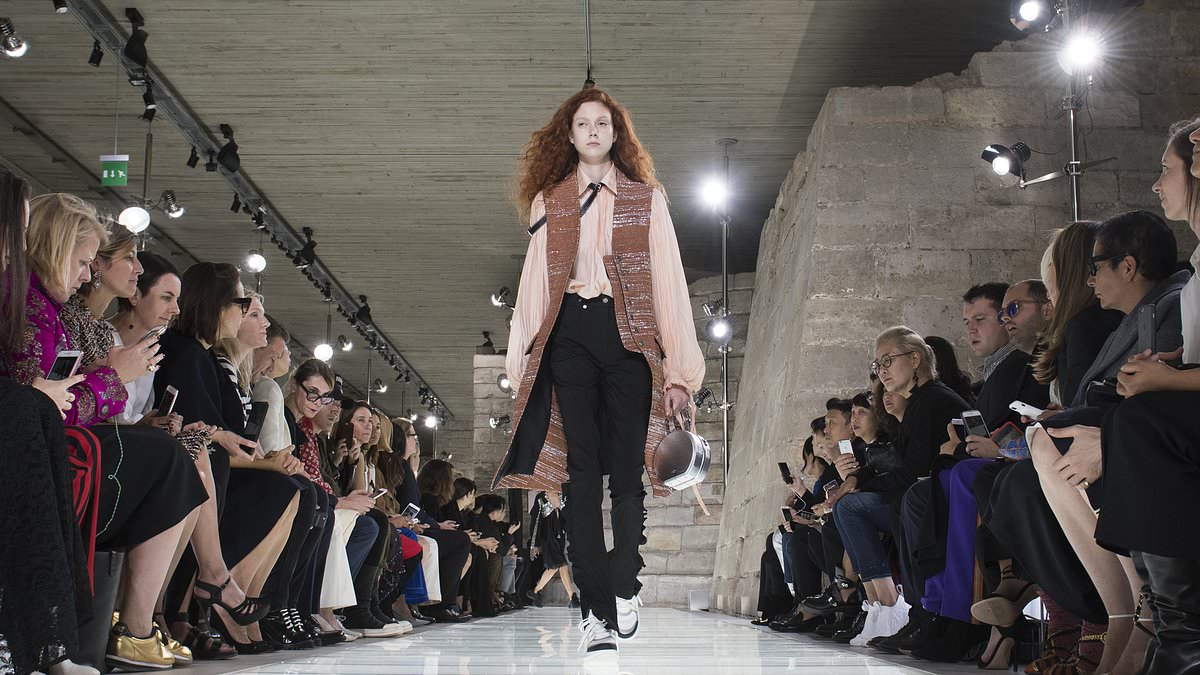
The style caravanserai swings into town this weekend for the glitz and glamour of London Fashion Week. But behind the smiles and the air-kissing at the designers' shows, fear will stalk the catwalk and Bond Street, home to luxury goods stores.Shares in companies like the iconic British brand Burberry and LVMH, luxe's most powerful player, have fallen out of vogue, declining further in recent days.This followed a gloomy report on prospects for the sector from HSBC analyst Anne-Laure Bismuth.As a consequence of weak sales and disappointing profits at LVMH and other constituents, the STOXX Europe Luxury index is down 20 per cent since January.Shares in LVMH, which owns ‘houses’ such as Dior, Louis Vuitton, Tiffany and Sephora, have sunk 35 per cent this year to €414.This is near its lows during the Covid retail shutdown. At the height of the revenge-spending spree that emerged when lockdowns eased, LVMH’s price soared to €841.Even the seemingly invincible Hermes, maker of the Birkin bag, has tumbled by a third to €1,409.Burberry is down 17 per cent over the same period – and 50 per cent over the past three years. The company’s fortunes had been reviving, thanks to a new emphasis on 'Britishness'. Luxury loses lustre: Fashion houses have suffered a slump in recent months But ‘turnaround’ stocks have been hardest hit, presumably on the belief that the recovery could now stall.By contrast, shares in high street fashion leaders such as Marks & Spencer, Next and Zara owner – the Spanish giant Inditex – are prospering.Indeed, so successfully has M&S ‘dumped the frump’ that it will be staging its first-ever show at London Fashion Week, alongside Burberry, Erdem and other elite participants.Next week, the focus moves to the shows in Milan and then Paris. But the questions British investors will be asking are: should I quit Bond Street for the High Street? Or is Bond Street now a bargain alley?Why luxe lost its allure The factors behind the sector’s malaise include the impact of conflict in Iran on Middle East tourism, and the continuing consumer downturn in China, where the passion for baubles and handbags was previously voracious.Americans may fast be becoming almost as keen, thanks to fortunes made from soaring artificial intelligence (AI) tech stocks. But apprehension over a bubble in these shares persists.Bank of America analysts say that third-quarter data indicates a dip in demand in the US and other key markets, such as South Korea, where the AI boom has also enriched luxury goods fans.Yet although an AI stock rout imperils the taste for luxury, the deft deployment of AI could reset luxury goods companies’ relationship with customers, reigniting their urge to spend. Or so argues Claudia D’Arpizio, of management consultancy Bain.Meanwhile, as Bain also highlights, cost-of-living pressures have curtailed the spending of more than 60 million ‘aspirational’ shoppers worldwide who used to make up about 15 per cent of luxury companies’ clientele.Some of this pain is self-inflicted. From 2019 onwards, LVMH and the rest raised the prices of bags and other items by 50 to 70 per cent.Now, as Mamta Valecha, analyst at Quilter Cheviot, points out, LVMH is trying to win back these shoppers.Initiatives include lipsticks that sell for £120, a more affordable proposition than a Louis Vuitton Neverfull bag, which costs around £1,400 (against £990 in 2020). Investors can cash in on the catwalk slump as London Fashion Week begins New Louis Vuitton stores are being designed as ‘immersive brand experiences’ in which a younger crowd can buy lipsticks and dream of one day acquiring a Neverfull.But Valecha adds that change takes time in a conglomerate the size of LVMH, suggesting that the benefits may not be visible in results for a few quarters.All this suggests that luxury would not suit risk-averse investors.But if you want to inject an adventurous twist into your portfolio, it could be worth taking a bet on a bounceback. After all, these businesses have built their reputation on successive reinventions.Note that Bain still expects growth in the sector of 3 per cent this year and 4 per cent in each of the next three years, while broker Bernstein forecasts 5 per cent.The Bond Street options Broker analysts are taking a cautious view, rating the following as a 'hold': Burberry, Kering, the Gucci group and LVMH. But Berenberg, Bernstein, Deutsche and others are more optimistic about Hermes, considering it a ‘buy’ at its current level.The view of Richemont is also more upbeat, because of this Swiss company's concentration on jewellery through its Cartier and Van Cleef & Arpels divisions.So expensive have handbags become that bracelets and necklaces seem, relatively, affordable, and also a way to hold gold at a nervous geopolitical time.Rolexes and other timepieces also appear to be seen as a desirable asset – good news for Watches of Switzerland, a British company. Despite a recent retreat, its shares are 38 per cent up this year.Investors seem to agree with the company’s chief executive David Hurley that ‘your iPhone is going to tell you the time more accurately, but a watch is a symbol of success.’The high street choicesShares in Next, the £17.4billion group regarded as the high street bellwether, have bounced by 9 per cent this year to 15,000p. Ahead of half-year results next Thursday, most analysts see the shares as a ‘hold’.But, on the basis that Next almost always contrives to deliver a pleasant surprise, Citigroup and Deutsche view the shares as a ‘buy’ Citigroup has set a target of 18,400p.M&S shares have advanced by 76 per cent over the past three years, and by 17 per cent this year to 386p.But analysts hope for more, with the majority believing M&S to be a ‘buy’ with an average target price of 442p. The company will be ensuring that the creations that it sends down the runway at its fashion week show support this favourable assessment.Inditex, the Spanish behemoth and the world’s largest fashion retailer, this week unveiled a 7.6 per cent increase in first-half sales to €19.8billion.This may have been below forecast but the group has made a strong start in the third quarter, taking catwalk copy specialist Zara upmarket, while expanding its discount chain Lefties. The first store opened this month in Liverpool.Analysts love Inditex’s strategy, it seems. The shares stand at €54 but are tipped as a ‘buy’ with an average price of €60.I have stakes in both Bond Street through Burberry and LVMH, and in the high street through Next and M&S. Trends come and go. But diversification is seldom out of style.DIY INVESTING PLATFORMSAJ BellAJ BellEasy investing and ready-made portfoliosHargreaves LansdownHargreaves LansdownFree fund dealing and investment ideasinteractive investorinteractive investorFlat-fee investing from £4.99 per monthFreetradeFreetradeInvesting Isa now free on basic planTrading 212Trading 212Free share dealing and no account feeAffiliate links: If you take out a product This is Money may earn a commission. These deals are chosen by our editorial team, as we think they are worth highlighting. This does not affect our editorial independence.Compare the best investing account for you
London Fashion Week begins as luxury stocks slump: Here's how investors can bag a catwalk bargain
Full Article
Original Source
Read the full article at Dailymail →KhanList aggregates and links to publicly available news content. We do not host full articles from third-party sources. Always verify important information with original sources.