
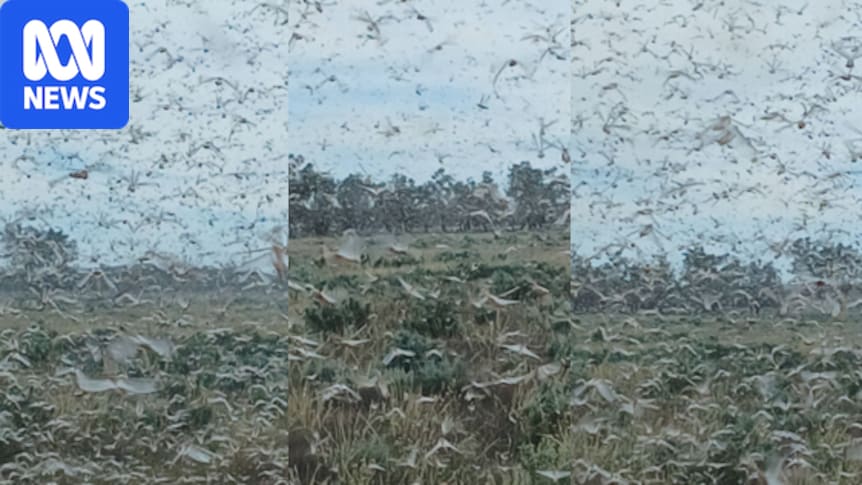
Locust outbreaks are reaching new highs in parts of South Australia, as landholders raise concerns that the time for effective control has passed.Outbreaks have occurred across SA, with producers reporting higher numbers this year than in previous years.The Department of Primary Industries and Regions (PIRSA) began surveying the outbreaks in early September and has completed aerial spraying for locusts over 115,000 hectares around the Flinders and Mid North regions.A locust in a paddock at Bugle Hut in South Australia's Riverland. (ABC Riverland: Amelia Walters)Peterborough livestock producer Bridget Woods said she filed a report with PIRSA after first noticing locusts on her property about five weeks ago."There were thousands of them everywhere that were about half a centimetre in size," she said."There's not much left there for them to eat now, but while we still had clover, they ate all the plants, just leaving half-formed seed pods behind."Bridget Woods said watercourses on her station were covered by "a black cloud" of locusts. (ABC Rural: Brooke Neindorf)Since then, the pests have grown, both in size and population."We had the rain, and they've hatched. The volume of them is like nothing I've seen. It's incredible," Ms Woods said."It's at the point where you couldn't even ride a motorbike, they're that thick."Though PIRSA has regularly monitored the station, Ms Woods said it took about five weeks before the department began aerial spraying on Thursday."They kept telling us … that we didn't have enough grasshoppers; we needed to have between 80 and 500 per square metre per 100 hectares," she said."Now they're adults, they're flying, they're laying eggs. This should have been tackled at least four weeks ago."SA's locust commissioner, Michael McManus, said survey teams had been at Peterborough regularly, but swarms of adult locusts had infested the area in the past week, triggering the aerial spraying.He said several factors had to be evaluated when considering aerial spraying, including the target's size and the landscape.Michael McManus said the department had to consider several factors when determining where and if to conduct aerial spraying. (ABC News: Marco Catalano)"We need to be efficient and effective with our locust response," he said."We're trying to control very large areas, so we focus on those big targets where we can effectively take out large populations."Earlier this month, the state government backflipped on its outbreak management approach when it sprayed parts of the Mallee despite previously saying the region was unsuitable for spraying.A spreading problemFurther north at Mount Little Station in the Flinders Ranges, pastoralist Peter Zadow said the locusts had been "out of control" this year.Mr Zadow said the best time to control locusts was at the banding stage a few weeks after hatching, when the pests gather in large groups."They'll all be millions of grasshoppers all combined together in one area, and they'll just hop around," Mr Zadow said."You'll see them in one place at lunchtime, you'll go back to spray them and they'll be moved two or three kilometres up the road."Mr Zadow said PIRSA had been monitoring his property, but the outbreak did not meet the threshold for aerial spraying.The locusts at Mount Little Station have been "out of control" this year. (Supplied: Peter Zadow)He was instead told about the department's Plague Locust Chemical Rebate."That doesn't help if you haven't got any machinery and misters to go out there and actually do the job," he said.Mr McManus said while locusts are harder to control in the adult stage, concerned producers could try to control the pests in the morning or evening when they settle.He said PIRSA would continue to monitor locusts in the Flinders Ranges and Mid North, while aerial spraying where possible.
Locusts wreaking havoc across South Australia's pastoral land
Full Article
Original Source
Read the full article at Abc →KhanList aggregates and links to publicly available news content. We do not host full articles from third-party sources. Always verify important information with original sources.