
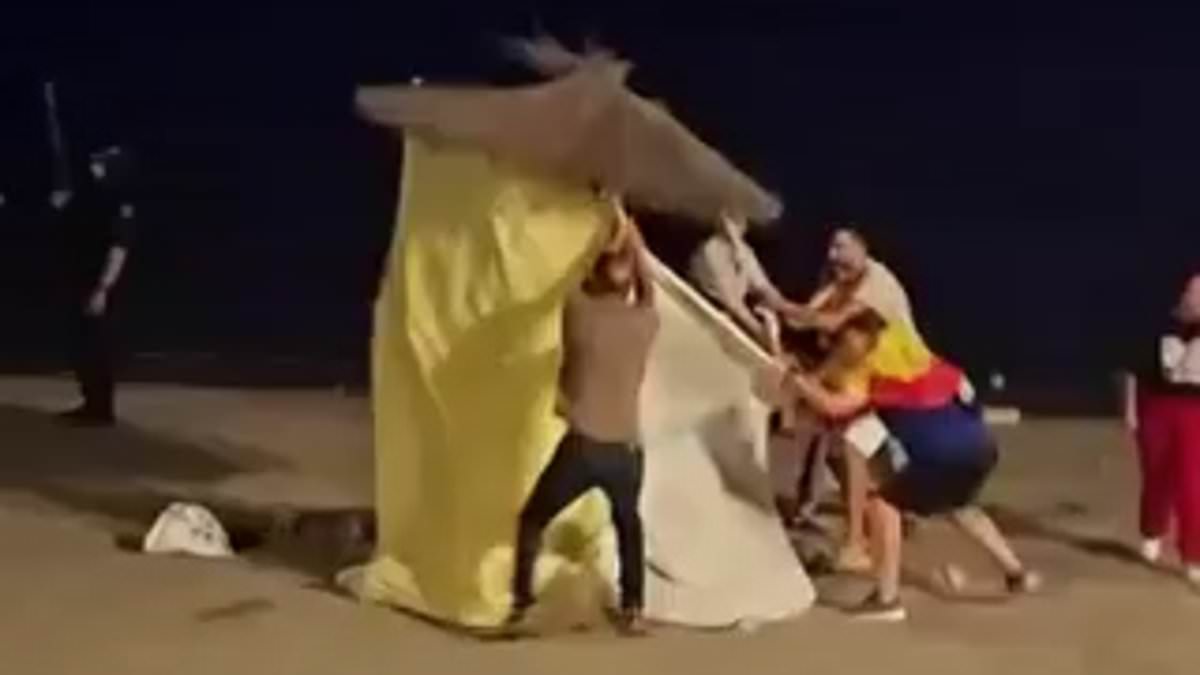
Furious Ceuta locals tore down a make shift camp in the Spanish enclave amid rising regional tensions about the 'invasion' of migrants following a mass influx from Morocco in July.More than 70,000 migrants swam or crossed on foot from neighbouring Morocco in a chaotic influx that left scores dead and fuelled fresh tensions in the European Union over migration.Frustrations have been visible in the city this week, which saw thousands of residents protesting about the handling of the situation yesterday and even saw locals attempt to dismantle a makeshift camp.Footage showed several men – one with a Spanish flag wrapped around him – violently tearing at sheets that have been hung up around a sun umbrella on a beach.Police appear to be standing mere metres away but do not intervene, and horns and shouts from a crowd can be heard in the background. Meanwhile, Spanish officials held a meeting yesterday in the Government Delegation to establish a response plan for the remaining migrants, with guards stationed at the entrance to prohibit protesters entering. Although most migrants have since returned to Morocco, between five percent and 10 percent of those who entered – between 3,500 and 7,000 people – remain in Ceuta, with many resorted to sleeping in public areas and on the beach.Local residents have complained about insecurity following reports of sexual assault and hygiene problems linked to homeless migrants sleeping or roaming in the streets, accusing the left–wing central government of neglecting Ceuta. Furious Ceuta locals tore down a make shift camp in the Spanish enclave amid rising regional tensions about the 'invasion' of migrantsFrustrations have been visible in the city this week, which saw thousands of residents protesting about the handling of the situation yesterday Migrants walk at Trampolin beach beach in Ceuta, Spain, 14 August 2026More than 2,000 residents took to the streets yesterday voicing these concerns, first gathering around 6pm outside Military Hospital, in the O'Donnell neighbourhood, which is one of the locations that is set to accommodate the migrants in the government's contingency plan.Spanish and Ceuta flags were being waved and protesters shouted, 'Ceuta is not for sale, Ceuta is defended', while insisting that the hospital and other buildings should not house the migrants.Demonstrators also shouted, 'Ceuta is not a CETI', a reference to the migrant reception centre in the enclave. The government announced last week that reception centres would be created for 1,800 migrants.The resignation of the central government's delegate in Ceuta, Miguel Angel Perez Triano, was further demanded, alongside Spanish Prime Minister Pedro Sanchez.The day before, hundreds of residents similarly marched through the streets, criticising the central government's handling of the migrants.The fate of the migrants has become a major political flashpoint, with Spain's government facing demands from the conservative opposition and far–right parties for all those who entered, including minors, to be returned to Morocco.Spain's government took steps on Tuesday to speed up the return of thousands of migrants still in the Spanish territory of Ceuta after a declaration that the migrant situation was a matter of interest to national security.As such, Spain's cabinet approved the creation of a 'single command' for Ceuta, to be led by Territorial Policy Minister Angel Víctor Torres, which allows resources from various administrations to be organised and coordinated under a single structure. Migrants sleep in a construction site amid recent mass crossings from Morocco into the Spanish territory of Ceuta by land and sea, in Ceuta, Spain, August 7, 2026 Moroccan migrant Wafae Atid sits on her inflatable mattress as workers spray water on the road nearby, near the Temporary Immigrant Reception Center (CETI) in Ceuta, Spain, August 16, 2026A meeting yesterday with government officials would have involved discussions with his command to identify those remaining in Ceuta to establish whether they are entitled to international protection or, if not, begin procedures for their return.Officials have tried to quell locals' concerns that buildings will be converted to temporarily house migrants by explaining this is only done in exceptional circumstance and with the agreement of involved administrations.The priority is 'the return and repatriation of the greatest possible number of people, adults and minors', while respecting Spanish law and human rights, Torres told reporters after the cabinet approved the measure. Torres added that Spain had to abide by international law, warning that those advocating such a solution 'out of populism or to scrape together a few votes are mistaken'. While return procedures are accelerated, the government will continue to provide humanitarian assistance to those who seek asylum or are unaccompanied minors -of which there around 2,000 - and therefore cannot be returned, he added. However, more temporary accommodation will be made available 'in order to restore normality in Ceuta', government spokeswoman Elma Saiz said.Last week, it was announced at least 500 migrant girls will be moved from Ceuta to mainland Spain following reports of sexual assault.Spanish police said that they have recorded 15 sexual assaults in Ceuta since July 15, with the majority of the victims being under age and the assaults mostly occurring on the beach where migrants were concentrated. The move came as a massive U-turn for the Spanish government, after it originally said no illegal migrants would be allowed to enter the mainland. Ceuta, together with Spain's other North African enclave of Melilla, has the European Union's only land borders with Africa.The territories have a special arrangement within the free–travel Schengen zone, meaning people cannot travel onwards to mainland Spain without border checks.
Locals fighting to remove thousands of migrants who remain in Ceuta following 'invasion' destroy makeshift camp as fears grow over groups of men roaming the streets
Full Article
Original Source
Read the full article at Dailymail →KhanList aggregates and links to publicly available news content. We do not host full articles from third-party sources. Always verify important information with original sources.