
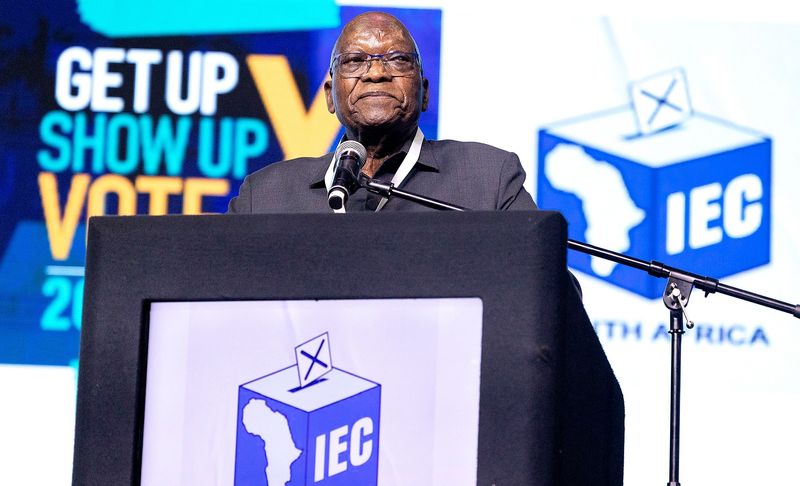
While vowing that party members would conduct themselves in a manner conducive to free and fair elections, the former SA president and leader of uMkhonto Wesizwe (MK) party, Jacob Zuma, still maintains that his party was robbed by the Electoral Commission of South Africa (IEC) in the 2024 elections.Zuma made the remarks in Midrand on Wednesday, 23 September, as political parties and independent candidates signed the Electoral Code of Conduct ahead of the 4 November local government elections. Two days later, the Electoral Court dismissed the party’s latest challenge over the 2024 elections.The signing required contesting parties to commit themselves to the rules governing free, fair and peaceful elections, including standards aimed at protecting the integrity of the electoral process.Former president Jacob Zuma addresses supporters at Alexandra Stadium in Johannesburg in February 2024. (Photo: Tebogo Letsie/ City Press / Gallo Images ) On the sidelines of Wednesday’s ceremony, Zuma said the MK party remained convinced that the 2024 election had not been properly conducted and that its dispute with the IEC was not over.“We are here to sign the IEC’s Code of Conduct. We’ve told ourselves we are people of this place; we don’t want to cause trouble and a noise but to keep quiet and move on with the work,” Zuma said.“But we still maintain that we were robbed, and we told them. We will still win that case. That’s why they didn’t want to come to court until the time lapsed,” he said.He added that even if the legal process could no longer change the outcome of the 2024 election, the party would continue pursuing the matter to establish what happened.“Even if we go to court now, it won’t change anything, but we still aim to show that they didn’t do things the right way,” he said.His comments came as the MK party prepared to contest local government elections for the first time.Case dismissed The Electoral Court heard arguments in June over the party’s challenge relating to a roughly two-hour interruption in the IEC’s public results dashboard during the 2024 election results process. The party has since argued that the interruption was more than a technical glitch, alleging that it formed part of “rigging and manipulation” against it.However, the court, on Friday, 25 September, rejected the MK party’s challenge to the integrity and reliability of the IEC’s digital vote-capturing and reporting system, a challenge that centred on the so-called “leaderboard incident” on 31 May 2024.The court said it found that the MK party had not followed the mandatory procedure under section 55 of the Electoral Act and that its application to review the declaration of the 2024 election results was not competent in law.On the merits, the court found that the incident, during which the IEC’s leaderboard and dashboard displayed zero results, did not affect the capturing or verification of the election results.It accepted the IEC’s evidence that the underlying National and Provincial Elections Results System remained operational and uncompromised, with the audit trail showing that results continued to be captured and edited and that no data was lost.The court also considered discrepancies in some voting-district-level reports generated from the IEC’s website and dashboard, but it found that these resulted from a website coding error and had no bearing on the integrity of the results system or the declared election results.It further found that, where there was a factual dispute over the integrity and reliability of the digital system, the IEC’s version was supported by proven and undisputed facts, while the MK party’s version was based on inferences. The court concluded that the MK party had not demonstrated that the results system lacked integrity. The MK party had not commented on the ruling at the time of writing. ‘Not easy to be optimistic’On Wednesday, Zuma said the dispute over the 2024 results made it difficult for him to be optimistic about the upcoming elections.While he claimed that the MK party was “robbed”, it emerged as the third-largest party nationally, winning 14.58% of the vote and 58 seats in the National Assembly in its first elections. Its strongest performance was in KwaZulu-Natal, where it won 44.91% of the provincial ballot, emerging as the largest party in the province’s 80-seat legislature, securing 37 seats. According to a recent Ipsos poll, the party is currently positioned third nationally, with 14% support, behind the African National Congress and Democratic Alliance.Supporters at the MK party manifesto launch on 18 May 2024, at Orlando Stadium in Soweto. (Photo: Sharon Seretlo / Gallo Images) “It is not easy to be optimistic that things will turn out differently in these local elections,” he said.“We were optimistic in the 2024 general elections, when we started then, and we were leading, but we don’t know what happened.”He declined to elaborate on matters that, at the time, remained before the courts.“We don’t want to speak on a matter that has not yet been resolved or concluded,” Zuma said.“We are still not happy, but we have not resolved the case; however, it is still there and we are still raising the question of what were you guys doing?”Zuma said the party’s concerns centred on whether the IEC had complied with the law.“Everything was supposed to be done according to the law, but that did not seem to be the case,” he claimedLeadership shake-upThe electoral dispute is not the only issue confronting the MK party as it prepares for the November poll. The party has undergone a series of leadership changes since its emergence as a major political force in the 2024 elections.In August, Zuma announced a major organisational restructuring that saw his son, Duduzane Zuma, appointed as first deputy president. Former first deputy president, John Hlophe, was relieved of the position but retained his role as the party’s parliamentary leader.Nkosinathi Nhleko was replaced as national chairperson by Reverend Mxolisi Phakathi, while Lindiwe Mtshali was appointed deputy secretary-general. Tony Yengeni was confirmed as second deputy president. The party has defended the changes as part of efforts to strengthen organisational discipline, build an effective structure and adapt after its rapid emergence in 2024.Former president Jacob Zuma (right) and his son Duduzane Zuma (left). (Photo: Felix Dlangamandla / Netwerk24 / Gallo Images) ‘Profound historical crossroads’With 40 days remaining until election day, political parties and independent candidates publicly committed themselves to the Electoral Code of Conduct, which provides standards for free, fair and peaceful campaigning.IEC chairperson Mosotho Moepya described the signing as a “sacrosanct ingredient” in ensuring the integrity of the 2026 elections and as a “solemn, binding contract” with South Africans.Mosotho Moepya, IEC chairperson, at the official Electoral Code of Conduct signing ceremony at the Gallagher Convention Centre in Midrand on 23 September 2026. (Photo: Alet Pretorius / Gallo Images) On Wednesday, Moepya said the ceremony was taking place against a backdrop of declining public trust in democratic institutions.He referred to findings from a voter-participation survey conducted with the Human Sciences Research Council, saying South Africa was facing a particularly challenging pre-electoral environment marked by democratic scepticism and institutional disillusionment.“We stand at a profound historical crossroads, navigating what researchers describe as the most challenging pre-electoral climate ever observed in South Africa over the last 30 years,” Moepya said.He said voters were effectively demanding that democracy deliver tangible results.“Our citizens are saying democracy must work, and work for them,” he said, urging political parties to use the November elections to restore confidence in democratic institutions and demonstrate that the electoral process could be responsive, clean and accountable. The code applies to the 136,790 candidates and 547 parties certified by the IEC to contest the municipal elections and is intended to ensure that candidates have an equal opportunity to campaign without violence, intimidation or unfair distortion.For the first time, the IEC has also introduced a separate code of conduct on measures to counter disinformation during the elections. The IEC also reminded political parties and individuals that they could face a hefty fine, forfeiture of election deposits or imprisonment if found to have violated the IEC’s code of conduct. DM
LOCAL ELECTIONS 2026: Zuma pledges no ‘trouble’ at polls but still insists MK was robbed in 2024
Full Article
Original Source
Read the full article at Dailymaverick →KhanList aggregates and links to publicly available news content. We do not host full articles from third-party sources. Always verify important information with original sources.