
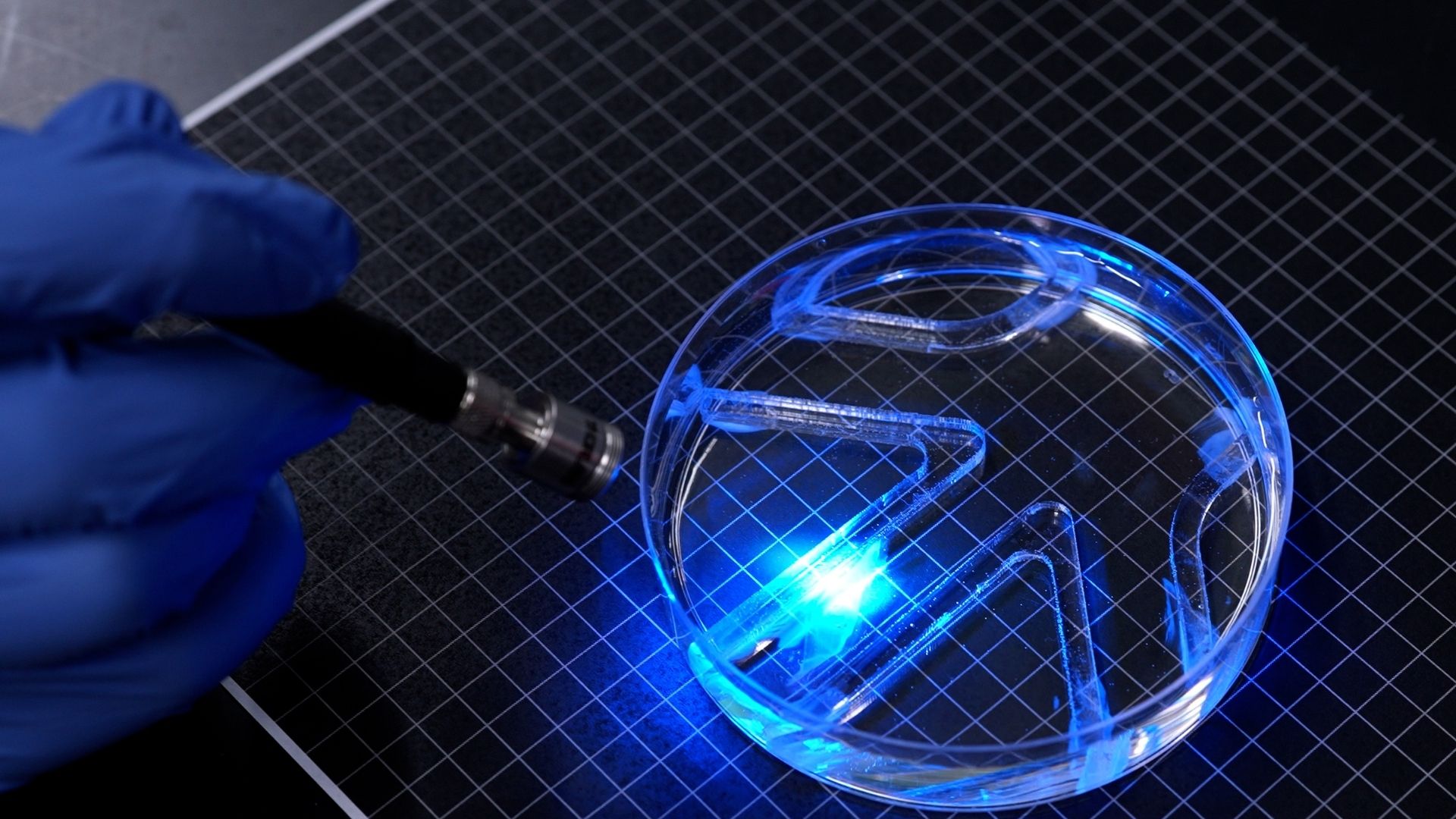
MIT engineers have developed a paper-thin swimming robot powered by a single layer of living muscle cells, demonstrating how biohybrid machines could move through water using far less biological material than previous designs. The small robot uses light-responsive muscle tissue grown on a thin gel skeleton to propel itself through water. Researchers demonstrated that it could swim and turn through a simple underwater maze by directing light onto its two fins. The robot can travel approximately four times its own body length in one minute at its fastest speed. While considerably slower than human swimmers, the researchers say the design demonstrates a new way to build small, efficient robots powered by living tissue. How the muscle-powered robot swims According to MIT, The robot’s body consists of a gelatin-based film approximately half a millimeter thick, with two flexible sections that act as fins. Each fin is covered with a layer of living skeletal muscle cells that is thinner than a human hair. The cells are genetically engineered to contract in response to light. When researchers shine light onto one fin, the muscle cells twitch, causing the fin to flap and push the robot through the surrounding water. By directing light onto either fin and adjusting the timing of the illumination, the researchers can control the robot’s direction and speed. Activating both sides causes both fins to move. During testing, the team submerged the robot in a large petri dish and manually moved a light source above it. The robot followed the light as it navigated a maze placed inside the dish. The researchers describe it as the first demonstration of a very thin, two-dimensional, muscle-powered robot capable of locomotion. A different approach to biohybrid robotics The new design builds on earlier work by Ritu Raman, an associate professor of mechanical engineering at MIT, and her research group. In a previous experiment, the team developed an artificial muscle structure inspired by the human iris. Researchers grew muscle cells on a gel disk patterned with concentric and radial grooves. When light stimulated the cells, they contracted in different directions, causing the disk to stretch and squeeze. Although the earlier design demonstrated controllable movement, the displacement was limited to approximately 100 micrometers. For the swimming robot, the researchers needed to generate substantially more force. They found that the material supporting the muscle cells was just as important as the cells themselves. The earlier design used fibrin, an ultrasoft gel that could deform under the forces generated by contracting muscle. In the new study, the team experimented with different gel compositions, stiffness levels, and groove geometries to improve muscle alignment and force production. The researchers found that square-bottomed grooves encouraged the cells to align more effectively than curved grooves. Better alignment helped the cells fuse into muscle fibers that could contract in a more coordinated manner. The team also replaced fibrin with gelatin methacrylate, or GelMA, a material commonly used in tissue engineering. Stiffer formulations supported better cell alignment and stronger contractions. A film approximately half a millimeter thick provided enough structural support for the muscle cells while remaining flexible and light enough to move with them. The researchers also used a training routine involving repeated light stimulation to strengthen the muscle tissue before assembling the robot. Potential applications in aquatic environments Conventional biohybrid robots often rely on bulky, three-dimensional structures made from millions of lab-grown muscle cells. The MIT team believes its thinner design could reduce the amount of biological material required and potentially improve movement efficiency. Living muscle tissue could eventually help robots perform delicate tasks in environments where conventional hardware may be difficult to deploy. Raman has suggested applications such as exploring fragile or unpredictable environments, including aquatic ecosystems. However, the current robot remains an early research demonstration. The researchers manually controlled its light source, and its swimming speed is still limited. The team says its next goal is to optimize the robot’s body design to swim faster. The findings demonstrate how carefully engineered materials and living muscle cells can work together to produce movement in extremely thin robotic structures, offering a potential foundation for smaller biohybrid machines. The study was published in the journal Advanced Functional Materials. Get the latest in engineering, tech, space & science - delivered daily to your inbox.Kaif Shaikh is a journalist and writer passionate about turning complex information into clear, impactful stories. His writing covers technology, sustainability, geopolitics, and occasionally fiction. A graduate in Journalism and Mass Communication, his work has appeared in the Times of India and beyond. After a near-fatal experience, Kaif began seeing both stories and silences differently. Outside work, he juggles far too many projects and passions, but always makes time to read, reflect, and hold onto the thread of wonder.
Living muscle cells help MIT’s new ultra-thin robot swim underwater
Full Article
Original Source
Read the full article at Interestingengineering →KhanList aggregates and links to publicly available news content. We do not host full articles from third-party sources. Always verify important information with original sources.