
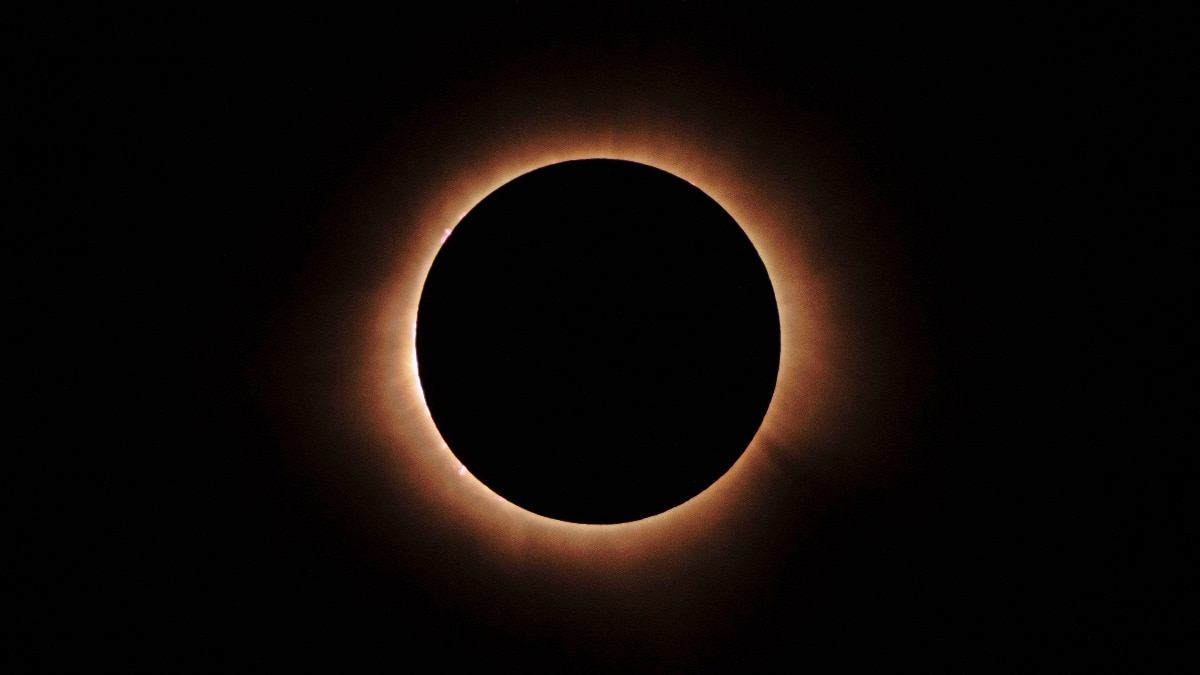
Download AppNewsSCIENCELive: Total solar eclipse today as Moon readies to block the giant SunLive blogA rare celestial spectacle will unfold today as the Moon completely blocks the Sun, turning day into darkness along a narrow path. The total solar eclipse is among 2026’s most significant astronomical events, offering scientists and skywatchers a fleeting view of the Sun’s corona....Read MoreAn image of a total solar eclipse with a visible, glowing corona. (Photo: Pexels)Aug 12, 2026 12:10 ISTWhat time is the total solar eclipse today? Check Indian timings Partial eclipse begins: 9:04 pm, August 12 Total eclipse begins: 10:28 pm Maximum eclipse: 11:16 pm Total eclipse ends: 12:04 am, August 13 Partial eclipse ends: 1:28 am, August 13 The total solar eclipse will be visible from a relatively narrow corridor that includes Greenland, Iceland and parts of Spain and Portugal, while a partial eclipse will be visible across much wider areas of Europe and parts of North America and Africa. Aug 12, 2026 11:54 ISTTotal Solar Eclipse Today: How and why will Nasa and ESA study the Sun?Nasa and ESA will use today’s eclipse as a rare chance to study the Sun’s outer atmosphere and how it drives space weather. Nasa will send its WB-57 aircraft to about 50,000 feet, while scientific balloons in Iceland and Spain will track changes in Earth’s atmosphere, including ozone. For a couple of minutes on Aug. 12, the Sun all but disappears in the middle of the day. NASA-funded student teams will launch research balloons from Iceland and Spain to track how the lowest layer of the atmosphere responds.🎈 More: https://t.co/zPn8UavJ3m pic.twitter.com/A56gYXvovu — NASA Solar System (@NASASolarSystem) August 9, 2026 ESA’s Proba-3, using its ASPIICS camera, will create artificial eclipses in space and observe the Sun’s faint corona for much longer than a natural eclipse. Aug 12, 2026 11:44 ISTTotal Solar Eclipse in India: When is the eclipse and how to watch?The total solar eclipse will not be visible from any part of India, as the country will be on the night side of Earth when the eclipse takes place. In Indian Standard Time (IST), the eclipse will begin at around 9:04 pm on August 12, reach its maximum at about 11:16 pm, and end around 1:28 am on August 13. Indian viewers can watch live streams from space agencies, including Nasa and the European Space Agency (ESA): Aug 12, 2026 11:37 ISTTotal Solar Eclipse 2026: Why is this eclipse special?This eclipse is especially significant for Europe, as it is the first total solar eclipse visible from mainland Western Europe since 1999. The Moon’s shadow will sweep from the Arctic across Greenland and Iceland before reaching Spain, while totality will last up to 2 minutes and 18 seconds. It is also a rare “sunset eclipse”, with parts of Spain seeing the Sun disappear close to the horizon. Aug 12, 2026 11:32 ISTTotal Solar Eclipse 2026: Spain prepares for eclipse as wildfires risk remainsSpain is preparing for a massive influx of visitors for the total solar eclipse, but the event comes as the country faces extreme heat and a high wildfire risk. Authorities expect up to 6 million people along the eclipse path and have designated 660 viewing sites, with more than 35,000 officers deployed. Meanwhile, temperatures could reach 40 degrees Celsius, while about 2 lakh hectares have already burned in wildfires this year. Aug 12, 2026 11:21 ISTTotal Solar Eclipse Today: What is a Total Solar Eclipse?A total solar eclipse occurs when the Moon passes directly between the Earth and the Sun, completely blocking the Sun's bright face. This alignment briefly turns day into twilight along a narrow path on Earth, revealing the Sun's faint outer atmosphere, known as the corona, which is usually hidden by its intense glare.
Live: Total solar eclipse today as Moon readies to block the giant Sun
Full Article
Original Source
Read the full article at Indiatoday →KhanList aggregates and links to publicly available news content. We do not host full articles from third-party sources. Always verify important information with original sources.