
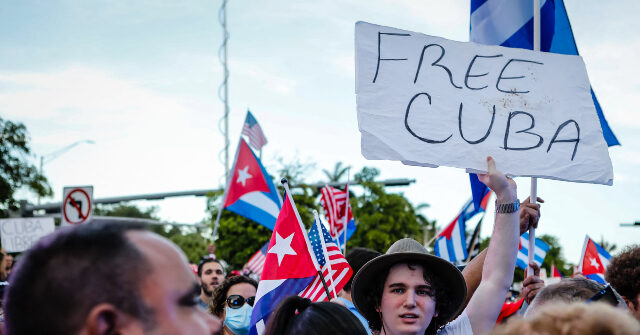
The government of Lithuania hosted an event on the sidelines of the U.N. General Assembly on Tuesday, alongside Costa Rica and America, announcing the creation of a global initiative called “Nations for a Free Cuba.” Government representatives met with Cuban anti-communist dissidents and civil society leaders to discuss how the free nations of the world could support the movement towards ending the over half-century-old dictatorship in Havana, including cutting off critical financial flows and empowering the voices of the victims of persecution in the country. Lithuanian Foreign Minister Kęstutis Budrys presided over the event, noting that opposing the Cuban communist regime is especially important for Eastern European nations as Cuba allows the Russian government to fraudulently recruit Cuban nationals as cannon fodder in the ongoing invasion of Ukraine. Officials at the event also noted that Lithuania’s freedom from communism during the Soviet era arrived with significant international support, which the country is now in a position to provide to Cuba. “Met with representatives of Cuban democratic forces in New York. #Lithuania stands firmly with the Cuban people in their pursuit of freedom, democracy, human rights and fundamental freedoms,” Budrys wrote on social media, sharing images of the meeting. “We condemn the regime’s repression and its support for Russia’s war against #Ukraine. We will continue supporting #Cuba’s civil society and human rights defenders.” The government of Ukraine has repeatedly denounced discovering Cuban nationals on the battlefield against Russia. In May 2025, Ukrainian officials estimated that as many as 20,000 Cubans were in Russia fighting against their country. Similarly, Costa Rican officials attended the event in representation of the conservative government of recently inaugurated President Laura Fernández, which has emphasized its hope to distance itself from communist and other leftist dictatorships around the world. Even prior to Fernández winning the presidency this year, her predecessor Rodrigo Chaves Robles announced in March that the country would formally cut diplomatic relations with the Cuban communist regime, declaring, “we have to clean the hemisphere of communists. Simple as that.” The Fernández administration has emphasized strengthening ties with President Donald Trump in Washington, joining the Shield of the Americas security initiative, and even suggesting the deployment of American ground operations in the country. “It would obviously be very good for national security if it were about pursuing a common objective against transnational crime, transnational drug trafficking, transnational terrorism,” Fernández asserted in September. The United States has prioritized identifying Cuba as a national security threat both during the Trump administration generally and at the U.N. General Assembly this week. Addressing the forum on Tuesday, President Trump noted the specific dangers that the Castro regime presents to America. He said: The Cuban regime has also spent decades coordinating with the left-wing radicals and communist networks here in the United States. As our State Department has detailed, they’ve cultivated ties to subversive and radical groups such as the Communist Party USA, Antifa, and the “Dumocrat” Socialists of America. Communism will never be coming to America — but freedom will be coming to Cuba and safety and security will be coming to Mexico.” The Cuban dissident groups who attended the meeting establishing an international coalition against the Castro regime noted the unprecedented nature of the event. While the Cuban communist regime has for decades used the United Nations to leverage the allegation that only the United States opposes its nefarious global activities and the world is united in its favor, national governments are actively choosing to distinguish themselves as opponents of the violent terror-sponsoring regime. In a press release after the event on Tuesday shared with Breitbart News, the Assembly of the Cuban Resistance, a coalition of anti-communists on and off the island, noted, “For the first time, a group of democratic nations have sat down to discuss how to support the Cuban people.” “When this takes its next step, for the first time the Cuban people will have a group of nations at the international level who defend its right to be free. This means that for the first time, we are multilateralizing the backing for freedom for the Cuban people,” the coordinator of the Assembly of the Cuban Resistance, Orlando Gutiérrez-Boronat, noted. The Cuban regime’s claims to solidarity from the rest of the world have become increasingly difficult to support, even at the United Nations, where the communists traditionally relied on international support. The U.N. General Assembly holds routine votes to condemn the United States for its longstanding sanctions against Cuba, colloquially referred to as the “embargo.” For years, only America and Israel voted against the condemnation of the “embargo.” With each subsequent vote in the past two years, however, the number of countries willing to abstain from the vote or outright oppose it has grown. In October 2025, for example, seven countries voted against condemning the embargo, including Ukraine, Paraguay, Hungary, and North Macedonia. (Costa Rica and Lithuania abstained from the vote.) In July, a similar vote resulted in nine votes against condemning the embargo and 30 countries abstaining, a new low in support for the communist regime. Follow Frances Martel on Facebook and Twitter.
Lithuania, Costa Rica, and U.S. Establish Global 'Free Cuba' Initiative
Full Article
Original Source
Read the full article at Breitbart →KhanList aggregates and links to publicly available news content. We do not host full articles from third-party sources. Always verify important information with original sources.