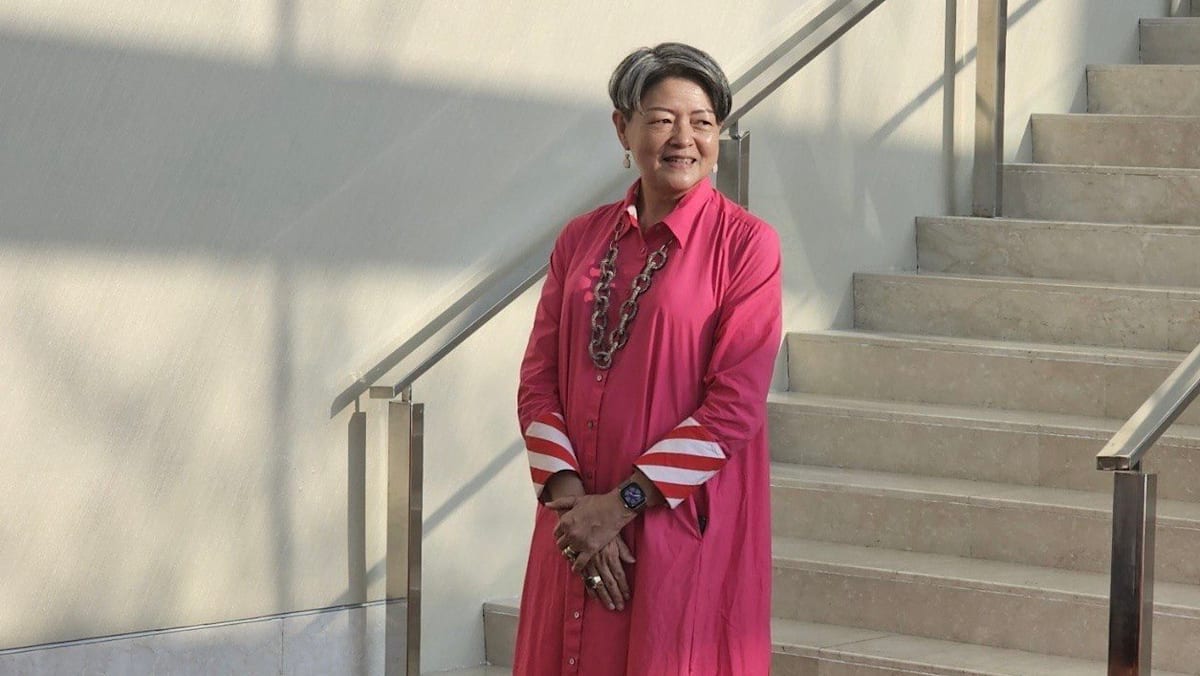
Anita Fam still remembers the day her brother awkwardly handed her a brown envelope. “Anita’s documents”, it said in her mother’s handwriting. That was 2014. Fam’s father had recently passed away. While clearing the family house, Fam’s brother found the envelope in the safe. It contained Fam’s original birth certificate and an adoption petition. “I've known I was adopted since probably the age of five,” said the 63-year-old. “I vaguely remember my mum coming to my bedside and telling me.”But this was the first time Fam was seeing her original birth certificate. There was a section in it that listed an unmarried 19-year-old woman from a small town in Johor, Malaysia, as her birth mother. Where her birth father’s name should be, there was nothing but a dash. The address? Not a hospital. Not a home. It simply noted: “Care of Salvation Army Singapore”.Decades later, Fam, the president of the National Council of Social Service (NCSS), helped shape Singapore’s hundreds of social service agencies, including The Salvation Army. “When I shared my birth story with The Salvation Army folks, they said that my roots are in social service – I was literally born into it,” Fam said. Fam (third from left) with her adoptive parents and brother at her christening. “I was adopted. I've known since probably the age of five,” she says. (Photo: Anita Fam) As Fam steps down from her presidency on Jul 31, 2026, she reflects on her journey.THE FULL-TIME VOLUNTEERSurprisingly, Fam does not know her birth name. “I didn’t even look at it (on my birth certificate). It didn’t matter to me,” she told CNA Women.Her father’s family had a strong culture of adoption – many of her cousins were adopted – so she accepted her being adopted as a “natural thing”. She grew up in a privileged household and loving family, she said, and became a lawyer.In 1994, she had just made junior partner in a law firm when a family friend invited her to sit on the board of the Asian Women’s Welfare Association (AWWA) and do pro bono legal work. She did for three years.Then in 1999, she gave birth to her eldest daughter. Fam, who described herself as “not the world’s most maternal”, simply loved being a mum.She was then an in-house finance lawyer at an American multinational. She took two months’ maternity leave – standard at that time – then extended it to four months. Then, she converted to a part-time role, taking conference calls in the dead of the night while breastfeeding her baby. But when she realised she was not giving her best to either work or family, on Dec 31, 1999, Fam resigned to become a full-time mum. Fam (left) with her husband Goh Eck Kheng, daughter Gillian and son Timothy on his second birthday. (Photo: Anita Fam) But it would not be just changing diapers and supervising play time for Fam. Less than a month later, the same family friend roped her in as a volunteer to help children with physical disabilities integrate into mainstream schools. She became vice-chairperson of AWWA’s Teach Me programme, which provided therapy and education assistance, and introduced the students to sports.A few months later, in September, heavily pregnant with her second child, Fam became chairperson of the programme. Later, she also chaired TM Services, AWWA’s umbrella for programmes supporting children and youth with physical disabilities and additional needs, and launched a job-readiness programme that offered vocational training and internships for youths. “Today, the pressure is to get five or six internships in the pocket. But in those days, internships (for students in institutes of higher learning) weren’t a thing,” she recalled. Fam knew this would give these youths an edge in the job market.Many of today’s most recognisable disability advocates passed through her programmes, including Paralympians Yip Pin Xiu, Theresa Goh and Jovin Tan.“I watched them grow up. And they left their mark (on me) because of their drive, resilience and clarity (of purpose),” she said.FROM VOLUNTEER TO SECTOR LEADERIn part, this experience inspired Fam to devote herself to volunteering. By 2010, she was serving on more than 10 boards and committees, working across diverse social issues including healthcare, palliative care, disability and autism support – all unpaid.“I used to tell everyone I haven’t worked since the end of last century,” mused Fam. “My husband corrects me. I just haven’t been paid since the last century, he says.” Fam with Hsieh Fu Hua (left), outgoing NCSS president, at the Social Service Summit 2018. (Photo: National Council of Social Service) It was also in 2010 that Fam was diagnosed with atrial fibrillation (irregular heartbeat). Her doctor believed it was because her workload was too heavy, and she had to leave more than half the boards, Fam said.But she continued volunteering. And in 2016, she was appointed to co-chair a task force with the then-NCSS president to steer Singapore’s social service sector for the next five years. The roadmap the task force developed identified four priorities – to empower individuals and families, build stronger communities, strengthen organisational capabilities and develop the ecosystem. The vision was for every person to be empowered to live with dignity in a caring and inclusive society. Two years later, she was offered the role of president at NCSS. LEADING CHANGEThe idea was to focus on people, not just programmes, Fam said.Holistically, a person may have a host of challenges, spanning health, social and education, Fam explained. “One programme will only fix one challenge. It doesn't help the whole person. You’ll need a whole village to support someone in need.” Fam on NCSS Day on May 5, 2026. Her purpose in life is to make a difference, she says. (Photo: National Council of Social Service) For vulnerable families, needs can be even more complex. A family living in a rental flat may struggle to afford rent, for instance, and needs the Social Service office to assess their financial situation and coordinate assistance, Fam said.If the father is unemployed, he needs the Family Service Centre to provide case management, counselling and support, while other agencies like Workforce Singapore and SkillsFuture help him upgrade his skills and find employment.If the mother has depression, she will require treatment and counselling from mental health providers. And if the children have disabilities, they will require support from special education or disability service providers, she explained. One of NCSS’s roles: “Making (different agencies) realise that they cannot do it by themselves. They need to work together.” Today, social service agencies are also larger and more complex. They need funding not just for programmes, but to hire skilled staff, and improve the way they work – which is harder to raise funds for. NCSS has been investing in strengthening agencies in areas such as leadership, governance and digital transformation, and encouraging donors to do the same. In July 2025, Fam became the inaugural recipient of the Ministry of Social and Family Development’s Lifetime Achievement Award for her contributions to Singapore’s social service sector. (Photo: Ministry of Social and Family Development) During her term, Fam also started the Invictus Fund in 2020 when the pandemic diminished funding. She seeded it with a S$1 million (US$780,000) donation of her own.Bolstered by contributions from the government, Community Chest and other donors, the fund grew to more than S$20 million, supporting hundreds of social service agencies with their operation costs and digital transformation during the pandemic.Looking forward, digitalisation and climate change will rise in importance, Fam said. She sees one of NCSS’ key roles as helping charities tap into new technologies like artificial intelligence, navigating cyber security to protect clients’ data, and helping vulnerable groups cope with the physical and mental toll of global warming.THE NEXT CHAPTERWith her presidency ending, Fam, whose children are now 27 and 25, said her personal mission remains unchanged. She wants to continue “to bridge the health and social divide”. Fam (front, centre) with the NCSS team on NCSS Day on May 5, 2026. (Photo: National Council of Social Service) Looking back at her adoption, Fam sees her life as a great blessing. She recognised that her birth mother probably had extenuating reasons for giving her up for adoption. “She didn't abort me in some deep dark alley in Johor Bahru. Instead, she had the guts to come across the Causeway and give birth to me,” she said. That decision changed the course of Fam’s life.Fam is determined to make the most of that life. In her free time, she solemnises weddings as a Justice of the Peace, goes on safaris, paints, does pottery and cooks, even making a fruit cake for her daughter’s best friend’s wedding recently. “I do extract (life) to the fullest,” she said. Volunteering will always remain close to her heart. She continues volunteering in areas such as palliative care, inmate welfare, ageing and the arts, chairing and sitting on boards.“Life is precious, and we need to try and find as much meaning – to try as much as possible to have positive purpose,” she said. CNA Women is a section on CNA Lifestyle that seeks to inform, empower and inspire the modern woman. If you have women-related news, issues and ideas to share with us, email CNAWomen [at] mediacorp.com.sg.
‘Literally born into it’: Given up for adoption at birth, Anita Fam found her life's purpose in helping others
Full Article
Original Source
Read the full article at Cnalifestyle →KhanList aggregates and links to publicly available news content. We do not host full articles from third-party sources. Always verify important information with original sources.