
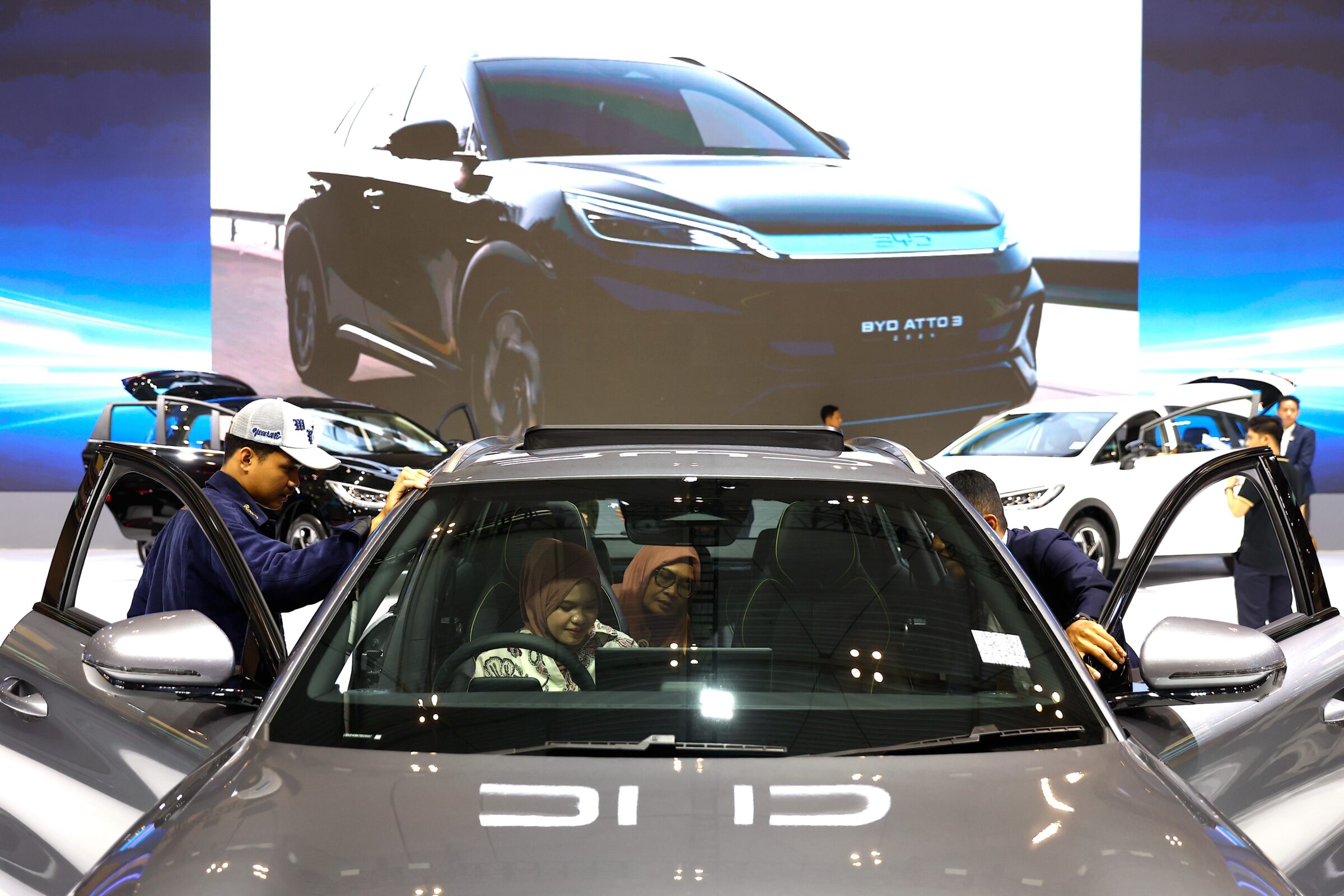
Production: By Europod, in co-production with Sphera Network. EUobserver is proud to have an editorial partnership with Europod to co-publish the podcast series “Briefed” hosted by Léa Marchal. The podcast is available on all major platforms. Find the full transcript below: Chinese carmakers are taking an increasing share of the European car market, particularly when it comes to electric vehicles. Why are European carmakers now opening their factories to their Chinese competitors? Until recently, the main concern in Europe was Chinese-made electric vehicles being imported into the EU. That’s why, two years ago, the EU imposed hefty tariffs on Chinese electric cars. But Chinese manufacturers have found another way into the European market: they are setting up production here. Some are building factories of their own. Others are entering partnerships with European carmakers and using their existing production sites. That’s the case with Stellantis and Chinese manufacturer Leapmotor. And now Dongfeng is also negotiating to produce cars at the French plant of Rennes La Janais. Because by moving production to Europe, Chinese manufacturers may be losing one of their main advantages, which is cheap labour. But low labour costs are only one part of their competitive edge. Chinese manufacturers also continue to benefit from state support. And setting up production in Europe doesn’t necessarily mean building brand-new factories. In many cases, Chinese companies are looking to partner with European manufacturers and use factories that are already there — factories that are no longer operating at full capacity. That means they can save significantly on investment costs. And they can also rely on their European partners’ existing sales and distribution networks. So how big is this Chinese presence in Europe becoming? For 2028, there are already 12 projects involving Chinese carmakers setting up production in Europe. Several are in Spain, with others in France, Belgium, Slovakia, Hungary, Sweden and Austria. Now, why would European manufacturers allow their Chinese competitors to produce cars in their own factories? Part of the answer is that European carmakers are struggling to keep up in electric vehicles sells. And that is contributing to factory closures and job losses. European manufacturers have to meet EU targets on average CO2 emissions each year. And producing more electric vehicles is necessary to meet those requirements. So partnerships with Chinese manufacturers can serve two purposes: they can help European companies fulfilling their green cars objectives, while also keeping existing factories and jobs running. Though there is a longer-term risk for European manufacturers. The more Chinese companies establish themselves in Europe, the more competitive pressure they could put on European brands — potentially even leading to takeovers. That has happened before: Volvo Cars, for example, was acquired by Chinese group Geely in 2010. In Germany, carmakers are for now refusing to open the doors of their production sites to the Chinese. But they do have partnerships with Chinese companies to produce vehicles in China, where they can benefit from lower production costs. That explains why they were very much opposed to imposing tariffs on Chinese electric vehicles. But the situation is now changing. Volkswagen closed its Dresden factory last year, and other German plants are also facing closure risks. Germany’s car industry is therefore increasingly joining calls for stronger protection against Chinese competition. And that brings us back to the Franco-German paper that is circulating in Brussels, which calls for measures to restrict Chinese access to the European market. Because this debate goes well beyond cars. The EU is increasingly concerned about Chinese competition and dependence in a range of strategic industries. This will be discussed next week, when EU leaders meet in Brussels. The European Commission could also present a new so-called “diversification” tool, either at the summit or around it. One possibility would be to require companies not to rely exclusively on China for certain critical materials. Something which could trigger what we call a trade war. I’ll be following that very closely!
Listen: Are we now heading to a trade war with China?
Full Article
Original Source
Read the full article at Euobserver →KhanList aggregates and links to publicly available news content. We do not host full articles from third-party sources. Always verify important information with original sources.